For latte art, I’d choose the Breville Barista Pro as the best overall fit in this group: its integrated grinder and fast heating support a repeatable espresso-and-steam workflow. The Barista Touch adds guided controls for buyers who want help with milk texture, while the Bambino suits people who already have a grinder and need a compact machine. The main tradeoff is between hands-on control, built-in assistance, and the space or extra equipment each setup demands. I compare all six machines by how well their features support learning and repeating the steps behind latte art. Continue reading for the full breakdown and recommendations by buyer type.

Get kitchen gear delivered free with Prime
- Fast, free delivery on millions of items
- Prime Video, Amazon Music and more included
- Member-only deals all year
Complete the kit


Key Takeaways
- The Barista Pro leads this lineup for buyers who want an integrated grinder and a more direct path from grinding to steaming.
- The Barista Touch stands apart for guided controls and milk-texturing assistance, which can reduce the learning burden for new latte artists.
- The Barista Express and Barista Express in Black Truffle share the same core machine identity; the finish changes the look, not the main brewing decision.
- The Barista Express Impress adds assisted tamping, a useful aid for cleaner puck preparation, but it does not remove the need to practice steaming and pouring.
- The Bambino saves counter space, but its separate grinder requirement means it makes the most sense for buyers who already own one or are ready to choose one.


| breville espresso machines for latte art guide 2 | Power | Bean hopper | Water tank | Voltage |
|---|---|---|---|---|
| Breville BES878BSS Barista Pro | 1680 W | 1/2 lb | 67 oz | 120 V |
| Breville Barista Touch Espress | 1680 W | 1/2 lb | 67 oz (about 2 L) | 110–120 V |
| Breville BES870XL Barista Expr | 1600 W | 1/2 lb | 67 oz | 120 V |
| Breville Barista Express Impre | — | 250 g | 2 L | — |
| Breville Barista Express Espre | 1600 W | 1/2 lb | 67 oz | 120 V |
| Breville Bambino Espresso Mach | 1560 W | — | — | — |
More Details on Our Top Picks
Breville BES878BSS Barista Pro Espresso Machine – Brushed Stainless Steel
The Barista Pro makes the most sense for buyers who want to shape milk by hand while keeping the espresso workflow quick. Its manual microfoam wand gives you direct control over texture, a useful advantage when practicing latte art, and the integrated grinder keeps grinding and dosing in one machine. Compared with the Barista Touch, it asks you to do more of the milk work yourself, but that hands-on process gives you more room to adjust the pour. The three-second ThermoJet heat-up also cuts waiting between shots and steaming. The tradeoff is a learning curve: you must dial in grind and milk technique, then clean the grinder and wand regularly. I’d choose it over the Barista Express when speed and a guided LCD workflow matter more than a simpler setup.
Pros:- Manual microfoam wand gives direct control for practicing latte art
- ThermoJet system reaches operating temperature in about three seconds
- Integrated conical burr grinder supports a streamlined bean-to-cup workflow
- LCD progress cues make shot preparation easier to follow
Cons:- Manual steaming takes practice to produce consistent microfoam
- Large footprint can be difficult to accommodate in a small kitchen
- Grinder and steam wand need regular cleaning
Best for: Home baristas who want to practice manual milk texturing and make several espresso drinks without a long warm-up
Not ideal for: Buyers who want the machine to texture milk automatically or have very limited counter space
- Power:1680 W
- Voltage:120 V
- Bean hopper:1/2 lb
- Water tank:67 oz
- Grinder:Precision conical burr
- Heating system:ThermoJet, 3-second heat-up
- Temperature control:PID, ±2°C
- Steam wand:Manual microfoam wand
Our verdict“Choose the Barista Pro if you want quick heat-up and hands-on control over latte-art milk.”
Breville Barista Touch Espresso Machine BES880BSS, Brushed Stainless Steel
The Barista Touch is the easiest fit here for someone who wants latte-art practice with help managing the milk step. Its automatic microfoam texturing and touchscreen drink controls reduce the technique required to get started, while saved recipes make repeat drinks simpler. That convenience is the main difference from the Barista Pro, whose manual wand puts more control—and more responsibility—in your hands. The Touch still includes an integrated grinder and PID temperature control, so the assisted workflow does not mean giving up fresh grinding or controlled extraction. Its tradeoff is that automatic texturing offers less direct involvement in shaping the milk, and the touchscreen features add to the cleaning routine. I’d pick it for repeatable drinks and guided operation, rather than for buyers who want every part of steaming to be manual.
Pros:- Automatic microfoam texturing lowers the barrier to making latte-art-ready milk
- Touchscreen supports drink customization and saves up to eight recipes
- ThermoJet heating reaches extraction temperature in about three seconds
- Integrated conical burr grinder handles fresh grinding in the machine
Cons:- Automatic milk texturing gives less hands-on control than the Barista Pro’s manual wand
- Large footprint may crowd smaller counters
- Built-in features add steps to routine cleaning
Best for: Beginners and busy households who want customizable espresso drinks with assisted milk texturing
Not ideal for: Experienced home baristas who want full manual control of milk texture or buyers with little counter space
- Power:1680 W
- Voltage:110–120 V
- Bean hopper:1/2 lb
- Water tank:67 oz (about 2 L)
- Portafilter:54 mm
- Heating system:ThermoJet, 3-second heat-up
- Milk texturing:Automatic microfoam
- Saved recipes:Up to 8
Our verdict“Choose the Barista Touch if guided controls and repeatable milk texturing matter more than manual technique.”
Breville BES870XL Barista Express Espresso Machine, Brushed Stainless Steel
The Barista Express brings grinding, espresso preparation, and manual steaming together in a more straightforward package than the Barista Pro. Its integrated conical burr grinder and PID temperature control give you the core tools for repeatable shots, while low-pressure pre-infusion supports even extraction. For latte art, the hand-textured wand keeps milk preparation in your control; it also means you’ll need to learn the feel of stretching and rolling milk yourself. Compared with the Barista Express Impress, this model has no assisted tamping or intelligent dose correction, so puck preparation depends more on your consistency. That makes it a stronger fit for buyers who want to learn the fundamentals, but a weaker pick for anyone seeking a guided routine. Its sizeable footprint is another practical tradeoff.
Pros:- Integrated conical burr grinder delivers fresh grounds directly into the portafilter
- PID temperature control supports consistent extraction
- Manual wand allows hands-on microfoam practice for latte art
- Low-pressure pre-infusion supports balanced shot extraction
Cons:- Grind size, dose, and tamping require practice to get consistent results
- Large footprint can limit placement in compact kitchens
Best for: Aspiring home baristas who want an integrated grinder and manual steaming while learning espresso technique
Not ideal for: Buyers who prefer assisted dosing and tamping or need a compact machine for a small counter
- Power:1600 W
- Voltage:120 V
- Bean hopper:1/2 lb
- Water tank:67 oz
- Grinder:Integrated conical burr
- Portafilter:54 mm stainless steel
- Steam wand:Manual hand-textured microfoam wand
- Pre-infusion:Low pressure
Our verdict“Choose the Barista Express if you want to learn manual espresso and milk skills with an integrated grinder.”
Breville Barista Express Impress (BES876BSS) – Brushed Stainless Steel
The Barista Express Impress is the strongest choice for buyers who want manual latte-art steaming but would rather not make dosing and tamping another source of variation. Its intelligent dosing and assisted tamping help form a more consistent puck, which can make shot preparation feel less fiddly than on the standard Barista Express. The 25 grind settings leave room to adjust extraction, while the manual microfoam wand preserves hands-on control of milk. Compared with the Barista Touch, this model offers more direct involvement in steaming instead of automatic texturing. That tradeoff suits learners who want help with puck prep, but the added assistance does not eliminate the need to dial in grind or develop milk technique. Its larger footprint and feature-rich workflow may also feel like more machine than a casual user needs.
Pros:- Intelligent dosing and assisted tamping help make puck preparation more consistent
- Twenty-five grind settings allow adjustment for different beans and shots
- Manual microfoam wand supports hands-on latte-art practice
- PID-controlled heating helps maintain extraction temperature
Cons:- Assisted puck prep does not remove the learning curve for grind adjustment and steaming
- Large footprint takes substantial counter space
- More involved workflow may be unnecessary for occasional espresso drinkers
Best for: Newer home baristas who want manual latte-art practice with assistance for dosing and tamping
Not ideal for: Minimalist buyers who want a compact, simple setup or users who prefer automatic milk texturing
- Model:BES876BSS
- Grinder:Integrated conical burr
- Grind settings:25
- Bean hopper:250 g
- Water tank:2 L
- Portafilter:54 mm stainless steel
- Steam wand:Manual hand-textured microfoam wand
- Heating system:Thermocoil with PID control
Our verdict“Choose the Barista Express Impress if you want manual milk control and extra help producing consistent pucks.”
Breville Barista Express Espresso Machine, Black Truffle
The Black Truffle Barista Express offers the same core appeal as the brushed-steel BES870XL: an integrated grinder, controlled extraction, and a manual wand for building latte-art skills. Its black finish gives buyers a different countertop look, while the included 54 mm portafilter, jug, and dose-trimming tool provide the basics for a complete home workflow. Compared with the Barista Express Impress, this version leaves tamping and dose correction in the user’s hands, so it suits someone who wants fewer assisted steps and is willing to refine technique. That simplicity can be a drawback for beginners seeking more repeatable puck prep. Milk texturing and shot preparation are both manual, and the listed 120 V specification narrows its fit to compatible setups. I’d choose it for a classic hands-on routine and a darker finish.
Pros:- Integrated conical burr grinder doses fresh coffee into the portafilter
- PID temperature control and low-pressure pre-infusion support balanced extraction
- Manual wand allows hands-on microfoam preparation for latte art
- Includes a 54 mm portafilter, milk jug, trimming tool, and cleaning accessories
Cons:- Manual dosing, tamping, and milk texturing require practice
- Does not include the Impress model’s assisted tamping and dose correction
- 120 V specification limits use to compatible electrical setups
Best for: Buyers who want the classic integrated-grinder Barista Express workflow in a black finish and are ready to learn manual steaming
Not ideal for: People seeking automatic milk texturing, assisted tamping, or a machine for a voltage-incompatible setup
- Model:BES870BTR
- Color:Black Truffle
- Grinder:Integrated precision conical burr
- Water tank:67 oz
- Bean hopper:1/2 lb
- Power:1600 W
- Voltage:120 V
- Portafilter:54 mm stainless steel
Our verdict“Choose the Black Truffle Barista Express if you want a hands-on, integrated-grinder setup in a dark finish.”
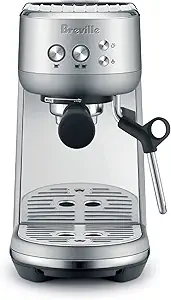
Breville Bambino Espresso Machine, Brushed Stainless Steel
The Bambino is the most space-conscious route in this lineup to espresso and milk microfoam for latte art. Its 3-second heat-up and digital PID temperature control help you get from a cold machine to brewing quickly, while low-pressure pre-infusion supports balanced extraction. The steam wand gives you manual control over milk texture, which suits learners who want to practice pouring rather than rely on a guided workflow. Compared with the Barista Express, the Bambino takes up less room but does not include a built-in grinder, so you’ll need a separate one and must prepare each shot yourself. That keeps the setup flexible, though less self-contained. Choose it for a compact counter and hands-on routine; skip it if you want an all-in-one machine or automated assistance.
Pros:- Compact design suits kitchens with limited counter space
- ThermoJet system reaches extraction temperature in 3 seconds
- Digital PID temperature control and low-pressure pre-infusion support consistent extraction
- Steam wand and included milk jug let you practice microfoam and latte art
Cons:- No built-in grinder, so a separate grinder is needed for a complete setup
- Manual espresso preparation and milk steaming require hands-on practice
- Smaller feature set than the Barista Pro and Barista Touch
Best for: Apartment dwellers and aspiring latte artists with limited counter space who already own, or plan to buy, a separate grinder.
Not ideal for: Buyers who want a built-in grinder, assisted tamping, or a guided workflow; the Barista Express Impress offers more help with preparation.
- Model:BES450BSS
- Heating system:ThermoJet
- Heat-up time:3 seconds
- Temperature control:Digital PID
- Portafilter size:54 mm
- Portafilter dose:19 g
- Power:1560 W
- Settings:1 cup, 2 cups, hot water, steam
Our verdict“Choose the Bambino if you want a compact, hands-on latte art setup and are comfortable sourcing a grinder separately.”

How We Picked
I ranked these machines around the parts of home espresso that shape latte art: getting a consistent dose, preparing a tidy coffee puck, managing the transition from brewing to steaming, and learning to create smooth, pourable milk. I also weighed how much guidance each machine offers, whether a grinder is built in, and the likely space and maintenance commitments. A machine can support practice, but no feature guarantees well-textured milk or a clean design; technique remains part of the decision.
The Barista Pro takes the top spot for balancing an integrated grinder with a workflow suited to repeat practice. The Barista Touch ranks close behind for buyers who value guidance, while the Express Impress earns a distinct place for assisted tamping. The two Barista Express finishes offer a more straightforward integrated setup, and the Bambino ranks as the compact choice for shoppers who can provide a separate grinder. I treat the two Express finishes as equivalent in core function rather than implying the color changes performance.
| breville espresso machines for latte art guide 2 | Grinder | Heating system | Steam wand | Model |
|---|---|---|---|---|
| Breville BES878BSS Barista Pro | Precision conical burr | ThermoJet, 3-second heat-up | Manual microfoam wand | — |
| Breville Barista Touch Espress | — | ThermoJet, 3-second heat-up | — | — |
| Breville BES870XL Barista Expr | Integrated conical burr | — | Manual hand-textured microfoam wand | — |
| Breville Barista Express Impre | Integrated conical burr | Thermocoil with PID control | Manual hand-textured microfoam wand | BES876BSS |
| Breville Barista Express Espre | Integrated precision conical burr | — | — | BES870BTR |
| Breville Bambino Espresso Mach | — | ThermoJet | — | BES450BSS |
Factors to Consider When Choosing Breville Espresso Machines For Latte Art Guide 2
Choosing a latte-art machine is partly a question of how you want to learn. Before focusing on a machine’s controls or accessories, decide which parts of the workflow you want it to handle and which skills you want to build yourself.
Decide How Much Guidance You Want
Guided controls can make the first sessions feel more manageable, but they do not replace the judgment involved in preparing espresso or pouring a design. If you like adjusting variables and learning through repetition, a more hands-on workflow may suit you better. If too many steps make practice frustrating, built-in prompts or milk assistance can help you focus on one skill at a time. A common mistake is treating automation as a shortcut to latte art; milk texture and pour control still take practice. Think about whether you want the machine to teach a routine or leave more choices in your hands. That preference can matter more than a long feature list.
Account for the Grinder Before Comparing Machines
Machines with integrated grinders create a more self-contained setup, which can simplify the path from beans to espresso. A separate grinder gives you more flexibility in choosing or upgrading that part of the setup, but it takes extra counter space and adds another purchase decision. Buyers sometimes compare machine features without counting the grinder they would need to use the machine day to day. Check your current equipment and measure the space available for both grinder and machine. If you already own a capable grinder, a compact machine may be a sensible pairing. If you are starting from scratch, an integrated option can make the setup easier to plan.
Treat Tamping Help as One Step in the Process
Even distribution and a consistent tamp help make espresso preparation more repeatable, which gives you a steadier base for milk drinks. Assisted tamping can reduce one source of variation and keep the counter cleaner during preparation. It cannot correct every issue with grind size, dose, or technique. Buyers may overvalue tamp assistance if their bigger challenge is steaming milk or controlling a pour. Consider which step currently feels hardest, or which one you most want help learning. Choose assistance that targets that step instead of assuming one helpful feature will solve the whole workflow.
Plan for Milk Texture and Practice Time
Latte art depends on milk that is smooth and fluid enough to pour, so the steam wand and your ability to use it deserve close attention. A machine’s interface may guide the process, but you still need practice judging texture and temperature. If you mostly want a quick drink with minimal learning, prioritize convenience over the promise of intricate designs. If making patterns is the goal, leave time for repeated steaming and pouring rather than expecting immediate results. You can practice with small amounts of milk to reduce waste while learning. That routine matters as much as selecting a machine with a particular set of controls.
Measure Your Counter and Workflow
Espresso preparation involves more than the machine’s footprint: you also need room to grind, tamp, handle a portafilter, and set down a milk pitcher. A compact machine can fit a smaller kitchen, but a separate grinder may use up the space you saved. A wider setup can be more comfortable if you prepare drinks regularly or want to keep accessories nearby. Measure the available depth and height, including the room needed to reach the water tank and clean the work area. Also consider whether the machine will stay assembled or be moved between uses. A workable station makes consistent practice easier to sustain.
Match Finish and Features to the Actual Difference
When two listings describe the same machine in different finishes, treat color as a style choice unless the specifications show a functional change. In this lineup, the stainless and Black Truffle Barista Express versions are best compared on the same brewing and workflow terms. This helps avoid paying attention to a cosmetic difference while overlooking a meaningful change such as guided controls or assisted tamping in another model. Check the exact model number and included accessories before choosing. If the feature set is otherwise the same, pick the finish that suits your kitchen. Put the rest of your decision on workflow, grinder needs, and available space.
Frequently Asked Questions
Which Breville in this group is the best starting point for learning latte art?
I’d start by choosing between the Barista Pro’s integrated workflow and the Barista Touch’s added guidance. The Pro fits someone who wants to practice the steps directly, while the Touch offers more support for someone who prefers a guided routine. Either way, expect to practice milk texture and pouring separately from dialing in espresso. If learning one step at a time sounds appealing, guidance may be worth prioritizing. If you would rather build skill through manual repetition, the Pro is a stronger match.
Is the Barista Touch worth choosing if latte art is my main goal?
It can be a good choice if its guided controls and milk assistance address the parts of the process that feel least familiar. Those features may make routine preparation less intimidating, but they do not guarantee the fine, pourable milk needed for patterns. The Barista Pro is a better fit if you want a more hands-on routine with an integrated grinder. Consider whether you value support while learning or prefer direct control over each step. Your answer matters more than choosing the model with the most guidance.
Should I pick the Barista Express Impress over the regular Barista Express?
The Impress is worth considering if assisted tamping would make puck preparation more consistent or less messy for you. The regular Express keeps the choice simpler if you are comfortable preparing the puck yourself and do not need that assistance. Both are integrated grinder machines, so grinder setup is not the deciding difference between them. Neither model removes the need to learn milk steaming and pouring. Choose the Impress for help with tamping; choose the standard Express if you want the more straightforward workflow.
Can I choose the Bambino for latte art if I do not own a grinder?
You can, but you will need to plan for a separate grinder as part of the setup. That adds another appliance, more counter space, and a separate choice to make before your workflow is complete. If you want one machine to cover grinding and espresso preparation, the Barista Pro or Barista Express models are more self-contained. The Bambino makes more sense if compact size is your priority and you already have a grinder or want to select one yourself. Compare the full setup you will use, not just the machine alone.
Do the stainless and Black Truffle Barista Express versions make different espresso?
The product names identify different finishes of the Barista Express, and this roundup treats them as the same core machine for the buying decision. The finish can help the machine suit your kitchen, but it is not a reason to expect a different latte-art workflow. Check the exact model listing and included accessories in case a seller’s bundle differs. If the specifications match, choose based on appearance and availability. Spend your functional comparison on the Pro, Touch, Impress, or Bambino if you need a different workflow.
Conclusion
For most buyers who want an integrated grinder and a direct routine for practicing latte art, I recommend the Barista Pro as best overall. The Barista Express is my value-oriented pick for a self-contained setup, while the Barista Touch is the premium choice for buyers who want more guidance and milk assistance. New learners who would benefit from support with puck preparation should look at the Barista Express Impress. For a small kitchen or an existing grinder owner, the Bambino is the specific fit. Pick the machine whose workflow you will practice consistently; that is the one most likely to support your latte-art goals.
Fall Picks
fall essentials
As an affiliate, we earn on qualifying purchases.