For most phone videographers, I’d start with the DJI Osmo Mobile 7P: it balances stabilization and useful filming tools without moving to a larger camera rig. The DJI RS 4 is a stronger fit for heavier interchangeable-lens camera setups, while the Hohem iSteady X3 SE keeps phone filming simple and portable. The main tradeoffs are camera compatibility, payload capacity, portability, and how much setup control you need. A phone gimbal can be convenient but cannot support a mirrorless camera, and a camera-focused model may be needless bulk for casual clips. Read on for the full breakdown of all 14 options and how to choose the right type for your footage.

Get kitchen gear delivered free with Prime
- Fast, free delivery on millions of items
- Prime Video, Amazon Music and more included
- Member-only deals all year
Complete the kit

Key Takeaways
- The lineup divides into three distinct groups: smartphone gimbals, an action-camera option, and camera gimbals; choose by the camera you intend to stabilize before comparing features.
- The DJI Osmo Mobile 7P stands out as the phone-focused all-rounder, while the Osmo Mobile 7 is a simpler alternative in the same family.
- The DJI RS 4 is aimed at heavier camera workflows; the RS 3 Mini and RS 4 Mini suit buyers who want a camera gimbal in a more compact class.
- Portability and filming extras are not the same as payload capacity: foldable smartphone models help with everyday carry, but they do not replace a camera rig.
- The FeiyuTech SCORP Mini-3-Pro covers a wider device mix than phone-only picks, while the Hohem iSteady Pro 4 is specifically aimed at action-camera use.
| Hohem iSteady X3 SE 3-Axis Gimbal Stabilizer for iPhone and Android, Black |  | Best for Remote Self-Filming | Stabilization: 3-axis iSteady 8.0 | Compatible devices: iPhone and Android smartphones | Payload capacity: 0.66 lb | VIEW ON AMAZON | See Our Full Breakdown |
| AOCHUAN Smart XE 3-Axis Foldable Gimbal Stabilizer for Smartphones |  | Best for Hands-On Framing Control | Axes: 3 | Compatibility: iPhone and most Android smartphones | Maximum weight recommendation: 280 g | VIEW ON AMAZON | See Our Full Breakdown |
| DJI Osmo Mobile 7P + Mic Mini TX (Infinity Black), Gimbal Stabilizer |  | Best Integrated Creator Kit | Stabilization: 3-axis | Model: Osmo Mobile 7P | Battery life: 10 hours | VIEW ON AMAZON | See Our Full Breakdown |
| FeiyuTech SCORP Mini-3-Pro Gimbal Stabilizer for Camera, Smartphone, and Action Cameras | 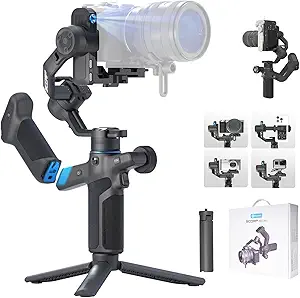 | Best for Multi-Camera Versatility | Payload capacity: 4.4 lb (2 kg) | Compatibility: Mirrorless cameras, compact cameras, smartphones, action cameras | Weight: 4.4 lb | VIEW ON AMAZON | See Our Full Breakdown |
| COMITOK L7C Pro 3-Axis Smartphone Gimbal Stabilizer with AI Tracking |  | Best Compact Foldable Pick | Stabilization: 3-axis | Phone compatibility: Smartphones under 7 inches and up to 0.62 lb | Weight: 0.8 lb | VIEW ON AMAZON | See Our Full Breakdown |
| DJI Osmo Mobile 8 3-Axis Phone Gimbal Stabilizer |  | Best Overall for Phone Videography | Brand: DJI | Model: Osmo Mobile 8 | Stabilization: 3-axis | VIEW ON AMAZON | See Our Full Breakdown |
| DJI Osmo Mobile 7P 3-Axis Smartphone Gimbal Stabilizer |  | Best for Quick-Start Phone Shoots | Brand: DJI | Stabilization: 3-axis | Compatibility: iPhone and Android smartphones | VIEW ON AMAZON | See Our Full Breakdown |
| Hohem iSteady Pro 4 3-Axis Splashproof Action Camera Gimbal |  | Best for Action Cameras and Splash-Prone Shoots | Brand and model: Hohem iSteady Pro 4 | Stabilization: 3-axis brushless motor with iSteady 5.0 anti-shake technology | Water resistance: IPX4 splashproof | VIEW ON AMAZON | See Our Full Breakdown |
| DJI RS 4 Gimbal Stabilizer for Camera |  | Best for Professional Mirrorless Rigs | Payload capacity: 3 kg (6.6 lb) | Extended tilt axis: 8.5 mm extension | Battery runtime: Up to 29.5 hours with optional BG70 grip | VIEW ON AMAZON | See Our Full Breakdown |
| hohem iSteady V3 Ultra 3-Axis Smartphone Gimbal Stabilizer |  | Best for Remote AI Tracking | Brand and model: Hohem iSteady V3 Ultra | Stabilization: 3-axis, iSteady 9.0 | Tracking: AI tracking for faces, pets, and objects | VIEW ON AMAZON | See Our Full Breakdown |
| DJI Osmo Mobile 7 3-Axis Gimbal Stabilizer for iPhone and Android |  | Best Value for Everyday Phone Videography | Brand and model: DJI Osmo Mobile 7 (DS307) | Stabilization: 3-axis | Subject tracking: ActiveTrack 7.0 | VIEW ON AMAZON | See Our Full Breakdown |
| DJI Osmo Mobile 8 Standard Combo Phone Gimbal Stabilizer |  | Best Phone Gimbal for Flexible Framing | Brand and model: DJI Osmo Mobile 8 | Stabilization: 3-axis | Pan rotation: 360° horizontal | VIEW ON AMAZON | See Our Full Breakdown |
| DJI RS 3 Mini Camera Gimbal Stabilizer |  | Best Compact Gimbal for Mirrorless Cameras | Brand and model: DJI RS 3 Mini | Weight: 795 g (1.75 lbs) in portrait mode; 850 g (1.8 lbs) with horizontal arm | Payload capacity: 0.4–2 kg (0.8–4.4 lbs) | VIEW ON AMAZON | See Our Full Breakdown |
| DJI RS 4 Mini Gimbal Stabilizer for Camera, Compatible with Canon, Sony, Nikon, Fujifilm |  | Best for Fast Vertical Camera Shoots | Brand and model: DJI RS 4 Mini | Payload capacity: Up to 2 kg (4.4 lbs) | Supported devices: Cameras and smartphones | VIEW ON AMAZON | See Our Full Breakdown |
| gimbal stabilizers for videography | Stabilization | Battery life |
|---|---|---|
| Hohem iSteady X3 SE 3-Axis Gim | 3-axis iSteady 8.0 | Up to 11 hours |
| AOCHUAN Smart XE 3-Axis Foldab | — | Up to 10 hours |
| DJI Osmo Mobile 7P + Mic Mini | 3-axis | 10 hours |
| FeiyuTech SCORP Mini-3-Pro Gim | — | — |
| COMITOK L7C Pro 3-Axis Smartph | 3-axis | — |
| DJI Osmo Mobile 8 3-Axis Phone | 3-axis | Up to 10 hours |
| DJI Osmo Mobile 7P 3-Axis Smar | 3-axis | — |
| Hohem iSteady Pro 4 3-Axis Spl | 3-axis brushless motor with iSteady 5.0 anti-shake technology | Up to 14 hours |
| DJI RS 4 Gimbal Stabilizer for | — | — |
| hohem iSteady V3 Ultra 3-Axis | 3-axis, iSteady 9.0 | Up to 9 hours |
| DJI Osmo Mobile 7 3-Axis Gimba | 3-axis | — |
| DJI Osmo Mobile 8 Standard Com | 3-axis | Up to 10 hours |
| DJI RS 3 Mini Camera Gimbal St | 3rd-generation RS stabilization algorithm | — |
| DJI RS 4 Mini Gimbal Stabilize | Gimbal stabilizer | — |
More Details on Our Top Picks
Hohem iSteady X3 SE 3-Axis Gimbal Stabilizer for iPhone and Android, Black
The Hohem iSteady X3 SE is a practical choice for smartphone videographers who often film themselves or need to start a shot from a distance. Its detachable remote works up to 32.81 feet away, letting a solo creator trigger filming without returning to the handle. Three-axis iSteady 8.0 stabilization and portrait or landscape shooting cover common social and everyday video formats, while the foldable body is easier to pack than the larger FeiyuTech SCORP Mini-3-Pro.
The tradeoff is its phone-only design and 0.66 lb payload limit; it cannot grow into a camera rig, and heavier phones may fall outside its stated capacity. The Hohem Joy app adds tracking and templates, but buyers who want integrated lighting and microphone functions may prefer the DJI Osmo Mobile 7P + Mic Mini TX. I’d choose this Hohem for portable, remote-operated phone filming, not as a long-term system for interchangeable cameras.
Pros:- Detachable remote can trigger shots from up to 32.81 feet away
- Three-axis stabilization supports smoother footage during active movement
- Foldable body supports both portrait and landscape shooting
- Up to 11 hours of stated battery life suits extended filming days
Cons:- 0.66 lb payload limit rules out some heavier phone setups
- Phone-only compatibility offers no upgrade path to a camera rig
- Tracking and creative templates depend on the Hohem Joy app
Best for: Solo smartphone creators who film walk-and-talk clips, group shots, or presentations and want remote triggering without a second operator.
Not ideal for: Videographers using heavier phones or planning to stabilize mirrorless, compact, or action cameras; the 0.66 lb limit keeps this model within smartphone territory.
- Stabilization:3-axis iSteady 8.0
- Compatible devices:iPhone and Android smartphones
- Payload capacity:0.66 lb
- Weight:0.79 lb
- Battery life:Up to 11 hours
- Charging time:2 hours
- Remote range:Up to 32.81 ft
- App:Hohem Joy
Our verdict“Choose the iSteady X3 SE for portable smartphone filming where remote control and long stated runtime matter more than camera-system flexibility.”
AOCHUAN Smart XE 3-Axis Foldable Gimbal Stabilizer for Smartphones
The AOCHUAN Smart XE gives smartphone filmmakers more direct lens control than the simpler Hohem iSteady X3 SE. Its focus wheel and zoom slider put adjustments on the handle, which can make reframing or changing focus during a take less disruptive than reaching for the phone screen. Face tracking, gesture control, and horizontal or vertical shooting add useful solo-creator tools, and its foldable 0.78 lb design remains portable.
Its stated battery life is up to 10 hours, a little less than the Hohem’s 11-hour claim, and compatibility may vary across Android phones. The AOCHUAN app is central to its tracking and camera modes, so buyers should check their device support before relying on those functions. Unlike the DJI Osmo Mobile 7P + Mic Mini TX, this package does not list an audio module or built-in lighting. I’d pick it for tactile phone-camera adjustments, not for an integrated creator setup.
Pros:- Focus wheel and zoom slider provide direct adjustments from the handle
- Face tracking and gesture control support solo filming
- Foldable design and 0.78 lb weight aid portability
- Supports horizontal and vertical shooting
Cons:- Android compatibility can vary by phone
- Tracking and camera modes rely on the AOCHUAN app
- Up to 10 hours of stated battery life is shorter than the Hohem iSteady X3 SE claim
Best for: Smartphone videographers who want physical focus and zoom controls for deliberate framing, interviews, or scripted solo shoots.
Not ideal for: Android users who need guaranteed app compatibility or creators seeking bundled microphone and lighting functions.
- Axes:3
- Compatibility:iPhone and most Android smartphones
- Maximum weight recommendation:280 g
- Weight:0.78 lb
- Battery capacity:2600 mAh
- Battery life:Up to 10 hours
- Controls and modes:Face tracking, gesture control, focus wheel, zoom slider, horizontal and vertical shooting
- Included items:Tripod, USB-C charging cable, user manual
Our verdict“Pick the Smart XE if physical focus and zoom controls matter more to your phone-video workflow than bundled audio or lighting tools.”
DJI Osmo Mobile 7P + Mic Mini TX (Infinity Black), Gimbal Stabilizer
The DJI Osmo Mobile 7P + Mic Mini TX is the most complete smartphone-focused filming package in this group. It combines three-axis stabilization and intelligent tracking with built-in lighting, an extension rod, tripod, magnetic phone clamp, and a Mic Mini transmitter. That collection is aimed at creators who want to record, light, and frame a piece to camera without assembling separate accessories. Compared with the AOCHUAN Smart XE, its appeal is less about handle-based focus and zoom controls and more about an integrated production setup.
The package’s breadth comes with setup and software tradeoffs: the supplied information says DJI Mimo must be downloaded from DJI’s official website, and app restrictions may limit compatibility on some Android devices. Buyers who want a lighter, simpler remote-filming tool may prefer the Hohem iSteady X3 SE. Its stated battery life is 10 hours, but this is still a smartphone gimbal, not a stabilizer for interchangeable-lens cameras. I’d favor it when bundled audio and lighting reduce gear juggling.
Pros:- Includes a Mic Mini transmitter, built-in lighting, and multifunctional module
- Intelligent tracking helps solo creators keep subjects in frame
- Built-in extension rod and tripod offer flexible framing and placement
- Three-axis stabilization is paired with a magnetic phone clamp
Cons:- DJI Mimo must be downloaded from DJI’s official website according to the supplied product information
- App restrictions may limit compatibility with some Android devices
- The feature-rich setup may take more preparation than the simpler Hohem iSteady X3 SE
Best for: Smartphone content creators who make talking-head videos, interviews, or social clips and want stabilization, lighting, audio, and an extension rod in one kit.
Not ideal for: Android users who cannot install DJI Mimo through DJI’s website, or camera videographers who need support for mirrorless and compact camera bodies.
- Stabilization:3-axis
- Model:Osmo Mobile 7P
- Battery life:10 hours
- Tracking:Intelligent tracking
- Lighting:Built-in lighting
- Included accessories:DJI Mic Mini Transmitter, multifunctional module, magnetic phone clamp, extension rod, tripod, charging cables, storage pouch
- Phone compatibility:iPhone and Android
Our verdict“Choose this DJI bundle if you want a smartphone gimbal that also supplies key audio and lighting accessories for solo production.”
FeiyuTech SCORP Mini-3-Pro Gimbal Stabilizer for Camera, Smartphone, and Action Cameras
The FeiyuTech SCORP Mini-3-Pro is the clear choice here for videographers who move between camera types. Its 4.4 lb payload capacity and compatibility with mirrorless, compact, smartphone, and action cameras give it a much broader role than phone-only options such as the Hohem iSteady X3 SE. AI tracking, a detachable remote handle, and a stated 18-meter tracking distance support varied framing setups, while the listed 0.003-second response time points to tracking designed to react quickly to subject movement.
That flexibility carries a physical cost: the gimbal itself weighs 4.4 lb, making extended handheld shooting more demanding than using the 0.8 lb COMITOK L7C Pro. The setup may also require more learning than a compact smartphone stabilizer, and the supplied data does not specify battery runtime. I’d choose it for a videographer building shots around different cameras, but casual phone creators may find its weight and system complexity unnecessary.
Pros:- Supports mirrorless, compact, smartphone, and action cameras
- 4.4 lb payload capacity accommodates broader camera setups than phone-only gimbals
- AI tracking is specified with an 18-meter tracking distance
- Detachable remote handle allows alternative control and grip positions
Cons:- 4.4 lb gimbal weight can tire operators during extended handheld filming
- Multi-camera setup may involve a steeper learning curve than smartphone gimbals
- Battery runtime is not specified in the supplied product data
Best for: Videographers who use a mix of mirrorless, compact, smartphone, and action cameras and need one stabilizer with a higher payload ceiling.
Not ideal for: Phone-only creators prioritizing a light travel setup or long handheld sessions; its 4.4 lb gimbal weight is substantial beside the smartphone models here.
- Payload capacity:4.4 lb (2 kg)
- Compatibility:Mirrorless cameras, compact cameras, smartphones, action cameras
- Weight:4.4 lb
- Tracking distance:18 meters
- Response time:0.003 seconds
- Tracking:AI tracking
- Charging:USB-C charging
- Warranty:1 year
Our verdict“Pick the SCORP Mini-3-Pro if camera compatibility and payload flexibility matter more than light weight and quick smartphone-only operation.”
COMITOK L7C Pro 3-Axis Smartphone Gimbal Stabilizer with AI Tracking
The COMITOK L7C Pro makes sense for phone videographers who want a compact stabilizer that can move quickly from bag to shoot. It folds to 6 × 4.3 × 1.8 inches, weighs 0.8 lb, and requires no leveling, reducing setup friction compared with the more involved FeiyuTech SCORP Mini-3-Pro. Three-axis stabilization, face and object tracking, gesture controls, and a grip tripod cover common solo filming needs without adding camera-rig bulk.
Its limits are specific: compatible phones must be under 7 inches and weigh no more than 0.62 lb, a tighter stated payload ceiling than the Hohem iSteady X3 SE. Tracking and creative modes also require the companion app, so this is less appealing to anyone who wants to operate entirely through a phone’s native camera app. The 2600mAh battery charges in about 80 minutes, but no runtime is provided. I’d pick it for compact, app-assisted phone filming, not for heavier devices or camera upgrades.
Pros:- Folds to a compact 6 × 4.3 × 1.8 inches
- No leveling is required before filming
- Face and object tracking plus gesture controls support solo operation
- Includes a grip tripod and wrist strap
Cons:- Phone must weigh no more than 0.62 lb and be under 7 inches
- Tracking and creative modes require the companion app
- Battery runtime is not specified in the supplied product data
Best for: Mobile creators who pack light, want a foldable gimbal with a grip tripod, and use a compatible phone under the stated size and weight limits.
Not ideal for: Videographers with phones over 0.62 lb or creators who need app-independent tracking and filming modes.
- Stabilization:3-axis
- Phone compatibility:Smartphones under 7 inches and up to 0.62 lb
- Weight:0.8 lb
- Folded dimensions:6 × 4.3 × 1.8 inches
- Unfolded dimensions:10.2 × 5.1 × 3.5 inches
- Battery capacity:2600 mAh
- Charging time:About 80 minutes
- Tracking:Face and object tracking
Our verdict“Choose the L7C Pro for a small, fast-to-set-up smartphone kit if your phone fits its tighter payload limit and app-based features suit your workflow.”
DJI Osmo Mobile 8 3-Axis Phone Gimbal Stabilizer
The Osmo Mobile 8 is my most balanced pick for phone-based videography: its 3-axis stabilization and 360° horizontal pan support smooth walks, tracking shots, and subject-following clips. The included multifunctional module adds tracking, lighting, and audio capabilities, while the built-in tripod and extension rod make it easier to switch from handheld framing to a stationary or wider-angle setup. Compared with the Hohem iSteady V3 Ultra, it offers longer stated battery life and phone charging, while the Hohem adds a detachable touchscreen remote and AI tracking for faces, pets, and objects. The Osmo’s main tradeoff is app setup: Android users must download DJI Mimo from DJI’s website rather than Google Play. Its feature mix makes it a stronger all-rounder than a simpler phone stabilizer, but that app friction may matter to some buyers.
Pros:- 3-axis stabilization supports smoother handheld phone footage
- 360° horizontal pan rotation suits tracking and sweeping shots
- Multifunctional module adds tracking, lighting, and audio capabilities
- Up to 10 hours of battery life, with the ability to charge a connected phone
Cons:- Android users must download DJI Mimo from DJI’s website
- Designed for smartphones, not heavier mirrorless camera rigs
Best for: Phone videographers who want tracking, a built-in extension rod and tripod, and enough battery life for long shoots.
Not ideal for: Android users who want to install every companion app directly through Google Play, or camera owners who need a gimbal for a mirrorless setup.
- Brand:DJI
- Model:Osmo Mobile 8
- Stabilization:3-axis
- Pan rotation:360° horizontal
- Battery life:Up to 10 hours
- Built-in features:Extension rod and tripod
- Included items:Gimbal, multifunctional module, magnetic phone clamp, USB-C phone charging/audio cable, storage pouch, USB-C power cable
Our verdict“Choose the Osmo Mobile 8 if you want a versatile phone gimbal with tracking and useful built-in shooting accessories, and can work around DJI’s Android app installation process.”
DJI Osmo Mobile 7P 3-Axis Smartphone Gimbal Stabilizer
The Osmo Mobile 7P suits smartphone videographers who want to get from setup to recording quickly. Its quick launch feature, subject tracking, and multifunctional module combine practical shooting aids with 3-axis stabilization; the built-in tripod and extension rod also help when a solo creator needs a wider frame or a hands-free take. Like the Osmo Mobile 8, it offers up to 10 hours of operation and a module for additional shooting functions. The Mobile 8 lists 360° horizontal pan and phone charging, while this 7P’s clearest distinction is its quick-launch workflow and compatible DJI microphone reception. The tradeoff is that Android users need to get DJI Mimo from DJI’s website instead of Google Play. It is less compelling for buyers who prioritize the newer model’s stated pan range or phone-charging feature.
Pros:- Quick launch supports a faster start to spontaneous phone shoots
- 3-axis stabilization and subject tracking help steady moving footage
- Multifunctional module supports lighting and compatible DJI microphone reception
- Built-in extension rod and tripod provide flexible framing options
Cons:- Android users must download DJI Mimo from DJI’s website
- The listed feature set does not include the Osmo Mobile 8’s 360° pan rotation or phone charging
Best for: Solo smartphone creators who value fast setup, subject tracking, and a built-in tripod and extension rod for varied framing.
Not ideal for: Android users who require Google Play app installation, or buyers specifically seeking the Osmo Mobile 8’s listed 360° pan rotation and phone-charging capability.
- Brand:DJI
- Stabilization:3-axis
- Compatibility:iPhone and Android smartphones
- Maximum operating time:Up to 10 hours
- Built-in features:Extension rod, tripod, quick launch
- Tracking and module:Subject tracking; multifunctional module for lighting and compatible DJI microphone reception
- Included components:Gimbal, multifunctional module, magnetic phone clamp, USB-C cables, storage pouch
Our verdict“Pick the Osmo Mobile 7P if quick-launch convenience and its tracking, lighting, and microphone features matter more than the Osmo Mobile 8’s listed pan and phone-charging extras.”
Hohem iSteady Pro 4 3-Axis Splashproof Action Camera Gimbal
The iSteady Pro 4 is the specialist option here: it stabilizes compatible action cameras rather than smartphones or mirrorless rigs. Its IPX4 splashproof rating and up to 14 hours of battery life make it a better fit than the phone-focused DJI Osmo Mobile 8 for outdoor action-camera shoots where splashes and extended recording sessions are concerns. The gimbal can also charge a camera while recording, and supported GoPro models get Bluetooth shutter control. Compatibility needs close attention, though: DJI Osmo Action and Insta360 ONE R cameras can be stabilized but cannot be controlled for photo capture or recording start and stop, and GoPro HERO7 White and Silver models are not supported. Its 160 g recommended maximum weight also limits camera choice. This is a focused action-camera tool, not a flexible phone-video alternative.
Pros:- 3-axis brushless stabilization with iSteady 5.0 anti-shake technology
- IPX4 rating protects against water splashes
- Up to 14 hours of battery life
- Can charge a camera while recording and offers Bluetooth shutter control for supported GoPro models
Cons:- DJI Osmo Action and Insta360 ONE R cameras cannot be controlled for shooting functions
- Not compatible with GoPro HERO7 White and Silver models
- Maximum recommended camera weight is 160 g
Best for: Action-camera owners filming outdoor activities who want splash protection, long battery life, and camera charging during recording.
Not ideal for: Smartphone or mirrorless videographers, owners of unsupported GoPro HERO7 White or Silver models, and users who need gimbal controls for DJI Osmo Action or Insta360 ONE R cameras.
- Brand and model:Hohem iSteady Pro 4
- Stabilization:3-axis brushless motor with iSteady 5.0 anti-shake technology
- Water resistance:IPX4 splashproof
- Battery life:Up to 14 hours
- Maximum recommended camera weight:160 g
- Compatible cameras:GoPro HERO 3–13, DJI Osmo Action, Insta360 ONE R, and similarly sized action cameras
- Camera control:Bluetooth shutter control for supported GoPro models
- Warranty:1 year
Our verdict“Choose the iSteady Pro 4 for a compatible action camera and splash-prone shoots, but skip it if you need smartphone support or full camera control across its listed compatibility range.”
DJI RS 4 Gimbal Stabilizer for Camera
For videographers working with a mirrorless camera and lens, the DJI RS 4 moves beyond the phone and action-camera options in this lineup. Its 3 kg payload capacity supports a more substantial rig, while native vertical shooting helps creators make portrait-format footage without relying on a phone gimbal such as the Osmo Mobile 8. Teflon-coated axes are intended to make balancing smoother, and the extended tilt axis gives more room to position a camera. This capability comes with a more involved workflow: switching between vertical and horizontal modes requires rebalancing, and the longest stated runtime depends on the separately sold BG70 grip. Control through the DJI Ronin app also requires a download from DJI’s website. The RS 4 makes sense for camera operators who need rig capacity and flexible orientation, not casual phone shooting.
Pros:- 3 kg payload capacity accommodates compatible mirrorless camera and lens setups
- Native vertical and horizontal shooting modes support different delivery formats
- Teflon-coated axes are designed to make balancing smoother
- Up to 29.5 hours of runtime is available with the optional BG70 grip
Cons:- Switching between vertical and horizontal modes requires rebalancing
- The BG70 grip needed for the stated maximum runtime is sold separately
- The DJI Ronin app must be downloaded from DJI’s website
Best for: Professional content creators using compatible Canon, Sony, Nikon, or Fujifilm mirrorless cameras who need a gimbal for larger rigs and vertical as well as horizontal footage.
Not ideal for: Smartphone videographers, lightweight travel creators, or operators who frequently switch orientations and want to avoid rebalancing or buying an optional grip.
- Payload capacity:3 kg (6.6 lb)
- Extended tilt axis:8.5 mm extension
- Battery runtime:Up to 29.5 hours with optional BG70 grip
- Control port:RSA communication port
- Camera compatibility:Canon, Sony, Nikon, and Fujifilm mirrorless cameras
- App compatibility:DJI Ronin app; download from DJI’s website
- Shooting orientation:Native vertical and horizontal shooting modes
- Axis coating:Teflon-coated axes
Our verdict“Choose the RS 4 for a compatible mirrorless rig that needs substantial payload capacity and vertical shooting, but expect more setup than with a smartphone gimbal.”
hohem iSteady V3 Ultra 3-Axis Smartphone Gimbal Stabilizer
The iSteady V3 Ultra stands out for creators who need to frame themselves from a distance: its detachable touchscreen remote works up to 33 feet away, while AI tracking follows faces, pets, and objects. That combination makes solo takes easier to manage than on the DJI Osmo Mobile 7P, whose listed strengths center on quick launch, subject tracking, and compatible DJI microphone reception. The Hohem also includes a tripod, fill light, and an 8-inch extension rod, bringing useful framing tools into a compact, foldable setup. Its compromises are practical rather than cosmetic: the phone load tops out at 14.11 oz, and battery life is up to 9 hours, shorter than the 10-hour claims for the DJI phone gimbals in this group. Buyers with heavier phones or long shoot days may prefer those alternatives.
Pros:- AI tracking supports faces, pets, and objects
- Detachable 1.22-inch touchscreen remote works up to 33 feet away
- Built-in tripod, fill light, and extension rod support varied phone framing
- Foldable design weighs 15.1 oz
Cons:- Maximum phone load is 14.11 oz
- Up to 9 hours of battery life is shorter than the 10-hour DJI Osmo Mobile 8 and 7P claims
Best for: Solo smartphone creators filming themselves, pets, or moving subjects who want to adjust framing from up to 33 feet away.
Not ideal for: Users with phones heavier than 14.11 oz, or videographers who need more than 9 hours of stated battery life between charges.
- Brand and model:Hohem iSteady V3 Ultra
- Stabilization:3-axis, iSteady 9.0
- Tracking:AI tracking for faces, pets, and objects
- Remote:Detachable 1.22-inch touchscreen remote; range up to 33 ft
- Extension rod:8 inches
- Battery life:Up to 9 hours
- Maximum phone load:14.11 oz
- Folded length and weight:6.3 inches; 15.1 oz
Our verdict“Pick the iSteady V3 Ultra if remote control and AI tracking are priorities for solo phone shoots, provided your phone fits its load limit and its battery runtime suits your sessions.”
DJI Osmo Mobile 7 3-Axis Gimbal Stabilizer for iPhone and Android
The Osmo Mobile 7 is a practical choice for creators who want steadier phone footage without moving up to a camera rig. Its 3-axis stabilization and ActiveTrack 7.0 help smooth walking shots and keep a moving subject framed, while the foldable body and built-in tripod make it easier to carry and set up for solo filming. Compared with the Osmo Mobile 8, this model lacks a built-in extension rod and 360° horizontal rotation, but it covers core handheld and tabletop shooting needs with less emphasis on add-on features. The stated 10-hour operating time and phone charging over USB-C suit longer shoots, though charging a phone will draw on the gimbal’s battery. One setup wrinkle: DJI Mimo must be downloaded from DJI’s website rather than Google Play.
Pros:- Three-axis stabilization helps reduce shake in handheld phone footage.
- ActiveTrack 7.0 can keep a moving subject in frame.
- Foldable design and built-in tripod support portable filming and stationary shots.
- Up to 10 hours of operation, with USB-C phone charging.
Cons:- DJI Mimo must be downloaded from DJI’s website because it is unavailable on Google Play.
- No built-in extension rod or 360° horizontal rotation, unlike the Osmo Mobile 8.
Best for: Phone videographers who want subject tracking, a foldable design, and a built-in tripod for travel, family clips, or solo social video.
Not ideal for: Creators who want a built-in extension rod or 360° panning, or Android users who prefer installing apps directly from Google Play.
- Brand and model:DJI Osmo Mobile 7 (DS307)
- Stabilization:3-axis
- Subject tracking:ActiveTrack 7.0
- Weight:300 g
- Maximum operating time:Up to 10 hours
- Built-in features:Tripod; foldable design; USB-C phone charging
- Included items:Gimbal, Magnetic Phone Clamp 4, 50 cm USB-C to USB-C cable, storage pouch
- App availability:DJI Mimo must be downloaded from DJI’s website; unavailable on Google Play
Our verdict“Choose the Osmo Mobile 7 for a portable, feature-rich phone gimbal; pick the Osmo Mobile 8 if its extension rod and full horizontal rotation matter more.”
DJI Osmo Mobile 8 Standard Combo Phone Gimbal Stabilizer
The Osmo Mobile 8 suits phone shooters who want more framing flexibility than a basic handheld stabilizer provides. Its built-in extension rod helps reach higher or wider angles without a separate accessory, while the tripod supports stationary filming and the 360° horizontal rotation enables continuous panning shots. Like the Osmo Mobile 7, it offers three-axis stabilization, up to 10 hours of battery life, and phone charging while filming; the Mobile 8’s advantage is its expanded shooting range rather than a longer stated runtime. The Standard Combo does not include the Multifunctional Module, so tracking, audio, and fill-light functions tied to that module require a separate purchase. DJI Mimo’s absence from Google Play also adds a setup step. Compared with the DJI RS 3 Mini, this is the simpler fit for phone-only creators, not interchangeable-lens camera work.
Pros:- Built-in extension rod makes wider and higher-angle phone shots easier to compose.
- 360° horizontal rotation supports continuous panning moves.
- Three-axis stabilization and tripod suit both moving and stationary footage.
- Up to 10 hours of battery life and phone charging while filming.
Cons:- The Multifunctional Module for tracking, audio, and fill light is sold separately.
- DJI Mimo is unavailable on Google Play according to the product listing.
- Phone-focused design is not a substitute for the RS 3 Mini’s mirrorless-camera support.
Best for: Phone videographers who frequently shoot solo, need elevated or wider angles, and want a built-in tripod and extension rod in one foldable gimbal.
Not ideal for: Creators who need a mirrorless-camera stabilizer or expect tracking, audio, and fill-light functions to come in the Standard Combo.
- Brand and model:DJI Osmo Mobile 8
- Stabilization:3-axis
- Pan rotation:360° horizontal
- Battery life:Up to 10 hours
- Built-in features:Extension rod and tripod
- Phone charging:Can charge a connected phone while filming
- Included accessories:Magnetic Phone Clamp, 15 cm USB-C to USB-C phone charging/audio cable, 50 cm USB-C to USB-C power cable, storage pouch
- Multifunctional Module:Sold separately; not included in Standard Combo
Our verdict“Choose the Osmo Mobile 8 if built-in reach and unrestricted horizontal panning are priorities, and budget for the separate module if you need its added functions.”
DJI RS 3 Mini Camera Gimbal Stabilizer
For videographers moving beyond a phone, the DJI RS 3 Mini brings three-axis stabilization to a compact mirrorless-camera setup. Its payload range up to 2 kg accommodates a range of camera-and-lens combinations, while native vertical shooting saves creators from relying on a phone gimbal for portrait-format work. A 1.4-inch color touchscreen gives access to settings on the unit, and Bluetooth shutter control can reduce dependence on direct camera-button access. Compared with the phone-focused Osmo Mobile 8, the RS 3 Mini is built for interchangeable-lens cameras but gives up the phone gimbal’s built-in extension rod and phone-charging convenience. Its 795 g weight in portrait mode keeps the rig relatively portable, though the camera, lens, and balancing process add to the load. Buyers should also check the supported camera list and plan for DJI Ronin app setup.
Pros:- Supports mirrorless camera setups up to a 2 kg payload.
- Native vertical shooting simplifies portrait-format video capture.
- Compact gimbal body weighs 795 g in portrait mode.
- Color touchscreen and Bluetooth shutter control provide on-device operation options.
Cons:- Camera compatibility depends on DJI’s supported camera list.
- The DJI Ronin app must be downloaded from DJI’s website for activation and full functionality.
- Camera and lens weight still count toward the payload and make the full rig less portable than a phone gimbal.
Best for: Traveling mirrorless-camera videographers who want a compact stabilizer, native vertical framing, and a camera-and-lens setup within the 2 kg payload limit.
Not ideal for: Phone-only creators, owners of camera-and-lens combinations over 2 kg, or buyers whose camera is not on DJI’s supported compatibility list.
- Brand and model:DJI RS 3 Mini
- Weight:795 g (1.75 lbs) in portrait mode; 850 g (1.8 lbs) with horizontal arm
- Payload capacity:0.4–2 kg (0.8–4.4 lbs)
- Stabilization:3rd-generation RS stabilization algorithm
- Display:1.4-inch full-color touchscreen
- Connectivity:Bluetooth shutter control
- Shooting orientation:Native vertical shooting
- Included accessories:Quick-release plate, tripod, USB-C charging cable, multi-camera control cable, mounting screws
Our verdict“Pick the RS 3 Mini when you need mirrorless-camera stabilization in a travel-friendly form and your full camera setup fits its payload limit.”
DJI RS 4 Mini Gimbal Stabilizer for Camera, Compatible with Canon, Sony, Nikon, Fujifilm
The DJI RS 4 Mini is aimed at camera creators who switch quickly between landscape and portrait video. Its automated axis locks reduce manual setup steps, and the stated 10-second horizontal-to-vertical change can help when a shoot alternates between conventional footage and social-first framing. It supports cameras and smartphones up to 2 kg and includes a tracking module, tripod, and briefcase handle. Against the RS 3 Mini, the RS 4 Mini puts more emphasis on quick switching and automated setup, while the RS 3 Mini lists a touchscreen and Bluetooth shutter control. The RS 4 Mini’s payload still rules out heavier professional camera builds, and its feature set may feel like extra complexity for casual use. App compatibility and updates may also require a visit to DJI’s website.
Pros:- Automated axis locks can shorten setup and adjustment steps.
- Switches from horizontal to vertical shooting in a stated 10 seconds.
- Supports cameras and smartphones up to 2 kg.
- Includes a tracking module, tripod, and briefcase handle.
Cons:- The 2 kg payload limit excludes heavier professional camera and lens combinations.
- App compatibility or updates may require downloading software from DJI’s website.
- The feature set may be more involved than casual phone videography requires.
Best for: Content creators and videographers who use supported cameras or smartphones under 2 kg and often switch between horizontal and vertical shooting.
Not ideal for: Operators with heavier camera rigs, or casual phone shooters who do not need automated axis locks, a tracking module, or fast orientation changes.
- Brand and model:DJI RS 4 Mini
- Payload capacity:Up to 2 kg (4.4 lbs)
- Supported devices:Cameras and smartphones
- Stabilization:Gimbal stabilizer
- Vertical shooting:Supported
- Auto axis locks:Yes
- Horizontal-to-vertical switch time:10 seconds
- Included accessories:Tripod, tracking module, briefcase handle
Our verdict“Choose the RS 4 Mini for fast portrait-to-landscape changes and automated setup, but look to a higher-capacity rig if your camera package exceeds 2 kg.”

How We Picked
I compared these 14 stabilizers by intended camera, stabilization role, setup demands, portability, and flexibility. A gimbal only makes sense when it can physically balance and support the camera and lens combination, so compatibility and payload class mattered more than a long feature list. I also considered how easily a buyer can move from setup to filming, whether the design suits run-and-gun work, and whether a model’s extras solve a practical shooting problem.
The order gives priority to useful fit for common videography workflows, not to a claim that one device is best for every camera. Phone models are judged against other phone models, camera gimbals against their camera-focused peers, and the action-camera unit by its more specialized role. A broader device range or heavier-duty build can earn a place, but added bulk and setup complexity count against it when a smaller option can handle the same job.
Factors to Consider When Choosing Gimbal Stabilizers For Videography
Before choosing a gimbal, I’d match it to the camera, lenses, and shooting habits you actually have. These picks span very different load classes, so a feature comparison alone can send you toward an incompatible or unnecessarily bulky rig.
Match the gimbal to the camera and lens
Start with the exact camera body, lens, and accessories you plan to mount, rather than the camera body alone. A heavier lens, microphone, or monitor can change the rig’s balance and push a setup beyond a gimbal’s supported load. Check the maker’s compatibility information for your exact configuration, since matching a brand name does not guarantee every combination will balance. Phone gimbals are built around smartphones and their clamps, while camera gimbals such as the DJI RS models serve a different class of equipment. A common mistake is buying for a future camera upgrade that still may not fit the gimbal’s capacity. I’d choose for the heaviest realistic setup you expect to film, while avoiding excess capacity that adds weight you will rarely use.
Choose the device class before the feature set
Smartphone, action-camera, and interchangeable-lens gimbals solve different problems, even when they share three-axis stabilization. Phone-focused models in this roundup prioritize a convenient mobile filming setup, while the Hohem iSteady Pro 4 targets action-camera use. The FeiyuTech SCORP Mini-3-Pro is unusual here because it is designed for several device types, which may appeal if your kit changes between shoots. That flexibility can bring more setup decisions than a phone-only owner needs. Do not assume a multi-device claim means every camera and accessory combination will balance equally well. Decide which device you use most often, then treat broader compatibility as a bonus rather than the main reason to buy.
Balance carrying weight against shooting time
A larger gimbal can support a more demanding camera setup, but that capacity matters less if the rig is tiring to carry all day. Compact foldable phone models, including the Hohem iSteady X3 SE and AOCHUAN Smart XE, suit creators who value a smaller kit for casual or travel filming. Camera-focused gimbals make more sense when your footage benefits from interchangeable lenses and a more involved rig. Think about the full carried load: gimbal, camera, lens, batteries, and any mounted accessories. A common buying error is comparing the gimbal’s folded dimensions while ignoring how often you will carry it assembled. If you film mostly short mobile clips, portability can matter more than expanding into a heavier camera class.
Separate stabilization from tracking and filming extras
Stabilization smooths camera movement; tracking and other filming tools address different needs. Features such as AI tracking can help a solo creator remain in frame, while a bundled transmitter or built-in extension element may simplify a particular phone workflow. These extras do not automatically improve footage from a moving camera, nor do they compensate for poor balancing or unsuitable camera support. Decide whether you need a gimbal to follow a walking subject, keep yourself framed, or simply reduce shake during deliberate moves. Then check whether the feature works with your phone, camera app, and preferred recording setup. Paying for tools you will not use can add complexity without changing the shots you make.
Account for setup, controls, and learning time
A gimbal can offer smooth movement yet still slow a shoot if balancing and control changes feel awkward for your workflow. Smartphone models generally keep the camera and controls close together, while camera rigs may require more attention to mounting, balance, and accessories. If you shoot spontaneous clips, favor a setup you can get filming quickly; if you plan controlled camera moves, a more involved rig may be a fair trade. Look into how the gimbal handles your intended portrait or landscape framing, since changing orientation can affect setup and balance. Check the control method and app requirements before choosing, especially if you rely on specific phone features. I’d favor a manageable learning curve over a longer feature list when filming opportunities are brief.
Pay for capacity or flexibility you will use
Spending more can make sense when a gimbal supports a heavier camera workflow, gives you room for planned accessories, or covers several device types you genuinely own. The DJI RS 4 sits at the more capable end of this roundup, while the RS 3 Mini and RS 4 Mini are alternatives for buyers who want a smaller camera-focused setup. For smartphone filming, a more basic model may already cover handheld movement without the added bulk of a camera rig. Avoid choosing solely by the number of modes or included extras; compatibility and repeatable setup matter more on an actual shoot. Consider how often you will use the additional capacity and whether it changes the footage you can capture. If the answer is rarely, a simpler model may be the more practical choice.
Frequently Asked Questions
Can a smartphone gimbal stabilize a mirrorless camera?
No. Smartphone gimbals in this roundup are designed around phones, not the weight and mounting needs of a mirrorless camera. A camera-focused model such as the DJI RS 3 Mini, RS 4 Mini, or RS 4 is the relevant category, subject to compatibility with your camera, lens, and accessories. Check the supported setup rather than assuming a clamp or adapter will make a phone gimbal suitable. If you film with both a phone and a camera, the FeiyuTech SCORP Mini-3-Pro is the multi-device option to investigate, but confirm your exact configuration before buying.
Should I choose the DJI Osmo Mobile 7, 7P, or 8?
Start by comparing the features and included accessories you will actually use, because all three are smartphone-oriented options rather than substitutes for camera gimbals. The Osmo Mobile 7P is the roundup’s all-round phone pick, while the Osmo Mobile 7 makes more sense if you prefer a simpler setup. The Osmo Mobile 8 and its Standard Combo are other phone-gimbal choices, so check the specific package contents and supported phone workflow before deciding. Do not select by model number alone: confirm your phone fits and that the controls work with how you record. If you rarely use tracking or bundled extras, a simpler model may suit you better.
Is the FeiyuTech SCORP Mini-3-Pro a good choice if I use more than one camera type?
It is the most broadly positioned option in this lineup, with support for camera, smartphone, and action-camera workflows. That makes it worth a closer look if you actually switch devices between shoots. Multi-device support does not mean setup is identical for every device, and different cameras can bring different balance needs and handling. Compare your exact camera and accessories against the manufacturer’s compatibility details before relying on it as a one-gimbal solution. If you mostly film with one phone, a dedicated smartphone model may be easier to carry and operate.
Do I need a full-size camera gimbal if I only film walking clips?
Usually not if your footage comes from a smartphone and you do not need interchangeable lenses or a larger camera rig. The phone models in this roundup are designed for mobile filming and are generally the more direct match for that workflow. A camera gimbal becomes relevant when your camera and lens setup needs its payload and mounting approach. Remember that walking technique still affects the shot; stabilization will not remove every bounce or correct poor framing. Choose the smallest compatible setup that supports the footage you actually make.
What should I check before mounting a camera with a lens and microphone?
Check the supported load and compatibility for the complete rig, including the camera body, lens, microphone, and any other mounted gear. Then confirm there is enough physical clearance for the equipment to move through the gimbal’s range without hitting an arm. Accessories can change both weight distribution and balance, so a setup that works with a bare camera may not work once built out. Read the setup instructions and confirm how the gimbal handles the framing orientation you need. If you plan to add gear later, include those additions in your compatibility check rather than relying on the camera body alone.
Conclusion
For most smartphone videographers, I’d choose the DJI Osmo Mobile 7P as the best overall because it is the most balanced phone-focused recommendation here. The Hohem iSteady X3 SE is my best value-style pick for buyers who want a straightforward, compact phone gimbal, while the DJI RS 4 is the best premium choice for a more demanding camera rig. Beginners who want a simpler phone setup can start with the DJI Osmo Mobile 7. For specific needs, look at the Hohem iSteady Pro 4 for action cameras or the FeiyuTech SCORP Mini-3-Pro for a mix of device types. Match the gimbal to your actual camera and carrying habits, and you can avoid paying for capacity or complexity your footage does not need.
Fall Picks
fall essentials
As an affiliate, we earn on qualifying purchases.