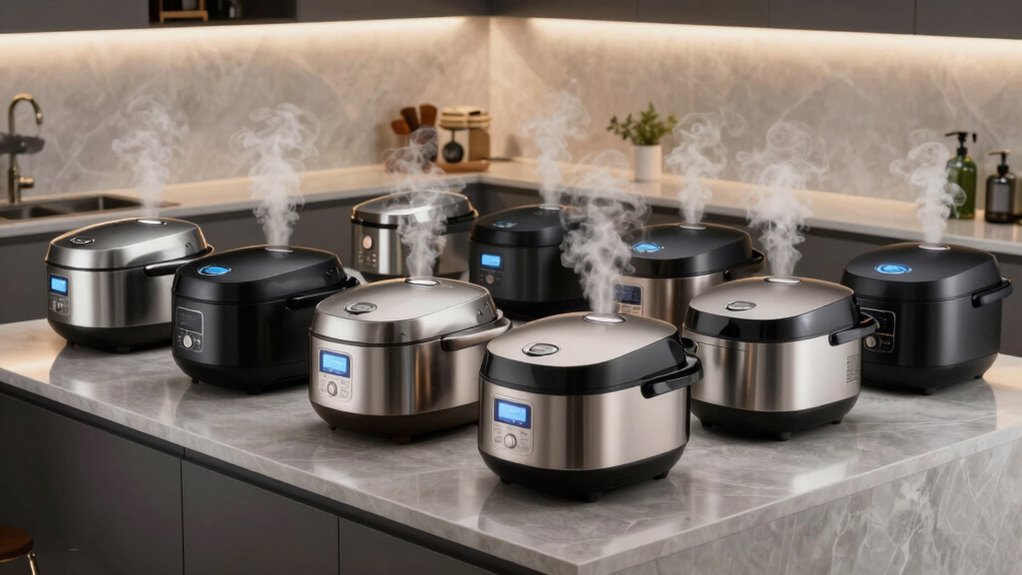

For batch cooking at home, I’d choose the Zojirushi NP-HCC18XH as the best overall fit: its induction heating and 1.8-liter capacity balance even cooking with practical household scale. The CUCKOO CR-3032 suits kitchens that need commercial-sized output, while the Zojirushi NW-JEC18BA offers a more advanced pressure-and-induction approach for cooks who value cooking control. The main tradeoff is between capacity and counter space, along with how much you value specialized cooking programs over simpler operation. A larger cooker can help with weekly portions, but it may be awkward when you usually make smaller batches. Read on for how the ten models compare and which one best matches your routine.

Get kitchen gear delivered free with Prime
- Fast, free delivery on millions of items
- Prime Video, Amazon Music and more included
- Member-only deals all year
Complete the kit

Key Takeaways
- The NP-HCC18XH is the most balanced home batch-cooking pick: its induction heating and 1.8-liter size suit recurring family portions without moving into commercial-scale equipment.
- The CUCKOO CR-3032 is in a different capacity class, with 60-cup cooked capacity for group service or very large batches; that scale can be excessive for ordinary household meal prep.
- Several Zojirushi models focus on cooking precision in different ways: pressure induction on the NW-JEC18BA, induction on the NW-QAC18, and fuzzy logic on the Neuro Fuzzy model.
- Capacity labels need context: the CUCKOO listing specifies cooked capacity, while many household models list uncooked rice capacity, so compare the actual portions you plan to store.
- Features beyond the cooking cycle affect everyday fit: the KitchenAid’s integrated scale and the ceramic-coated pots on the COSORI and 3L models offer distinct conveniences, but buyers should weigh those against their priorities for capacity and controls.
| Yum Asia Sakura Rice Cooker with Ceramic Bowl, 8 Cup (1.5 Litre), Black and Silver |  | Best Multicooker for Varied Rice Batches | Uncooked capacity: 8 cups (1.5 litres) | Rice cooking functions: 6 | Multicook functions: 6 | VIEW ON AMAZON | See Our Full Breakdown |
| CUCKOO CR-3032 Commercial Rice Cooker and Warmer, 60-Cup Cooked Capacity |  | Best for Large-Scale Batch Cooking | Model: CR-3032 | Uncooked capacity: 30 cups | Cooked capacity: 60 cups | VIEW ON AMAZON | See Our Full Breakdown |
| Zojirushi NP-HCC18XH Induction Rice Cooker and Warmer, 1.8 L, Dark Gray |  | Best Induction Pick for Mixed Rice Menus | Model: NP-HCC18XH | Capacity: 1.8 L | Heating: Induction heating | VIEW ON AMAZON | See Our Full Breakdown |
| Zojirushi NW-JEC18BA Pressure Induction Heating Rice Cooker, 10-Cup |  | Best for Adjustable Rice Texture | Model: NW-JEC18BA | Capacity: 10 cups uncooked rice (1.8 litres) | Heating method: Pressure induction heating | VIEW ON AMAZON | See Our Full Breakdown |
| Zojirushi Neuro Fuzzy 10-Cup Rice Cooker and Warmer, Premium White |  | Best for Set-and-Serve Family Batches | Model: NS-ZCC18 | Capacity: 10 cups cooked rice | Cooking technology: Neuro Fuzzy | VIEW ON AMAZON | See Our Full Breakdown |
| Zojirushi NW-QAC18 10-Cup Induction Rice Cooker and Warmer, Black |  | Best for Large, Varied Batches | Model: NW-QAC18 | Capacity: 10 cups uncooked; up to 20 cups cooked | Heating: Induction heating | VIEW ON AMAZON | See Our Full Breakdown |
| KitchenAid 8-Cup Grain and Rice Cooker with Integrated Scale, Matte Black | 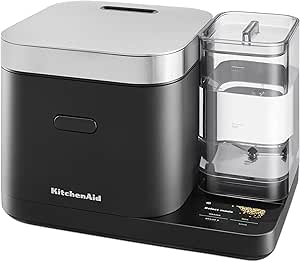 | Best for Hands-Off Meal Prep | Model: KGC3155 | Capacity: 8 cups; cooked or uncooked measurement not specified | Cooking presets: 21 | VIEW ON AMAZON | See Our Full Breakdown |
| COSORI 10-Cup Rice Cooker with Fuzzy Logic and Ceramic-Coated Inner Pot |  | Best for Flexible Everyday Batches | Capacity: 10 cups; cooked or uncooked measurement not specified | Functions: 18 | Cooking technology: Fuzzy logic with a 7-step cooking process | VIEW ON AMAZON | See Our Full Breakdown |
| 3L Smart Rice Cooker with Fuzzy Logic and Ceramic Nonstick Pot |  | Best for Small-Family Batch Cooking | Capacity: 3 L; approximately 12 cups cooked | Cooking technology: Fuzzy logic with 7 cooking phases | Pot coating: Ceramic; PFOA- and PTFE-free | VIEW ON AMAZON | See Our Full Breakdown |
| Zojirushi NS-TSC18 Micom Rice Cooker and Warmer, 1.8 L |  | Best for Reliable Rice-First Prep | Capacity: Up to 10 cups / 1.8 L | Cooking technology: Computerized fuzzy logic | Dimensions: 11.12 x 15 x 9.87 inches | VIEW ON AMAZON | See Our Full Breakdown |
| high end rice cooker for batch cooking | Capacity | Model | Cooking technology |
|---|---|---|---|
| Yum Asia Sakura Rice Cooker wi | — | — | — |
| CUCKOO CR-3032 Commercial Rice | — | CR-3032 | — |
| Zojirushi NP-HCC18XH Induction | 1.8 L | NP-HCC18XH | — |
| Zojirushi NW-JEC18BA Pressure | 10 cups uncooked rice (1.8 litres) | NW-JEC18BA | AI-powered fuzzy logic |
| Zojirushi Neuro Fuzzy 10-Cup R | 10 cups cooked rice | NS-ZCC18 | Neuro Fuzzy |
| Zojirushi NW-QAC18 10-Cup Indu | 10 cups uncooked; up to 20 cups cooked | NW-QAC18 | — |
| KitchenAid 8-Cup Grain and Ric | 8 cups; cooked or uncooked measurement not specified | KGC3155 | — |
| COSORI 10-Cup Rice Cooker with | 10 cups; cooked or uncooked measurement not specified | — | Fuzzy logic with a 7-step cooking process |
| 3L Smart Rice Cooker with Fuzz | 3 L; approximately 12 cups cooked | — | Fuzzy logic with 7 cooking phases |
| Zojirushi NS-TSC18 Micom Rice | Up to 10 cups / 1.8 L | — | Computerized fuzzy logic |
More Details on Our Top Picks
Yum Asia Sakura Rice Cooker with Ceramic Bowl, 8 Cup (1.5 Litre), Black and Silver
Versatility for different rice types is the Sakura’s main strength: its fuzzy logic cooking uses seven phases, and its programs cover white, long-grain, short-grain, sushi, and brown rice. For batch cooks who also want one appliance for other meals, it adds six multicook functions, a steam basket, and a 24-hour timer. Compared with the Zojirushi NS-ZCC18, which offers a 10-cup cooked-rice capacity and extended keep-warm, the Sakura provides more emphasis on multicooking but less headroom for a large rice batch. Its 8-cup uncooked capacity suits regular family portions, though large gatherings may call for the 60-cup CUCKOO. The ceramic-coated bowl has water markings and lift handles, but this model is designed for 120 V, 60 Hz power, so buyers should check compatibility before choosing it.
Pros:- Seven-phase fuzzy logic cooking supports multiple rice types
- Six multicook functions expand its use beyond rice
- Ceramic-coated bowl has water-level markings and lift handles
- Includes a steam basket and two-year manufacturer warranty
Cons:- Eight-cup uncooked capacity is smaller than the 30-cup CUCKOO CR-3032
- 120 V, 60 Hz design limits suitability where power differs
Best for: Home cooks who make several rice varieties and want multicook programs in a mid-sized cooker.
Not ideal for: Hosts or meal preppers who routinely need more than eight uncooked cups per batch, and buyers without compatible 120 V, 60 Hz power.
- Uncooked capacity:8 cups (1.5 litres)
- Rice cooking functions:6
- Multicook functions:6
- Cooking method:Fuzzy logic with seven cooking phases
- Inner bowl:5-layer, 2 mm Ninja ceramic-coated
- Display:Ice-blue LED with 10-minute countdown for rice functions
- Power:120 V, 60 Hz
- Timer and warranty:24-hour timer; 2-year warranty
Our verdict“Choose the Sakura if you want varied rice settings and multicook flexibility for family-sized batches, and do not need commercial-scale capacity.”
CUCKOO CR-3032 Commercial Rice Cooker and Warmer, 60-Cup Cooked Capacity
When the batch itself is the priority, the CUCKOO CR-3032’s 30-cup uncooked capacity puts it in a different class from the home-focused Zojirushi NP-HCC18XH and its 1.8-litre capacity. It produces up to 60 cups cooked, then switches to keep-warm mode, which makes it a practical fit for restaurant service, community meals, or large gatherings where repeated small cycles would slow preparation. Its one-switch operation keeps the process simple, while cETL and NSF certifications and an easy-to-clean pot and silicone pad suit frequent use. The tradeoff is specialization: the supplied details describe straightforward cooking and warming, without the varied rice menus, timers, or texture controls offered by the Zojirushi NW-JEC18BA. Buyers should choose the CUCKOO for volume and uncomplicated service, not menu flexibility.
Pros:- Makes up to 60 cups cooked rice from a 30-cup uncooked batch
- Automatically switches to keep-warm mode
- cETL and NSF certifications
- Easy-to-clean inner pot and silicone pad
Cons:- One-switch operation offers less control over rice types and texture than the Zojirushi NW-JEC18BA
- Its 30-cup uncooked capacity is excessive for routine small household meals
Best for: Caterers, community kitchens, and large households that need a full batch of up to 60 cooked cups at once.
Not ideal for: Home cooks who want settings for different rice varieties, adjustable textures, or a compact everyday appliance.
- Model:CR-3032
- Uncooked capacity:30 cups
- Cooked capacity:60 cups
- Certifications:cETL, NSF
- Operation:One-switch cooking
- Warming:Automatic keep-warm mode
- Inner pot:Nonstick
- Included accessories:Rice measuring cup, cooking silicone pad, rice spatula
Our verdict“Pick the CUCKOO when a single high-volume batch matters more than specialty rice programs or fine texture control.”
Zojirushi NP-HCC18XH Induction Rice Cooker and Warmer, 1.8 L, Dark Gray
The NP-HCC18XH pairs induction heating with a triple heater, giving it a strong case for cooks who want different rice varieties across a regular family-sized batch. Its menu covers white, jasmine, sushi, mixed, sweet, brown, and GABA brown rice, plus porridge and quick cooking. That breadth makes it more adaptable than the CUCKOO CR-3032, whose 60-cup capacity favors high-volume plain service over menu choice. Against the Zojirushi NW-JEC18BA, this model offers a broad set of rice settings without the listed pressure and texture controls; batch cooks seeking those adjustments may prefer the NW-JEC18BA. Automatic keep-warm and a delay timer help coordinate cooking with meals. The stated 1.8-litre capacity is suited to household batches, while the product details do not give dimensions or weight, leaving kitchen fit harder to assess.
Pros:- Induction heating and triple heater support even cooking
- Settings cover seven rice types plus porridge and quick cooking
- Automatic keep-warm and delay timer support meal planning
- Includes measuring cup, spatula, and spatula holder
Cons:- Household-sized 1.8-litre capacity is far below the CUCKOO CR-3032’s 60 cooked cups
- Dimensions and weight are not stated in the supplied product data
Best for: Households that batch-cook several rice styles and want induction heating, porridge, and quick-cook options.
Not ideal for: Caterers needing dozens of cooked cups per cycle or buyers who require stated dimensions before planning counter space.
- Model:NP-HCC18XH
- Capacity:1.8 L
- Heating:Induction heating
- Rice settings:White, jasmine, sushi, mixed, sweet, brown, GABA brown
- Other cooking settings:Porridge and quick cooking
- Heating elements:Triple heater
- Convenience features:Automatic keep-warm, delay timer, LCD control panel
- Warranty:1-year limited warranty on parts and labor
Our verdict“Choose this Zojirushi for varied household rice batches with induction cooking, rather than maximum batch volume or pressure-based texture control.”
Zojirushi NW-JEC18BA Pressure Induction Heating Rice Cooker, 10-Cup
For batch cooks who care about how a full pot turns out, the NW-JEC18BA combines pressure induction heating with AI-powered fuzzy logic and menu-based pressure adjustments. Three pressure levels and four texture settings let it adapt cooking to different preferences, a level of control the NP-HCC18XH does not list. Its 10-cup uncooked capacity also gives it more room for a household batch than the Sakura’s eight cups, though it remains far smaller than the CUCKOO CR-3032 for institutional volume. A detachable, washable stainless steel inner lid makes routine cleanup more manageable after frequent cooking. The product information does not list specific rice menus, so buyers focused on a clearly documented range of rice varieties may prefer the NP-HCC18XH. This model makes the most sense when capacity and texture adjustment lead the decision.
Pros:- Pressure induction heating with AI-powered fuzzy logic
- Three menu-selected pressure levels and four texture settings
- Detachable stainless steel inner lid is washable
- Includes measuring cup, spatula, and self-standing spatula holder
Cons:- Ten-cup uncooked capacity cannot match the CUCKOO CR-3032 for high-volume service
- Supplied product data does not specify its rice menu
Best for: Families and meal preppers who cook up to ten uncooked cups and want several pressure and texture choices.
Not ideal for: Large-scale food service buyers or shoppers who need a documented list of rice programs before choosing.
- Model:NW-JEC18BA
- Capacity:10 cups uncooked rice (1.8 litres)
- Heating method:Pressure induction heating
- Cooking technology:AI-powered fuzzy logic
- Pressure settings:3 levels selected by menu
- Texture settings:4
- Inner lid:Detachable and washable stainless steel
- Country of manufacture:Japan
Our verdict“Choose the NW-JEC18BA for substantial household batches where pressure and texture adjustment matter more than commercial capacity or a documented menu list.”
Zojirushi Neuro Fuzzy 10-Cup Rice Cooker and Warmer, Premium White
The NS-ZCC18 Neuro Fuzzy is a straightforward fit for households that want a generous cooked-rice yield and a menu that includes white, brown, semi-brown, sweet, rinse-free, sushi rice, and porridge. Neuro Fuzzy technology adjusts cooking time and temperature, while two delay-start options and automatic and extended keep-warm make it easier to plan a batch ahead and serve it over time. Compared with the pressure-focused NW-JEC18BA, this model emphasizes flexible scheduling and familiar rice programs rather than listed pressure and texture controls. Its capacity is stated as 10 cups cooked rice, so buyers comparing uncooked batch sizes should not assume it matches the NW-JEC18BA’s 10-cup uncooked figure. The removable inner lid helps with cleaning, but the supplied information omits dimensions and cooking times.
Pros:- Neuro Fuzzy adjusts cooking temperature and time
- Programs cover several rice types and porridge
- Two delay-start options plus automatic and extended keep-warm
- Removable inner lid and fold-down handle aid cleaning and storage
Cons:- Capacity is listed as 10 cups cooked, unlike models specified by uncooked capacity
- Dimensions, weight, and cooking time are not stated in the supplied product data
Best for: Families who want a variety of rice programs, advance scheduling, and extended warming for meals served over time.
Not ideal for: Meal preppers comparing uncooked capacity directly, or buyers who need listed dimensions and cooking times before purchase.
- Model:NS-ZCC18
- Capacity:10 cups cooked rice
- Cooking technology:Neuro Fuzzy
- Rice settings:White, brown, semi-brown, sweet, rinse-free, sushi rice, porridge
- Delay start:2 options
- Keep-warm settings:Automatic and extended
- Inner lid:Removable
- Warranty:1-year limited warranty
Our verdict“Pick the NS-ZCC18 if you want scheduled family batches with varied rice programs and extended warming, and cooked-capacity labeling suits your planning.”
Zojirushi NW-QAC18 10-Cup Induction Rice Cooker and Warmer, Black
The NW-QAC18 pairs induction heating and pressure cooking with room for up to 20 cups cooked, making it a strong fit for households that prepare rice ahead for several meals. Its menu covers several rice styles, grains, congee, and steel-cut oatmeal, while the adjustable steam timer adds a way to cook a side alongside a batch. Compared with the COSORI 10-Cup Rice Cooker, this model spells out an uncooked-to-cooked capacity and offers pressure cooking, but COSORI lists more general-purpose functions and dishwasher-safe accessories. The tradeoff is scale: ten uncooked cups can be excessive for smaller households, and the product details give no dimensions or weight to help plan counter space. The double nonstick pan supports easier cleanup, though it still calls for care with the coating.
Pros:- Makes up to 20 cups of cooked rice from a 10-cup uncooked batch.
- Induction heating and pressure cooking support its rice-focused cooking options.
- Includes settings for varied rice types, grains, congee, and oatmeal.
- Adjustable steam timer and included steaming accessories add side-dish flexibility.
Cons:- Its large capacity may exceed the needs of smaller households.
- Dimensions and weight are not provided, making storage and counter fit harder to judge.
- The double nonstick coating requires care to avoid damaging the cooking surface.
Best for: Large households and meal preppers who want to cook several rice styles and grains in one large batch.
Not ideal for: Smaller households with limited counter space or cooks who usually make only a few servings.
- Model:NW-QAC18
- Capacity:10 cups uncooked; up to 20 cups cooked
- Heating:Induction heating
- Cooking functions:White, quick white, mixed, sushi/sweet, Jasmine, quick Jasmine, congee, brown rice, GABA brown rice, steel-cut oatmeal, quinoa, and steam
- Controls:LCD controls
- Inner pan:Double nonstick coating
- Included components:Measuring cup, rice paddle, steamer basket, steaming tray, self-standing spatula, and instruction manual
- Warranty:3-year limited warranty against defects in materials and workmanship
Our verdict“Choose the NW-QAC18 for large, varied batch cooking when its capacity and footprint suit your kitchen.”
KitchenAid 8-Cup Grain and Rice Cooker with Integrated Scale, Matte Black
The KitchenAid KGC3155 is the most automation-focused option here: its integrated scale and water tank weigh ingredients and dispense water, reducing the measuring steps before a scheduled batch. With 21 presets and a delay of up to 24 hours, it suits cooks who want to set up different grains or beans in advance. By comparison, the Zojirushi NW-QAC18 gives a clearly stated uncooked rice capacity and induction pressure cooking, so it is easier to assess for large rice batches; KitchenAid’s listing does not say whether its eight-cup capacity is cooked or uncooked. The ceramic pot and steamer basket add flexibility, but the available details do not explain how to clean the integrated water tank. Buyers should be comfortable with that maintenance uncertainty before making this their regular prep cooker.
Pros:- Integrated scale and water tank automate ingredient measurement and water dispensing.
- Twenty-one presets cover rice, grains, beans, and other cooking options.
- Delayed cooking can be scheduled up to 24 hours ahead.
- Removable nonstick ceramic pot and included steamer basket support varied meals.
Cons:- The product details do not clarify whether eight cups means cooked or uncooked capacity.
- Cleaning instructions for the integrated water tank are not provided.
- Its automated measuring system adds components that may require care beyond a basic cooker.
Best for: Meal preppers who cook a mix of rice, grains, and beans and value automated measuring and scheduled starts.
Not ideal for: Buyers who need a clearly specified uncooked rice capacity or want detailed guidance on cleaning the water system.
- Model:KGC3155
- Capacity:8 cups; cooked or uncooked measurement not specified
- Cooking presets:21
- Measuring system:Integrated scale and water tank with automatic water dispensing
- Delayed cooking:Up to 24 hours
- Pot:Removable nonstick ceramic
- Included accessories:Steamer basket
- Color:Matte black
Our verdict“Pick the KitchenAid if automated measuring and advance scheduling matter more than a clearly defined batch capacity.”
COSORI 10-Cup Rice Cooker with Fuzzy Logic and Ceramic-Coated Inner Pot
The COSORI 10-Cup Rice Cooker balances a broad menu with practical scheduling, making it a flexible choice for cooks who batch rice alongside oats, vegetables, or soup. Its 18 functions and seven-step fuzzy logic adjust the cooking process, while the 24-hour delay and keep-warm settings help fit cooking around a meal schedule. Compared with the Zojirushi NW-QAC18, COSORI lists dishwasher-safe accessories and a wider range of non-rice dishes, but it does not specify whether its ten-cup capacity is cooked or uncooked, and the Zojirushi explicitly uses induction heating and pressure cooking. Quick cooking is described for white rice only, so it may not shorten preparation for other grains. The ceramic-coated pot and stainless steel steamer basket suit cooks who value an adaptable routine, provided they verify that the capacity matches their needs.
Pros:- Eighteen functions cover rice, grains, oats, vegetables, and soups.
- Seven-step fuzzy logic adjusts the cooking process.
- 24-hour delay and keep-warm settings help coordinate batch cooking.
- Includes a stainless steel steamer basket and dishwasher-safe accessories.
Cons:- The product details do not clarify whether ten cups refers to cooked or uncooked rice.
- Quick cooking is specified for white rice only.
- Capacity comparison with other cookers is difficult without a defined measurement basis.
Best for: Households that want one cooker for rice, grains, oats, soups, and steaming with delay scheduling.
Not ideal for: Batch cooks who need a confirmed uncooked rice capacity or expect quick cooking across multiple grain settings.
- Capacity:10 cups; cooked or uncooked measurement not specified
- Functions:18
- Cooking technology:Fuzzy logic with a 7-step cooking process
- Power:1000 W
- Delay timer:24 hours
- Keep warm:Up to 24 hours
- Inner pot:Ceramic-coated
- Included accessory:Stainless steel steamer basket; accessories are dishwasher-safe
Our verdict“Choose COSORI for a versatile, scheduled cooker when its unspecified ten-cup measurement is acceptable.”
3L Smart Rice Cooker with Fuzzy Logic and Ceramic Nonstick Pot
This 3L Smart Rice Cooker is sized for modest batches, with a stated yield of about 12 cups cooked. Its seven-phase fuzzy logic and modes for rice, quinoa, congee, soup, steaming, and cakes let a small household vary meals without moving up to the larger capacity of the Zojirushi NW-QAC18. That Zojirushi is better suited to high-volume prep, since it can make up to 20 cups cooked and offers induction heating and pressure cooking. The 3L model instead emphasizes a ceramic-coated pot described as PFOA- and PTFE-free, plus a detachable steam valve and inner lid that simplify access during cleanup. Its one-year warranty is shorter than the NW-QAC18’s three-year limited warranty, and its stated capacity may leave larger families cooking more than one batch.
Pros:- Stated capacity of approximately 12 cups cooked gives buyers a useful batch-size reference.
- Seven-phase fuzzy logic adjusts heat during cooking.
- Modes include rice, quinoa, congee, soup, steaming, and cakes.
- Detachable steam valve and inner lid simplify cleaning access.
Cons:- Its capacity may be too small for larger households or high-volume meal prep.
- One-year warranty is shorter than the three-year limited warranty listed for the Zojirushi NW-QAC18.
- The listed capacity is in liters with an approximate cooked-cup conversion.
Best for: Small families who want to prepare a few days of rice and rotate among grains, soup, and steamed dishes.
Not ideal for: Large households or weekly meal preppers who need more than about 12 cups of cooked rice at a time.
- Capacity:3 L; approximately 12 cups cooked
- Cooking technology:Fuzzy logic with 7 cooking phases
- Pot coating:Ceramic; PFOA- and PTFE-free
- Cooking modes:Rice, quinoa, congee, soup, steaming, and cakes
- Delay timer:24 hours
- Keep warm:Keep-warm function included
- Steam valve:Detachable
- Warranty:1 year
Our verdict“Choose this 3L model for flexible small-family batches, and look to a larger cooker if you regularly prep for a crowd.”
Zojirushi NS-TSC18 Micom Rice Cooker and Warmer, 1.8 L
The Zojirushi NS-TSC18 is a straightforward choice for cooks who want a familiar rice-focused appliance for repeat batches. Its computerized fuzzy logic, automatic and extended keep-warm settings, reheating cycle, and two delay timers support cooking ahead and serving later. Against the KitchenAid KGC3155, it offers a stated capacity of up to ten cups and reheating functions, while KitchenAid adds automated ingredient weighing and water dispensing for a wider grain-and-bean routine. The NS-TSC18’s product details do not list a broad grain menu or induction heating, so buyers seeking those capabilities may prefer the NW-QAC18. Its capacity also depends on the included measuring cup and rice type, which makes it less directly comparable to cookers that state cooked yield. A retractable cord helps with storage, though the listed dimensions still call for counter and cabinet space.
Pros:- Computerized fuzzy logic cooking.
- Automatic and extended keep-warm settings support serving rice later.
- Reheating cycle and two delay timer settings aid advance preparation.
- Retractable power cord makes storage neater.
Cons:- Capacity measurements depend on the included measuring cup and rice type.
- The supplied product details do not list a broad grain menu or induction heating.
- Listed dimensions may require a dedicated counter or storage spot.
Best for: Rice-focused households that want scheduled cooking, reheating, and extended warming for meal prep.
Not ideal for: Buyers who need a confirmed cooked yield, a wide grain menu, or induction pressure cooking.
- Capacity:Up to 10 cups / 1.8 L
- Cooking technology:Computerized fuzzy logic
- Dimensions:11.12 x 15 x 9.87 inches
- Exterior:Clear-coated stainless steel
- Keep-warm settings:Automatic and extended
- Delay timer:2 settings
- Additional function:Reheating cycle
- Power cord:Retractable
Our verdict“Pick the NS-TSC18 for scheduled rice batches and reheating if broad grain options are not a priority.”
How We Picked
I ranked these cookers around the needs of repeat batch cooking: usable capacity, cooking approach, ease of portioning, and the practical demands of storing and serving larger quantities. Induction and pressure-based heating can offer more involved cooking control, while fuzzy-logic models adapt cooking behavior without asking the user to manage every step. I also considered useful workflow details, such as an integrated scale or a pot coating that may change cleanup habits. Capacity claims deserve careful reading because cooked and uncooked measurements describe very different amounts of food.
The ranking favors models that appear to balance substantial home portions with a cooking system suited to repeat use. The NP-HCC18XH leads as a practical home-scale combination; the CUCKOO CR-3032 earns a separate role for very large-volume service, rather than a default recommendation for every home. More specialized Zojirushi models follow for buyers who want particular heating methods, while the KitchenAid, COSORI, Yum Asia, and 3L models bring other feature or usability priorities. Product details provided here do not establish independent cooking-test results, so I judge the options by their listed capacity and features, and call out where the intended buyer matters most.
| high end rice cooker for batch cooking | Model | Cooking technology |
|---|---|---|
| Yum Asia Sakura Rice Cooker wi | — | — |
| CUCKOO CR-3032 Commercial Rice | CR-3032 | — |
| Zojirushi NP-HCC18XH Induction | NP-HCC18XH | — |
| Zojirushi NW-JEC18BA Pressure | NW-JEC18BA | AI-powered fuzzy logic |
| Zojirushi Neuro Fuzzy 10-Cup R | NS-ZCC18 | Neuro Fuzzy |
| Zojirushi NW-QAC18 10-Cup Indu | NW-QAC18 | — |
| KitchenAid 8-Cup Grain and Ric | KGC3155 | — |
| COSORI 10-Cup Rice Cooker with | — | Fuzzy logic with a 7-step cooking process |
| 3L Smart Rice Cooker with Fuzz | — | Fuzzy logic with 7 cooking phases |
| Zojirushi NS-TSC18 Micom Rice | — | Computerized fuzzy logic |
Factors to Consider When Choosing High End Rice Cooker For Batch Cooking
Choosing a cooker for batch cooking starts with how much cooked rice you actually need and how you plan to use it through the week. I’d match capacity to household portions, then decide how much cooking control and workflow convenience are worth in a machine that will occupy counter or cupboard space.
Match Capacity to Your Real Batch
Start with the number of portions you cook at once, then check whether the listed capacity refers to uncooked rice or cooked rice. Those measures are not interchangeable, and a large number on a commercial model can describe a much bigger output than a household cooker’s cup rating. Avoid buying extra capacity just because you might host occasionally; a very large appliance takes up space even when it is only partly filled. If your batches vary widely, check the manufacturer’s guidance on minimum quantities, since a cooker designed around large loads may not suit a small weeknight portion. Think about container sizes and fridge space too, because cooking more rice only helps if you can store and use it safely. The right capacity is the largest amount you regularly portion, not the biggest number available.
Choose the Heating Approach You’ll Use
Induction heating and pressure induction are aimed at buyers who want a more involved cooking system, while fuzzy logic offers automated adjustment without requiring manual control of every cooking stage. A sophisticated method matters most when you cook rice often enough to value repeatable settings across different routines. It may matter less if your priority is simply producing a dependable large batch with minimal interaction. Think about the grains and programs you actually use before paying for more control options. Added complexity can also mean more settings to learn and a longer decision process each time you cook. Compare the cooking approach with your habits, not with a feature count.
Plan for Portioning and Storage
Batch cooking shifts work from the cooker to the steps that follow: measuring, dividing portions, cooling, and storing. A built-in scale may help simplify ingredient measurement, but it does not replace planning how much cooked rice fits your meal containers. Before choosing a high-capacity machine, consider whether your freezer or refrigerator can handle the output you intend to make. Smaller, repeatable batches may fit a household routine better than one very large cook that is difficult to portion. Write down a typical week’s rice use and compare it with the cooker’s capacity before deciding. That simple check can prevent buying a machine whose headline capacity is rarely useful.
Weigh Pot Care Against Convenience
Inner-pot construction affects the daily routine as much as it affects cooking. A ceramic-coated or nonstick-style surface may appeal if you want rice to release easily and cleanup to feel straightforward, but follow the maker’s care instructions to protect the coating. Avoid assuming that every coating can tolerate metal utensils, abrasive pads, or dishwasher cleaning. A heavier or more specialized pot may feel like a tradeoff if you regularly lift it while full. Check whether replacement pots and care guidance are available before settling on a model. The easiest cooker to maintain is the one whose cleaning steps fit the way you already work in the kitchen.
Pay More for a Feature You’ll Notice
Higher-end features have the most value when they solve a repeated problem, such as cooking substantial amounts, choosing among specialized programs, or measuring ingredients more conveniently. Pressure induction or induction heating can be appealing if you care about the cooking process, but a longer feature list does not automatically improve a batch-cooking routine. A commercial-sized machine makes sense when the output demand is genuinely high, such as group meals or frequent service. For household meal prep, counter space, straightforward controls, and manageable capacity may matter more than extra modes. Consider how often a feature will be used over a normal month rather than how impressive it sounds on a product page. Spend for a clear routine benefit, not for settings you are unlikely to select.
Frequently Asked Questions
Is a 60-cup cooked-capacity rice cooker suitable for household meal prep?
It can suit a household that routinely prepares very large quantities, but the CUCKOO CR-3032 is built around a scale of output far beyond many weekly meal-prep routines. Check the size of your storage containers and available refrigerator space before choosing it. A large batch is inconvenient if you cannot cool, divide, and store it promptly. For most home buyers, a household cooker’s capacity may be easier to use regularly. Compare cooked output with your actual portion plan rather than relying on the model’s headline number.
How do I compare a cooker rated in cooked cups with one rated in uncooked cups?
First confirm exactly what each manufacturer means by its capacity figure, then compare the amount of cooked rice you expect to serve or store. Cooked and uncooked measurements describe different stages and should not be treated as matching numbers. Product listings may also use a rice-cooker cup measurement, so check the manual or specifications for the measurement standard. If a capacity label is unclear, look for the manufacturer’s serving guidance before buying. This avoids selecting a cooker that is too large or too small for your regular batches.
Is induction heating worth prioritizing if I mainly cook rice for the week?
Induction heating is most compelling if you value a more advanced cooking system and expect to use the cooker frequently. For routine weekly portions, capacity, easy operation, and a workable storage plan may have a bigger effect on satisfaction. Pressure induction adds another specialized approach, while fuzzy-logic models offer automated adjustments through a different design. Consider whether the cooking features address a problem you currently have, such as wanting more control or flexibility. If your current method already fits your needs, extra technology may not improve the meal-prep routine much.
Should I choose a 10-cup cooker if I sometimes make only a small batch?
Not automatically: the useful range depends on the manufacturer’s minimum quantity and the kinds of small batches you expect to make. Look up minimum rice and water amounts in the manual, since the largest listed capacity does not tell you how well a cooker handles a small load. If your weekly quantities vary, compare those instructions across the models you are considering. A large cooker can be convenient for family portions while still being awkward for a single meal. Let your smallest regular batch influence the choice alongside your largest one.
Which matters more for meal prep: a built-in scale or a more advanced heating system?
It depends on where your routine gets difficult. An integrated scale, as listed on the KitchenAid model, may make ingredient measurement more convenient; a more advanced heating system may matter more if you prioritize the cooking method and its controls. Neither feature solves the storage and portioning work that follows a large cook. Think about which step you repeat most often and which one you want to simplify. If you already measure easily, capacity and operation may deserve more attention than a built-in scale.
Conclusion
For most households that batch cook rice regularly, I’d start with the Zojirushi NP-HCC18XH as the best overall choice for its home-scale capacity and induction heating. Choose the CUCKOO CR-3032 when your routine genuinely calls for very large cooked batches, and consider the Zojirushi NW-JEC18BA as the best premium pick if pressure induction is a priority. The KitchenAid Grain and Rice Cooker is the best fit for beginners who want an integrated scale as part of the measuring workflow. For a ceramic-coated-pot option, compare the COSORI and 3L models against your capacity needs; for simpler household routines, the Yum Asia Sakura and Zojirushi NS-TSC18 offer alternatives to the more specialized induction models. Choose by your normal batch size and kitchen workflow, then use heating features to break a close tie.
Halloween Picks
halloween
As an affiliate, we earn on qualifying purchases.