Induction cooktops are a natural fit for RVs and small kitchens because they heat fast, waste little energy, and stay cool to the touch — but not every portable model handles the realities of life on the road. The Duxtop 9600LS stands out as my best overall pick thanks to its precise temperature control and lockable settings that hold up when power fluctuates at a campground pedestal. For tight budgets, the Duxtop 8100MC delivers reliable 1800W performance at a lower cost, while the Rosewill Foldable Dual makes the most sense for anyone who wants two burners without giving up counter space. The main tradeoffs in this category come down to wattage versus your RV’s electrical capacity, physical footprint, and whether you need fine temperature control or just raw on/off simplicity. Read on for the full breakdown of all 15 models and which one matches your rig and cooking style.

Get kitchen gear delivered free with Prime
- Fast, free delivery on millions of items
- Prime Video, Amazon Music and more included
- Member-only deals all year
Complete the kit


Key Takeaways
- The Duxtop 9600LS earned the top spot because its temperature-mode precision and touch-lock controls outperform cheaper power-only models when campground voltage sags.
- Several 1800W models (8100MC, 9100MC, Mueller RapidTherm) perform nearly identically on paper — the differences that matter are control layout, fan noise, and cord length, not raw wattage.
- Dual-burner options like the Rosewill Foldable only make sense if your RV has a 30-amp service or a soft-start setup; on 15-20 amp shore power, running both sides will trip breakers.
- Nuwave‘s temperature-probe models (Diamond series) are the strongest choice for slow cooking and simmering in an RV, but their slower heat-up frustrates people who just want to boil water fast.
- Slim and lightweight picks like the Elite Gourmet 1500W trade peak power for portability — a worthwhile swap for van lifers counting every pound and inch.
| Nuwave Precision Induction Cooktop with Shatter-Resistant Ceramic Glass |  | Best Overall | Wattage: 1,400 watts | Temperature range: 100°F to 500°F | Temperature settings: 81, in 5°F increments | VIEW ON AMAZON | See Our Full Breakdown |
| Duxtop 9600LS Portable Induction Cooktop, 1800W, Silver |  | Best Feature Set | Power: 100–1,800 watts, 20 levels | Temperature range: 100°F–460°F, 20 settings | Timer: Up to 10 hours | VIEW ON AMAZON | See Our Full Breakdown |
| Duxtop 1800W Portable Induction Cooktop Countertop Burner, Gold (8100MC) |  | Best Value | Power: 200–1,800 watts, 15 levels | Temperature range: 140°F–460°F, 15 settings | Timer: Up to 170 minutes in 1-minute increments | VIEW ON AMAZON | See Our Full Breakdown |
| Stainless Steel 1800W Portable Induction Cooktop |  | Best for Outdoor and Rugged Use | Wattage: 1,800 watts | Temperature range: 140°F–460°F | Presets: 18 temperature presets | VIEW ON AMAZON | See Our Full Breakdown |
| Nuwave Gold Precision Induction Cooktop with 8″ Heating Coil | 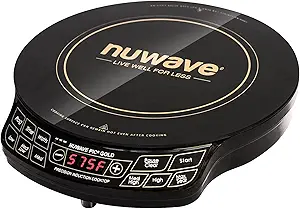 | Best for High-Heat Precision | Wattage: 1,500 watts, 3 presets | Temperature range: 100°F–575°F, 96 settings | Heating coil: 8 inches | VIEW ON AMAZON | See Our Full Breakdown |
| Rosewill Portable Induction Cooktop Burner with 6 Cooking Modes & 12-Hour Timer |  | Best for Slow Cooking and Hot Pot | Power: 1400W (9 levels, 200W–1400W) | Temperature Range: 118°F–464°F (9 settings) | Cooking Modes: 6 (Sauté, Slow Cook, Hot Pot, Steam/Boil, Keep Warm, DIY) | VIEW ON AMAZON | See Our Full Breakdown |
| Nuwave Portable Induction Cooktop Diamond with Probe, 100°F to 500°F |  | Best for Precision Cooking | Temperature Range: 100°F–500°F | Temperature Settings: 91 settings in 5°F increments | Presets: 5 (Low, Medium, Medium High, High, Sear) | VIEW ON AMAZON | See Our Full Breakdown |
| ChangBERT Professional Induction Cooktop, NSF Certified Large Coil Burner |  | Best Heavy-Duty Build | Power: 1800W (9 levels, 200W–1800W) | Temperature Range: 120°F–460°F (18 presets) | Heating Coil: 8 inches | VIEW ON AMAZON | See Our Full Breakdown |
| Portable Induction Cooktop, 1800W Induction Burner |  | Best Value | Power: 1800W (10 levels, 180W–1800W) | Temperature Range: 120°F–460°F (10 settings) | Timer: 3 hours | VIEW ON AMAZON | See Our Full Breakdown |
| Nuwave Diamond Induction Cooktop, Electric Burner with Precision Probe |  | Best for Delicate Low-Heat Cooking | Temperature Range: 50°F–500°F | Temperature Settings: 91 pre-programmed settings in 5°F increments | Presets: 5 (Low 100°F, Medium 200°F, Med High 300°F, High 400°F, Sear 500°F) | VIEW ON AMAZON | See Our Full Breakdown |
| Elite Gourmet Ultra Slim Portable Induction Cooktop, 1500W |  | Best for Tight Counters and Modest Amp Budgets | Power: 1500W | Power Levels: 10 (600–1500W) | Temperature Range: 140°F–465°F | VIEW ON AMAZON | See Our Full Breakdown |
| Mueller RapidTherm 1800W Portable Induction Cooktop |  | Best Safety Suite for Family RVing | Wattage: 1800 watts | Power Levels: 8 | Temperature Settings: 8 (140°F–460°F) | VIEW ON AMAZON | See Our Full Breakdown |
| Rosewill Foldable Dual Induction Cooktop, 1800W |  | Best for Two Dishes at Once | Power: 1800W total | Burners: 2 independent heating zones | Cooking Modes: 8 | VIEW ON AMAZON | See Our Full Breakdown |
| AAOBOSI Portable Induction Cooktop, 1800W |  | Best Temperature Precision | Wattage: 1800 watts | Power Levels: 20 | Temperature Settings: 20, 120°F–465°F | VIEW ON AMAZON | See Our Full Breakdown |
| Duxtop 1800W Portable Induction Cooktop Countertop Burner, 9100MC (Black) |  | Best Plug-and-Play Workhorse | Wattage: 1800 watts | Voltage: 120 volts | Power Levels: 20 (100–1800W) | VIEW ON AMAZON | See Our Full Breakdown |
| induction cooktops for rvs small kitchen | Temperature range | Timer |
|---|---|---|
| Nuwave Precision Induction Coo | 100°F to 500°F | — |
| Duxtop 9600LS Portable Inducti | 100°F–460°F, 20 settings | Up to 10 hours |
| Duxtop 1800W Portable Inductio | 140°F–460°F, 15 settings | Up to 170 minutes in 1-minute increments |
| Stainless Steel 1800W Portable | 140°F–460°F | — |
| Nuwave Gold Precision Inductio | 100°F–575°F, 96 settings | — |
| Rosewill Portable Induction Co | 118°F–464°F (9 settings) | 12 hours |
| Nuwave Portable Induction Cook | 100°F–500°F | — |
| ChangBERT Professional Inducti | 120°F–460°F (18 presets) | 10 hours |
| Portable Induction Cooktop | 120°F–460°F (10 settings) | 3 hours |
| Nuwave Diamond Induction Cookt | 50°F–500°F | — |
| Elite Gourmet Ultra Slim Porta | 140°F–465°F | 1 minute–3 hours |
| Mueller RapidTherm 1800W Porta | — | Up to 4 hours |
| Rosewill Foldable Dual Inducti | — | 12 hours |
| AAOBOSI Portable Induction Coo | — | Up to 4 hours |
| Duxtop 1800W Portable Inductio | 100°F–460°F | — |
More Details on Our Top Picks
Nuwave Precision Induction Cooktop with Shatter-Resistant Ceramic Glass
81 temperature settings in 5°F increments is the kind of control that actually matters when you’re simmering a sauce in a galley kitchen with nowhere to move a pot that’s gotten too hot. This Nuwave stands out for letting me conceptually split the difference between low and medium with real precision — something the Duxtop 8100MC, with only 15 temperature steps, simply can’t match. The shatter-resistant ceramic glass is a genuine plus for RV life, where vibration and road bumps punish fragile surfaces. At 4 pounds and under 12 inches wide, it slides into a cabinet without eating your only storage bay. The tradeoff is 1,400 watts — noticeably less power than the 1,800W Duxtop models, so boiling a pot of pasta takes longer, and serious searing is off the table.
Pros:- 81 precise temperature settings from 100°F to 500°F
- Adjust temperature and cook time mid-cycle without restarting
- Shatter-resistant ceramic glass suited to bumpy travel
- Lightweight at 4 pounds and compact for cabinet storage
Cons:- Lower 1,400-watt output slows boiling compared to 1,800W rivals
- Requires induction-compatible cookware
Best for: RV cooks who prioritize fine temperature control for simmering, melting, and low-heat cooking over raw boiling speed
Not ideal for: Boil-heavy cooks or anyone wanting fast searing — 1,400 watts trails the 1,800W units in this lineup
- Wattage:1,400 watts
- Temperature range:100°F to 500°F
- Temperature settings:81, in 5°F increments
- Dimensions:11.8 × 10.3 × 2.3 inches
- Weight:4 pounds
- Surface:Ceramic glass
- Controls:Digital touch
- Voltage:120 volts
Our verdict“This is the pick for precision simmering and space-constrained RV kitchens where control matters more than raw speed.”
Duxtop 9600LS Portable Induction Cooktop, 1800W, Silver
Among the 1,800-watt burners here, the Duxtop 9600LS earns its spot through convenience features rather than raw heat. The fast-boil and keep-warm buttons are one-touch shortcuts that the basic Duxtop 8100MC makes you dial in manually, and a 10-hour timer dwarfs the 8100MC’s 170-minute cap — handy for slow simmering stock on a rainy travel day. The child safety lock and automatic pan detection make it the safest choice if young grandkids ride along. Where does it fall short? The touch panel demands clean, dry fingers, which is friction when your hands are covered in flour or camp dust, and like all induction units it insists on a magnetic base of at least 5 inches — your favorite small kettle may not register.
Pros:- 20 power levels and 20 temperature settings for flexibility
- Fast-boil and keep-warm presets simplify daily cooking
- Child safety lock and automatic pan detection
- Compact and lightweight at roughly the size of a hardcover book
Cons:- Touch controls can be unresponsive with wet or dirty hands
- High-pitched hum reported with some cookware
- Needs cookware with a magnetic base of 5 inches or wider
Best for: Traveling families and convenience-minded cooks who want one-touch presets, a long timer, and safety locks
Not ideal for: Boaters or dusty-camp cooks — touch controls are fussier than the push buttons on the stainless steel 1800W model
- Power:100–1,800 watts, 20 levels
- Temperature range:100°F–460°F, 20 settings
- Timer:Up to 10 hours
- Keep-warm:140°F for 1–30 minutes
- Cookware requirement:Magnetic base, minimum 5-inch diameter
- Energy efficiency:83%
- Certification:ETL listed
Our verdict“The most feature-complete single burner in this lineup — ideal if presets and safety locks matter more to you than button simplicity.”
Duxtop 1800W Portable Induction Cooktop Countertop Burner, Gold (8100MC)
The Duxtop 8100MC proves you don’t need the 9600LS’s full feature sheet to cook well on the road. You still get full 1,800-watt power, a digital panel, and a 170-minute timer — plenty for nearly any RV meal — while skipping the presets and marathon timer that drive up the sibling model’s price. Where it lags the Nuwave PIC Flex is granularity: 15 temperature steps versus 81, so delicate tasks like holding chocolate just below seizing require more babysitting. What it offers instead is honest simplicity and rugged basics — auto-pan detection, diagnostic error messages, and low/high voltage warnings that genuinely matter when campsite power is unreliable. Some clad cookware produces an audible whine at higher settings, which is annoying in a small space.
Pros:- Full 1,800-watt output at an approachable price
- Voltage warnings and diagnostic messages protect against sketchy shore power
- Lightweight and compact for tight storage
- Auto-pan detection shuts off heat when cookware is removed
Cons:- Only 15 temperature steps limits fine control
- High-pitched sound with some multi-layer clad pans
- Timer caps at 170 minutes, far short of the 9600LS
Best for: Budget-conscious RVers and first-time induction buyers who want full power without paying for extras
Not ideal for: Precision cooks doing candy-making or gentle sauces — the 15-step temperature ladder is too coarse for that
- Power:200–1,800 watts, 15 levels
- Temperature range:140°F–460°F, 15 settings
- Timer:Up to 170 minutes in 1-minute increments
- Safety features:Auto-pan shutoff, diagnostics, voltage warnings
- Certification:ETL approved
- Cookware requirement:Induction-compatible magnetic cookware
Our verdict“The smart money pick — full 1,800W performance and real electrical safeguards for less than the feature-loaded alternatives.”
Stainless Steel 1800W Portable Induction Cooktop
Most induction burners here are plastic-bodied apartment appliances pretending to travel. This one is built differently: a stainless steel housing with water-resistant shielding, which changes where you can realistically cook — under an RV awning, at an outdoor table, near a splash-prone washup station. Compared with the Duxtop 9600LS, the physical push-button controls are a practical upgrade in grimy or damp conditions where touch panels misbehave. The cost is weight and bulk: at 7 pounds and 16 inches long, it’s the heaviest, largest single burner in this group, so it belongs in a bay rather than a drawer. Its 18 temperature presets land mid-pack — more flexible than the 8100MC’s 15 steps, far coarser than Nuwave’s 81.
Pros:- Stainless steel housing stands up to travel and outdoor use
- Water-resistant shielding tolerates damp environments
- Physical push buttons work reliably with wet or dirty hands
- Overheat sensors, auto shutoff, and hot-surface indicators
Cons:- Heaviest and bulkiest single-burner option here at 7 pounds
- Requires induction-compatible cookware
- Single heating element limits meal throughput
Best for: Camp cooks and outdoor entertainers who need a burner that shrugs off weather, spills, and rough handling
Not ideal for: Minimalist van-lifers counting every pound and inch — it’s nearly double the weight of the Nuwave PIC Flex
- Wattage:1,800 watts
- Temperature range:140°F–460°F
- Presets:18 temperature presets
- Controls:Push button
- Housing:Stainless steel, water-resistant shielding
- Dimensions:16 × 12.5 × 3 inches
- Weight:7 pounds
Our verdict“The rugged workhorse of the group — pick it when cooking happens outside, in the weather, not just at the galley counter.”
Nuwave Gold Precision Induction Cooktop with 8″ Heating Coil
A 575°F ceiling sets this Nuwave apart from everything else here — the Duxtop models and the stainless steel burner all top out at 460°F, and that difference is exactly what determines whether you can get a real crust on a steak or properly blister a tortilla. The 8-inch heating coil is also the largest in this group, spreading heat more evenly across big skillets and griddles instead of concentrating it in a hot ring. With 96 settings in 5°F steps and on-the-fly adjustments, it pairs that high-end muscle with Nuwave-grade control, effectively bridging the PIC Flex’s precision and the 1,800W crowd’s power. The compromise: at 1,500 watts and 4.5 inches tall with a bulky footprint, it’s less trim than the flat Duxtop units, and its three wattage presets feel crude next to the 9600LS’s 20 levels.
Pros:- Highest temperature range in the lineup at 100°F–575°F
- Large 8-inch coil heats big skillets and griddles evenly
- 96 temperature settings adjustable mid-cook
- Shatter-proof ceramic glass with no exposed coils
Cons:- Only three wattage presets limits power-side flexibility
- Taller and bulkier than the low-profile Duxtop models
- 1,500 watts trails the 1,800W units for rapid boiling
Best for: Sear-focused cooks and cast-iron users who need the highest temperatures and even heating across large pans
Not ideal for: Boil-first cooks and tight-storage setups — 1,500 watts and a tall, wide footprint cost speed and space
- Wattage:1,500 watts, 3 presets
- Temperature range:100°F–575°F, 96 settings
- Heating coil:8 inches
- Surface:Shatter-proof ceramic glass
- Controls:Touch
- Dimensions:12″D × 14.25″W × 4.5″H
- Voltage:120 volts
Our verdict“The choice when searing and high-heat cooking are the mission — unmatched temperature ceiling and coil size in exchange for a chunkier body.”
Rosewill Portable Induction Cooktop Burner with 6 Cooking Modes & 12-Hour Timer
Most budget induction burners treat every meal the same, but the Rosewill stands out for its six dedicated cooking modes — Sauté, Slow Cook, Hot Pot, Steam/Boil, Keep Warm, and DIY — which matter more in an RV than a full kitchen. When the weather turns and you want a slow-simmered stew without burning propane, the 12-hour timer runs far longer than the 3-hour cap on the generic 1800W Portable Induction Burner elsewhere in this lineup. At 1400W and 4.1 lbs, it draws less power than the ChangBERT, making it friendlier to modest RV electrical systems. The tradeoff is raw heat: searing and rapid boils take noticeably longer than on 1800W models, and the touch panel can be fussy with damp fingers while boondocking. Still, for mode flexibility at a low wattage, this pick makes the most sense for RV cooks who simmer more than they sear.
Pros:- Six preset cooking modes cover slow cooking, hot pot, and keep warm better than basic rivals
- 12-hour timer doubles the maximum runtime of many competitors
- Lightweight 4.1 lb build with child lock and auto shutoff for safe small-space use
- Low 1400W draw is easier on limited RV circuits and inverters
Cons:- 1400W ceiling means slower boiling and weaker searing than 1800W models
- Touch controls can be unresponsive with wet or greasy hands
Best for: RV owners with limited electrical capacity who slow cook, hot pot, or keep dishes warm for hours
Not ideal for: Cooks who need fast searing and rapid boils — the 1400W ceiling lags behind 1800W rivals like the ChangBERT
- Power:1400W (9 levels, 200W–1400W)
- Temperature Range:118°F–464°F (9 settings)
- Cooking Modes:6 (Sauté, Slow Cook, Hot Pot, Steam/Boil, Keep Warm, DIY)
- Timer:12 hours
- Dimensions:10.63″D x 11.81″W x 2.56″H
- Weight:4.1 lbs
- Cookware Compatibility:Magnetic-bottom cookware 4–10 inches
Our verdict“A low-wattage, mode-rich burner built for RV travelers who simmer and slow cook rather than sear at high heat.”
Nuwave Portable Induction Cooktop Diamond with Probe, 100°F to 500°F
If the Duxtop 9600LS in this roundup is about straightforward power, the Nuwave Diamond is about control. With 91 temperature settings in 5°F increments, it lets you hold a sauce at exactly 165°F or oil at a steady frying temp — something coarser 10-step burners simply can’t match. The bundled digital thermometer probe is the real differentiator: it monitors internal food temperature and adjusts automatically, which means no more lifting lids in a cramped RV galley to check on chicken. Four automated recipes (pasta, soup, deep fry, rice) reduce guesswork for beginners. Compared with the Rosewill, its 500°F ceiling and finer control give it a genuine edge for searing and deep frying. The catch: the probe caps at 212°F for internal readings, so it won’t help with candy making or searing steaks, and the preset-heavy interface takes an evening to learn.
Pros:- 91 temperature settings in 5°F increments enable true low-and-slow precision
- Smart thermometer probe automates internal-temperature cooking
- 85–90% energy efficiency edges out most competitors in this roundup
- Four automated recipes simplify pasta, soup, rice, and deep frying
Cons:- Probe internal readings cap at 212°F, limiting high-heat probe uses
- Requires induction-compatible cookware like every burner here, plus probe setup adds steps
Best for: Cooks who want exact temperature hold for sauces, frying, and proteins — especially anyone tired of guessing doneness
Not ideal for: Set-it-and-forget users who just want high/low buttons — 91 settings and probe management add complexity
- Temperature Range:100°F–500°F
- Temperature Settings:91 settings in 5°F increments
- Presets:5 (Low, Medium, Medium High, High, Sear)
- Automated Recipes:4 (pasta, soup/stock, deep fry, rice)
- Probe Limits:212°F internal, 480°F for liquids
- Energy Efficiency:85–90%
Our verdict“The pick for temperature obsessives who want probe-verified results rather than approximate heat settings.”
ChangBERT Professional Induction Cooktop, NSF Certified Large Coil Burner
This is the tank of the roundup. The ChangBERT carries NSF and UL commercial certifications, an 8-inch coil for even coverage under large stockpots, and a stainless body rated for cookware up to 100 lbs — overkill for a backpacking trip, but reassuring for full-time RV living where gear takes abuse. Its sealed one-touch button panel is a practical advantage over the Rosewill’s touch controls, since physical buttons keep working with wet or greasy hands. The 10-hour timer also outclasses the 3-hour limit on the generic 1800W burner. The honest tradeoff: at a full 1800W draw, it can trip breakers in older RVs or when the air conditioner is running, and it’s bulkier and heavier than slim options like the Elite Gourmet. This model is better suited to stationary small kitchens and serious cooks than to weight-conscious van lifers.
Pros:- NSF/ETL/UL commercial certifications for genuinely rugged daily use
- 8-inch coil delivers wider, more even heating than typical 6-inch coils
- Physical button controls work reliably with wet or greasy hands
- Stainless build supports cookware up to 100 lbs with a 10-hour timer
Cons:- 1800W maximum draw can overload shared or older RV circuits
- Heavier and bulkier than slim portable rivals, reducing travel convenience
Best for: Full-time RV residents and small-kitchen cooks who want commercial-grade durability and wide, even coil coverage
Not ideal for: Older RVs with 15-amp circuits or limited shore power — the full 1800W draw demands a robust electrical setup
- Power:1800W (9 levels, 200W–1800W)
- Temperature Range:120°F–460°F (18 presets)
- Heating Coil:8 inches
- Energy Efficiency:83%
- Timer:10 hours
- Certifications:NSF, ETL, UL Commercial Standard 197
- Max Cookware Weight:100 lbs
Our verdict“A commercial-grade burner for cooks who prioritize durability and even heat over portability and low power draw.”
Portable Induction Cooktop, 1800W Induction Burner
Sometimes you just need a dependable burner that plugs in and works, and this unbranded 1800W unit does the basics well without paying for extras. Where the Nuwave Diamond spends its budget on a probe and 91 settings, this model puts it into raw power: Rapid Boil mode, 10 power levels, and a full 1800W ceiling that matches the ChangBERT at a friendlier price. The safety kit — auto pan detection, child lock, overheat protection, ETL certification — covers everything a small kitchen or RV actually needs. Its 3-hour timer is the weak point: fine for weeknight dinners, limiting for the all-day simmering the Rosewill handles with its 12-hour clock. Pan support stops at 10 inches, so oversized stockpots are out. For a first induction burner, a guest-kitchen backup, or a budget RV upgrade, this pick makes the most sense.
Pros:- Full 1800W output with Rapid Boil mode matches pricier rivals on speed
- Complete safety package including pan detection, child lock, and overheat protection
- ETL certified with energy-efficient 83% heat conversion
- Compact, lightweight form factor suited to RV counters and storage
Cons:- Short 3-hour timer limits slow cooking and long simmers
- Cookware restricted to magnetic pans 4–10 inches, excluding large pots
Best for: Budget-conscious buyers and first-time induction users who want full 1800W power without premium features
Not ideal for: Slow cooks and batch simmers — the 3-hour timer can’t run all day like the Rosewill or ChangBERT
- Power:1800W (10 levels, 180W–1800W)
- Temperature Range:120°F–460°F (10 settings)
- Timer:3 hours
- Voltage:110V/120V standard outlet
- Energy Efficiency:83%
- Certification:ETL
- Compatible Pan Size:4–10 inches (10–26 cm)
Our verdict“A straightforward, no-frills 1800W burner that delivers the essential induction experience at the lowest complexity.”
Nuwave Diamond Induction Cooktop, Electric Burner with Precision Probe
What separates this Nuwave Diamond from nearly everything else in the lineup is its 50°F minimum temperature. Most rivals — including Nuwave’s own 100°F-start Diamond with probe — can’t go low enough for true sous-vide-style holding, gentle chocolate work, or proofing dough, but this model’s 50°F–500°F range in 5°F steps covers the entire spectrum. The on-the-fly adjustment feature is another quiet win: change the temperature mid-cook without canceling the cycle, something the sealed-button ChangBERT can’t do as gracefully. Its thermal probe tracks internal food temperature continuously, making it well suited to roasts and custards where a few degrees matter. Compared with the Duxtop 9100MC, this is the gentler, more surgical tool rather than a boil-and-sear workhorse. The tradeoff is that all that precision adds menu-diving, and the probe adds a piece to store and clean in a tiny kitchen.
Pros:- 50°F floor enables gentle holding and delicate tasks no rival in this roundup matches
- Adjust temperature mid-cook without restarting the cycle
- Thermal probe monitors internal food temperature continuously
- 91 preset settings span the full 50°F–500°F range in 5°F steps
Cons:- Extra probe component requires storage, cleaning, and setup in cramped spaces
- Requires induction-compatible cookware and deeper menu navigation than simple burners
Best for: Cooks who do low-and-slow, sous-vide-style, or delicate work like chocolate, custards, and proofing
Not ideal for: Riders who want one-button simplicity — deep menus and a separate probe add fuss to everyday meals
- Temperature Range:50°F–500°F
- Temperature Settings:91 pre-programmed settings in 5°F increments
- Presets:5 (Low 100°F, Medium 200°F, Med High 300°F, High 400°F, Sear 500°F)
- Controls:Digital with on-the-fly adjustment
- Probe:Thermal probe for internal temperature monitoring
- Type:Portable induction cooktop
Our verdict“The gentlest, most adjustable burner here — ideal for precision low-heat cooking, overkill for basic boiling.”
Elite Gourmet Ultra Slim Portable Induction Cooktop, 1500W
Most 1800W burners in this roundup, like the Mueller RapidTherm or Duxtop 9100MC, want a dedicated 15-amp circuit — a real constraint in older RVs where the AC and fridge share a breaker. The Elite Gourmet’s 1500W draw gives you more headroom on a crowded power panel, and its 2-inch profile slides into a cabinet or slide-out drawer more easily than the chunkier 3.8-inch-tall Duxtop. You still get 10 power levels, a 140°F–465°F range, and a 3-hour timer, which covers simmering through searing. The tradeoff is raw heat: it boils water slower than 1800W rivals, and there’s no child lock or pan detection like the Mueller offers. For space- and amp-conscious RVers, that’s a fair swap.
Pros:- 1500W draw leaves amperage headroom on shared RV circuits
- 2-inch slim profile stores easily in drawers or under seats
- 3-hour timer supports hands-free slow cooking
- Works with common cast iron and magnetic stainless cookware
Cons:- Slower boil times than 1800W competitors
- No child lock or pan-detection safety features
Best for: RVers in older rigs or 30-amp service who can’t spare a full 15-amp circuit and need a burner that stores flat
Not ideal for: Boil-hungry cooks who want the fastest heat-up — the 1500W ceiling lags behind 1800W rivals like the Duxtop 9100MC
- Power:1500W
- Power Levels:10 (600–1500W)
- Temperature Range:140°F–465°F
- Thickness:2 inches
- Timer:1 minute–3 hours
- Controls:LED touch controls
- Cookware Compatibility:Induction-ready magnetic cookware
Our verdict“This is the pick when your rig’s electrical capacity, not your cooking ambitions, is the deciding factor.”
Mueller RapidTherm 1800W Portable Induction Cooktop
Where the Elite Gourmet keeps things basic, the Mueller RapidTherm stacks on the safety layers that matter in a moving home with kids aboard: a child safety lock, pan detection, overheat protection, and automatic shut-off. The four presets — Hot Pot, Slow Cook, Boil, Keep Warm — translate into one-tap cooking rather than fiddling with settings on a bumpy road. Its 4-hour timer beats the Elite Gourmet’s 3 hours for longer braises, though it matches the AAOBOSI‘s timer and offers fewer fine-grained levels (8 versus 20). Be honest about your rig’s wiring: sustained 1800W cooking wants a dedicated 15-amp circuit, and the cookware base size window (4.7–10.2 inches) is narrower than some rivals. If safety features rank above granular control, this stands out.
Pros:- Child lock plus pan detection and overheat protection
- Four one-tap presets simplify cooking in motion
- 4-hour timer handles slow cooking sessions
- Compact 5.9-pound body travels well
Cons:- Demands a dedicated 15-amp circuit at full power
- Only 8 power/temperature levels versus 20 on the AAOBOSI or Duxtop
Best for: Families traveling with children who want lockouts and multiple automatic shut-off protections
Not ideal for: Boondockers or 30-amp rigs without a dedicated circuit — full-power cooking risks tripping breakers
- Wattage:1800 watts
- Power Levels:8
- Temperature Settings:8 (140°F–460°F)
- Presets:Hot Pot, Slow Cook, Boil, Keep Warm
- Timer:Up to 4 hours
- Safety Features:Auto shut-off, child lock, pan detection, overheat protection
- Cookware Base Diameter:4.7 to 10.2 inches
- Dimensions:14.3 × 11.3 × 2.2 inches
Our verdict“The safest choice here for households where curious little hands are part of the journey.”
Rosewill Foldable Dual Induction Cooktop, 1800W
Every other burner in this batch is a single-zone unit — which means one pot at a time. The Rosewill foldable solves that with two independent heating zones, effectively replacing a built-in two-burner RV stovetop in a package that folds in half with a carry handle. Its 12-hour timer doubles the Mueller RapidTherm’s 4-hour maximum, and eight cooking modes cover the usual range. The catch is in the power math: listed power levels top out at 1000W per zone against an 1800W total, so neither burner matches a dedicated single-burner like the Duxtop 9100MC for hard searing or rapid boils. The 4–10 inch cookware window is also strict. For full-time RVers tired of cooking in sequence, that flexibility is worth giving up some peak heat.
Pros:- Two independent burners allow simultaneous dishes
- Foldable design with carry handle stores in half the footprint
- 12-hour timer doubles most rivals’ maximum
- Auto shutoff detects incompatible cookware
Cons:- Per-zone power tops out around 1000W despite the 1800W total
- Strict 4–10 inch magnetic cookware size requirement
Best for: Full-time RVers replacing a propane stovetop who genuinely need two dishes cooking simultaneously
Not ideal for: Searing and wok-style cooks — per-zone power caps at 1000W, well below single-burner rivals
- Power:1800W total
- Burners:2 independent heating zones
- Cooking Modes:8
- Power Levels:9 (200W–1000W per zone)
- Temperature Settings:9 (118°F–464°F)
- Timer:12 hours
- Design:Foldable with carry handle
- Cookware Compatibility:Magnetic-bottom, 4–10 inches
Our verdict“The only truly two-burner option here — pick it for cooking flexibility, not raw heat.”
AAOBOSI Portable Induction Cooktop, 1800W
Twenty power levels and twenty temperature steps give the AAOBOSI the finest control granularity in this lineup — double the Mueller RapidTherm’s eight settings — which pays off when you’re holding a sauce just below a simmer or warming leftovers without scorching. Its 120°F floor is the lowest starting point here, below the Duxtop 9100MC’s 100°F… on paper, though in practice both run gentle enough for warming duties. The residual heat indicator is a genuinely useful safety touch in a cramped galley, alongside the child lock. What you give up is breadth: one burner only, no foldable two-zone option like the Rosewill, and it shares the universal induction limitation of requiring magnetic cookware. Precision cooks in small spaces will find the trade worthwhile.
Pros:- 20 power and 20 temperature levels for fine control
- Low 120°F starting temperature suits delicate tasks
- Residual heat indicator warns of lingering warmth
- Slim 1.7-inch profile fits tight galley counters
Cons:- Single heating element limits multi-dish cooking
- Requires induction-compatible cookware like every rival here
Best for: Precision-focused cooks who simmer, melt, and hold temperatures and want the finest incremental control available
Not ideal for: Anyone needing multiple burners — the single zone limits you to one pot at a time
- Wattage:1800 watts
- Power Levels:20
- Temperature Settings:20, 120°F–465°F
- Preset Modes:Boil, Hot Pot, Stew, Keep Warm
- Timer:Up to 4 hours
- Controls:Touch
- Dimensions:11 × 13.8 × 1.7 inches
- Safety Features:Child safety lock, residual heat indicator
Our verdict“The most adjustable single burner of the group, built for cooks who treat temperature as a dial, not a switch.”
Duxtop 1800W Portable Induction Cooktop Countertop Burner, 9100MC (Black)
The 9100MC is the straightforward pick: standard 120V plug, ETL certification, 83% energy efficiency, and the widest power band here at 100–1800W across 20 levels, giving it a lower simmer floor than the Elite Gourmet’s 600W minimum. Its glass surface wipes clean in seconds — a real virtue when your counter is also your prep space. Unlike the touch-driven Mueller or AAOBOSI, it uses push-button controls, which some will find less sleek but arguably more reliable when your hands are damp or floured. Tradeoffs are real: the 3.8-inch height is the tallest profile in this batch, taking up more drawer space than the 2-inch Elite Gourmet, there’s no child lock, and the glass retains heat from hot pans. It’s a dependable single-purpose tool, not a feature showcase.
Pros:- 100W minimum power level enables true low simmering
- 83% energy efficiency with quick heat-up
- ETL certified with standard 120V plug
- Auto-pan detection shuts off after 60 seconds with bad cookware
Cons:- Tallest profile at 3.8 inches — eats drawer space
- No child lock; surface stays warm after cooking
Best for: Buyers who want a proven, certified, no-frills burner that works in any North American outlet out of the box
Not ideal for: Families wanting a child lock, and minimalists with shallow storage — it’s the thickest unit here
- Wattage:1800 watts
- Voltage:120 volts
- Power Levels:20 (100–1800W)
- Temperature Range:100°F–460°F
- Controls:Push button
- Energy Efficiency:83%
- Dimensions:12.7″D × 16.3″W × 3.8″H
- Certification:ETL Listed
Our verdict“A certified, plug-in-anywhere workhorse that trades flashy features for dependable performance.”

How We Picked
I evaluated each cooktop through the specific constraints of RV and small-kitchen life rather than generic countertop performance. The criteria that separated the winners were: power draw realism (can it run on a 15-20 amp circuit without tripping breakers, and does it handle voltage fluctuation?), physical footprint and weight (does it stow in a cabinet when not in use?), control precision (temperature modes beat crude power levels for simmering and low-heat cooking), and build durability (glass tops, housing rigidity, and how well the cooling fan survives vibration and road bounce).
I also weighed everyday usability factors that matter more in a small space: fan noise in a confined RV interior, cord length for awkward outlet placement, and whether the controls lock to prevent accidental activation during travel or by curious kids. Models ranked higher when they balanced 1800W capability with sensible low-power settings, because full-blast cooking is rarely the goal in a rig with limited electrical headroom. Products further down the list aren’t bad — they simply serve narrower needs, duplicate stronger picks at a higher effective cost, or carry tradeoffs most RV owners shouldn’t accept.
Factors to Consider When Choosing Induction Cooktops For Rvs Small Kitchens
Before picking a specific model, it helps to understand how induction cooking interacts with the realities of RV electrical systems and cramped galley layouts. These are the factors that most often make or break the purchase.Know Your Electrical Budget Before Anything Else
The single most common mistake RV buyers make is grabbing a full 1800W cooktop without doing the math on their service. At 120 volts, an 1800W burner pulls 15 amps on its own — if your rig is on a 15 or 20 amp pedestal circuit, running the burner alongside a refrigerator, converter, or air conditioner will trip a breaker mid-meal. Look for models with adjustable or lower power steps so you can dial back to 800-1000W when your electrical headroom is tight. If you boondock on batteries and an inverter, induction becomes a much harder proposition: even a modest cooking session can drain a lithium bank fast, so honest expectations matter here. A model with fine-grained power or temperature settings gives you far more flexibility than a brute-force burner with only high and low stages. This is why control quality, not peak wattage, drove most of my ranking decisions.
Footprint, Weight, and Stowability
In an RV galley, counter space is the scarcest resource, and a cooktop that lives permanently on the counter steals it every single day. Measure your available surface and your stowage compartments before buying — a unit that fits the counter but won’t slide into a cabinet defeats the purpose of portable induction. Slim profiles and lightweight housings earn their keep, which is why the Elite Gourmet and foldable Rosewill rank well for van and trailer owners. Also check the cord: a short tether forces you to cook near an awkward outlet, while an overly long one creates clutter in a small space. Consider whether you’ll leave the unit out or stow it after every meal, because that answer changes which size category makes sense. And remember that induction requires magnetic cookware, so your stored pans need to fit your stowage plan too.
Temperature Control Versus Power Levels
Cheaper induction cooktops control output in raw wattage steps; better ones let you set an actual target temperature and hold it. The difference shows up most at the low end — simmering a sauce or keeping coffee warm without scorching is genuinely difficult on power-only units. Temperature-mode models like the Nuwave Diamond series and Duxtop 9600LS shine for slow, patient cooking, which suits RVers who cook real meals rather than just boiling pasta. Power-mode units are simpler, cheaper, and faster to learn, which has its own appeal if you mostly heat water and sear. Neither approach is objectively better; it depends entirely on how you cook. If you’re torn, prioritize models offering both modes so you can adapt as your cooking habits evolve on the road.
Durability Under Vibration and Movement
An RV cooktop lives a harder life than a kitchen-counter unit: constant vibration, temperature swings, and the occasional slide across a cabinet during transit. Glass tops vary meaningfully in shatter resistance, and housing flex directly affects how well internal components survive rough roads. Heavier, rigidly built units with quality ceramic glass hold up better long-term, even though they cost you some portability. Pay attention to the cooling fan placement too — bottom-mounted fans that ingest crumbs and dust from galley surfaces tend to fail first. A model with a sealed, easy-to-wipe surface also saves real hassle, since galley messes happen in tight quarters. NSF-certified commercial units like the ChangBERT sit at the extreme durable end, which is overkill for some buyers and exactly right for full-timers.
Magnetic Cookware Compatibility
Induction only works with ferromagnetic cookware, and this catches plenty of first-time buyers off guard. If your existing RV pots are aluminum, copper, or non-magnetic stainless, you’ll need to budget for replacements — a hidden cost that can rival the cooktop itself. Test your current pans with a fridge magnet: if it sticks firmly to the base, the pan will work. Flat-bottomed cookware also matters, since induction coupling weakens dramatically with warped bases, and years of road vibration warps cheaper pans faster than home cooks expect. Cast iron works beautifully but scratches glass tops, so plan on using a protective interface disc or paper towel layer. This compatibility question should be settled before you choose a cooktop, not after it arrives.
When to Pay More — and When Not To
The step up from budget to mid-range buys you real value: better low-power control, lockable touch panels, quieter fans, and more durable glass. The step from mid-range to premium buys narrower benefits — probe-based temperature accuracy, premium housings, dual-zone flexibility — that only matter to specific users. Pay more if you’re a full-timer, a temperature-sensitive cook, or running demanding electrical setups; stay budget-minded if you’re a weekend camper boiling water for coffee and ramen. Avoid the trap of paying for wattage you can’t actually use on your electrical service. Also beware redundant purchases: if you already own a functional propane stove, a single simple induction burner as a backup or summer alternative makes more sense than a dual unit replacing everything. Match the spend to how often you’ll genuinely cook on it.
Frequently Asked Questions
Can I run an 1800W induction cooktop on my RV’s 30-amp service without problems?
Yes, generally — but with conditions. A 30-amp service at 120 volts gives you roughly 3600 watts of total capacity, so a dedicated 1800W burner leaves room for lighting, a refrigerator, and a converter, but not for an air conditioner or a second high-draw appliance at the same time. The real risk comes from startup surges and voltage drops at older campgrounds, which can cause the cooktop to error out or trip the pedestal breaker. Models with adjustable power settings let you drop to 1000-1200W and cook comfortably with more headroom, which is why I ranked controllability above raw power. If you’re on a 15 or 20 amp household-style outlet at home or a rustic site, plan on running the burner alone with everything else on that circuit turned off.
Is induction cooking practical for boondocking on battery power?
It’s possible but demands honest math. An 1800W burner pulling full power for 20 minutes consumes around 600 watt-hours — meaningful even for a 200Ah lithium bank once you factor in inverter losses of 10-15%. You’d also need a properly sized inverter (2000W continuous, minimum) with adequate wiring, since undersized inverters will shut down under induction loads. Realistically, most boondockers use induction for short tasks — morning coffee, a quick sauté — and rely on propane for longer cooking. If solar is your recharge method, expect to need substantial panel capacity to replace what cooking consumes. Induction is a convenience, not a primary off-grid cooking strategy, unless you’ve built a robust electrical system around it.
Why does my induction cooktop shut off with error codes in my RV?
The most frequent culprit is low or unstable input voltage, which is common at crowded campgrounds or on long extension cords; many cooktops shut down protectively below about 100 volts. Undersized or worn extension cords make this worse, so always use a heavy-gauge, short cord and plug directly into an outlet when possible. Overheating is the second cause — RV counters often lack the airflow clearance these units expect, and a blocked intake fan triggers thermal shutoff. Make sure there’s open space beneath and around the housing, especially if you cook inside a cabinet nook. Persistent errors on multiple outlets suggest the unit itself has a fault, but rule out power quality first since it accounts for most RV-specific complaints.
Are dual-burner induction cooktops worth it in an RV?
Only if your electrical system and counter space genuinely support two burners. Most dual units share a total budget of 1800 watts between both sides, so you’re not doubling your cooking power — you’re splitting it, which means two pots that each heat slower than a single burner would. Electrically, that shared draw is manageable, but full independent dual 1800W burners will overwhelm typical RV service. The Rosewill Foldable’s appeal is that it collapses flat for storage, addressing the space problem even if you rarely use both zones. If you cook most meals solo or for two people, a single well-controlled burner plus your existing propane stove is usually the smarter setup. Dual units shine for larger families with 50-amp rigs who dry-camp rarely.
Do I need special cookware for an induction cooktop in my RV?
You need magnetic cookware, but not necessarily expensive cookware. Test any existing pan by pressing a magnet to its base — strong attraction means it will work, and many RVers discover half their current pots are already compatible. Magnetic stainless steel and cast iron are the reliable choices; aluminum, copper, glass, and most non-stick pans with aluminum cores will not activate the cooktop at all. Flatness matters more in an RV than at home, because road vibration warps cheap pans and warped bases couple poorly with the induction coil, causing hot spots and error codes. If you’re buying new, budget cookware specifically labeled induction-ready performs nearly identically to premium brands for typical RV cooking, so spend your savings on the cooktop itself instead.
Conclusion
For most RV owners and small-kitchen dwellers, the Duxtop 9600LS is the best overall choice — its temperature control, lockable panel, and stable low-power performance cover the widest range of cooking and electrical situations. Budget-focused buyers should grab the Duxtop 8100MC or 9100MC, which deliver dependable 1800W cooking at the value end of this lineup. On the premium side, the Nuwave Diamond with precision probe justifies its price for temperature-sensitive cooks and full-timers, while the ChangBERT NSF-certified unit suits buyers who prioritize commercial-grade durability over portability. Beginners will find the Mueller RapidTherm the easiest to learn on, with straightforward controls and no confusing modes. For specific needs: choose the Elite Gourmet Ultra Slim if weight and stowage rule your decision, the Rosewill Foldable Dual if you have 30-amp service and want two burners, and the Rosewill 6-mode single burner if you want preset cooking programs for hands-off meals. Whatever you pick, match the wattage to your real electrical capacity — that single decision will determine your satisfaction more than any feature on the box.
Halloween Picks
halloween
As an affiliate, we earn on qualifying purchases.