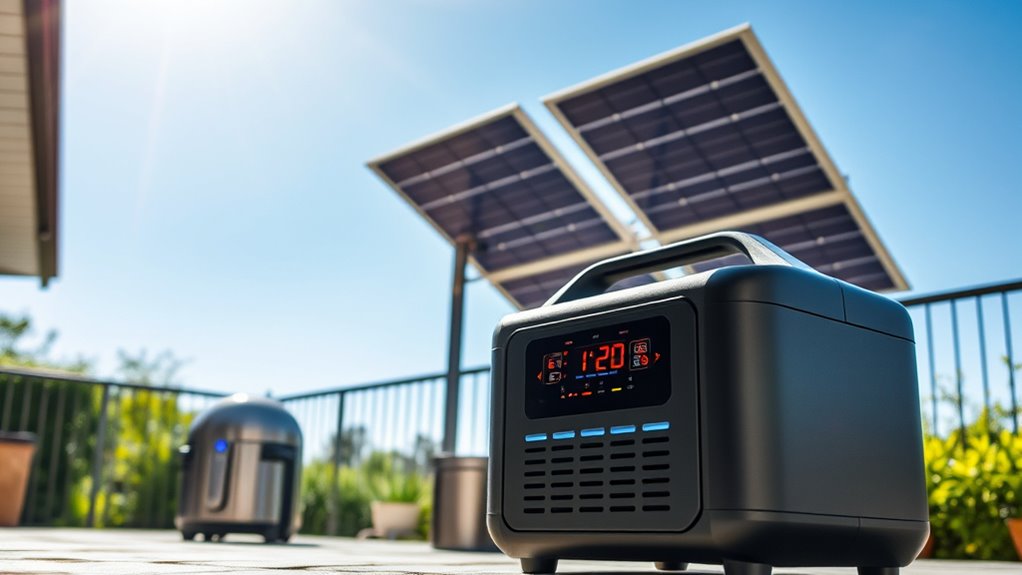
Choosing a solar generator compatible with an air fryer starts with the appliance’s running wattage, not the generator’s headline battery size. Among these five, I rank the Jackery HomePower 3600 Plus first for its ample output and 3,584Wh capacity, the EBL 2400W as the value-minded bundle with a panel included, and the Anker SOLIX C1000 Gen 2 for buyers who want a more portable station with rapid recharging.

Get kitchen gear delivered free with Prime
- Fast, free delivery on millions of items
- Prime Video, Amazon Music and more included
- Member-only deals all year
The tradeoff is straightforward: bigger batteries can sustain longer cooking sessions but are heavier and take more space, while compact models are easier to move but give you less stored energy. Solar panels also replenish a battery over time; they do not automatically make an air fryer run continuously. I compare these options by output headroom, usable capacity for cooking, included solar equipment, portability, and the compromises that matter for real meal planning.
Complete the kit


Key Takeaways
- The Jackery HomePower 3600 Plus leads for extended air-fryer use because its 3,600W output and 3,584Wh battery provide the most balanced high-capacity cooking setup here.
- The EBL 2400W combines 2,400W output and a 1,843.2Wh LiFePO4 battery with a 200W panel, but its 55-pound station is the heaviest option listed.
- The Anker SOLIX C1000 Gen 2 recharges especially quickly from AC power and offers 2,000W output, though its 1,024Wh battery is better for shorter cooking sessions.
- The Jackery Solar Generator 1000 v2 is the portable choice for smaller or shorter air-fryer jobs, but its 1,500W output may not suit higher-wattage appliances.
- The Jackery HomePower 3000 offers 3,072Wh and 3,600W output with two panels, yet its listed nine-hour solar charge to 80% makes solar replenishment slower than its AC charging.
| Jackery HomePower 3600 Plus Portable Power Station with 2x 200W Solar Panels |  | Best Overall for Longer Air-Fryer Sessions | Battery capacity: 3,584Wh; expandable to 21kWh per unit | AC output: 3,600W; 7,200W in parallel | Battery type: LFP with ceramic membrane | VIEW ON AMAZON | See Our Full Breakdown |
| Jackery HomePower 3000 Portable Power Station with Two 200W Solar Panels |  | Best for Air Frying During Outages | Battery capacity: 3,072Wh | AC output: 3,600W | Surge output: 7,200W | VIEW ON AMAZON | See Our Full Breakdown |
| EBL 2400W Portable Power Station with 200W Solar Panel |  | Best Value Bundle for Camp Cooking | Battery capacity: 1,843.2Wh | Battery type: LiFePO4 | Output wattage: 2,400W | VIEW ON AMAZON | See Our Full Breakdown |
| Anker SOLIX C1000 Gen 2 Portable Power Station |  | Best for Fast Recharging and Portability | Battery capacity: 1,024Wh | Output wattage: 2,000W | Peak output: 3,000W | VIEW ON AMAZON | See Our Full Breakdown |
| Jackery Solar Generator 1000 v2 with 200W Solar Panel |  | Best Compact Kit for Short Cooking Sessions | Battery capacity: 1,070Wh | Battery type: LFP | AC output: 1,500W | VIEW ON AMAZON | See Our Full Breakdown |
| solar generator compatible with air fryer | Battery capacity | Battery type | AC output | Weight |
|---|---|---|---|---|
| Jackery HomePower 3600 Plus Po | 3,584Wh; expandable to 21kWh per unit | LFP with ceramic membrane | 3,600W; 7,200W in parallel | — |
| Jackery HomePower 3000 Portabl | 3,072Wh | LiFePO4 | 3,600W | — |
| EBL 2400W Portable Power Stati | 1,843.2Wh | LiFePO4 | — | 55 pounds |
| Anker SOLIX C1000 Gen 2 Portab | 1,024Wh | — | — | 11.3kg |
| Jackery Solar Generator 1000 v | 1,070Wh | LFP | 1,500W | 23.8 pounds |
More Details on Our Top Picks
Jackery HomePower 3600 Plus Portable Power Station with 2x 200W Solar Panels
I put the HomePower 3600 Plus first because it offers the strongest combination of cooking headroom and stored energy in this group: 3,600W AC output paired with a 3,584Wh battery. That makes it the most accommodating option for air fryers with higher listed wattage and for buyers who want to cook more than one short batch between recharges. Its included pair of 200W panels gives it a solar starting point, while hybrid AC+DC charging is listed at two hours.
Compared with the HomePower 3000, this model has a somewhat larger battery and a stated 6,000-cycle lifespan, while both deliver 3,600W AC output. The HomePower 3000 lists a faster 1.7-hour hybrid recharge and a UPS function, so it may suit outage-focused buyers better. Against the EBL 2400W, the Jackery provides substantially more battery capacity and output, but the EBL is a less imposing cooking-power option with a panel included.
The wheels and telescoping handle are useful because a 3,584Wh system is not a casual carry, even with a luggage-style design. I would still treat the panels as a way to replenish energy gradually rather than a guarantee of uninterrupted cooking. The power station and panels ship separately, and the high capacity can be more than a buyer needs for occasional fries or a small countertop fryer.
Pros:- 3,600W AC output offers generous headroom for many air fryers.
- 3,584Wh battery supports longer cooking use than the smaller-capacity options here.
- Two 200W solar panels are included, with four charging methods listed.
- Wheels and telescoping handle make moving the large station easier.
Cons:- Large capacity and wheeled format are excessive for buyers seeking a compact camping station.
- The power station and solar panels ship separately and may arrive at different times.
- Solar charging is listed at four hours, subject to suitable sunlight and conditions.
Best for: Buyers with a higher-wattage air fryer who want extended cooking capacity, solar panels included, and a wheeled station for RV or home use.
Not ideal for: People prioritizing a light, easy-to-carry setup or only powering a small fryer for an occasional short session.
- Battery capacity:3,584Wh; expandable to 21kWh per unit
- AC output:3,600W; 7,200W in parallel
- Battery type:LFP with ceramic membrane
- Solar panels:2 × 200W included
- Recharge time:2 hours hybrid AC+DC; 2.5 hours AC/gas; 4 hours solar
- Battery lifespan:6,000 cycles / 10 years
- Voltage:120V; 240V in parallel
- Shipping:Power station and panels ship separately
Our verdict“I rank the HomePower 3600 Plus first for buyers who want the most well-rounded mix of air-fryer output headroom, battery capacity, and included solar equipment.”
Jackery HomePower 3000 Portable Power Station with Two 200W Solar Panels
The HomePower 3000 is my outage-oriented pick: it pairs a 3,072Wh LiFePO4 battery with 3,600W AC output and a UPS that switches within 20 milliseconds for supported devices. The output is ample for many air fryers, while the battery can support longer cooking than the Anker C1000 or Jackery 1000 v2. Two 200W solar panels are part of the bundle, and the station includes a TT-30 RV port alongside its other connection types.
Compared with the top-ranked HomePower 3600 Plus, this model has less capacity and a shorter listed cycle-life threshold, but its hybrid recharge time is faster at 1.7 hours. It also adds a specific UPS switching claim that matters more for keeping supported electronics running through an outage than for the fryer itself. The EBL 2400W is easier to understand as a lower-output alternative, but its 1,843.2Wh battery is much smaller.
Solar refill is the main compromise: the supplied panels are listed as taking nine hours to reach 80%, so this is not the quick-recharge choice for a cloudy day or a fast turnaround between meals. Buyers should also plan for a substantial home or RV station rather than a light carry. Separate shipments can mean the generator and panels do not arrive together.
Pros:- 3,600W AC output supports a broad range of appliance loads.
- 3,072Wh LiFePO4 battery provides substantial stored energy.
- UPS switches within 20ms for supported connected devices.
- Two 200W solar panels and a TT-30 RV port are included.
Cons:- Solar charging to 80% is listed at nine hours with the included panels.
- The power station and panels may arrive in separate packages.
- Its capacity and feature set may be more than a casual fryer user needs.
Best for: Households or RV owners who want high AC output, a UPS feature, a large battery, and included panels for backup cooking and essential devices.
Not ideal for: Buyers who need the quickest solar refill, a compact station, or a generator mainly for one brief air-fryer session.
- Battery capacity:3,072Wh
- AC output:3,600W
- Surge output:7,200W
- Battery type:LiFePO4
- UPS switching:≤20ms
- Solar panels:2 × 200W included
- Recharge time:1.7 hours hybrid AC/DC; 2.2 hours AC
- Battery cycle life:4,000 cycles to 70% capacity
Our verdict“I recommend the HomePower 3000 to buyers who value outage support and high output more than fast solar replenishment.”
EBL 2400W Portable Power Station with 200W Solar Panel
The EBL 2400W makes a persuasive middle ground for buyers who want a panel in the package without stepping up to a 3,000Wh-plus system. Its 2,400W output gives it more stated AC headroom than the Anker C1000 and Jackery 1000 v2, while the 1,843.2Wh LiFePO4 battery stores more energy than either compact station. For an air fryer whose rated draw fits within that output, this mix can support practical cooking away from home.
Its 200W monocrystalline panel is listed at up to 23.5% conversion efficiency, and the station accepts AC, solar, and combined charging. That is a useful package advantage over the Anker SOLIX C1000 Gen 2, which lists faster recharging but does not include a panel in the supplied description. Compared with the HomePower 3600 Plus, EBL offers less output and capacity, but its setup is less oversized for buyers who do not need a near-home-backup scale battery.
The defining drawback is weight: 55 pounds makes this a station to load into a vehicle, not a comfortable option to carry far. The product description says it can charge up to 12 devices, while the specifications identify four AC ports and additional USB ports; that broad port count is helpful for a group, but it does not change the limit imposed by total output. The solar panel ships separately, so package timing may vary.
Pros:- 2,400W output exceeds the listed output of both compact stations in this roundup.
- 1,843.2Wh LiFePO4 battery provides useful capacity for cooking and other gear.
- A 200W monocrystalline solar panel is included.
- AC, solar, and combined charging options add flexibility.
Cons:- At 55 pounds, it is the heaviest option listed.
- The solar panel ships separately from the power station.
- Its 200W panel and unspecified solar recharge time make planning a full refill less certain.
Best for: Campers and outdoor cooks seeking a mid-capacity station with an included 200W panel and more output headroom than the compact options.
Not ideal for: Anyone who needs to carry a generator over a distance or wants the longer runtime of a 3,000Wh-class system.
- Battery capacity:1,843.2Wh
- Battery type:LiFePO4
- Output wattage:2,400W
- AC ports:4
- Total outlets:12 listed
- Solar panel:200W, up to 23.5% conversion efficiency
- AC charging time:1.6–2 hours
- Weight:55 pounds
Our verdict“I see the EBL as the practical bundle choice for buyers who want stronger-than-compact output without moving up to a much larger Jackery system.”
Anker SOLIX C1000 Gen 2 Portable Power Station
The Anker SOLIX C1000 Gen 2 is the compact, quick-turnaround option in this ranking. It delivers 2,000W output from a 1,024Wh battery and can recharge from AC in 49 minutes, according to the supplied specifications. That fast refill is useful when an air-fryer meal is only one part of a camping or outage setup and the station can be plugged back in between uses. Its 600W maximum solar input is also higher than the 200W panel rating supplied with several competing bundles, though a compatible panel setup is needed.
Compared with the EBL 2400W, the Anker is much lighter at 11.3kg and recharges faster from AC, but it offers less output and roughly half the battery capacity. The Jackery 1000 v2 is similarly suited to smaller jobs, though its AC output is lower at 1,500W and it comes with a 200W panel. For air fryers with a high rated wattage or for repeated batches, I would step up to the EBL or one of the larger HomePower systems.
Anker adds a UPS with under-10ms switchover and a battery rated to retain at least 80% capacity after 4,000 cycles. One detail needs checking before purchase: the listing says nine outlets in the specifications but 10 ports in the description. Solar charging also depends on arranging compatible input equipment. The 1,024Wh capacity keeps this a better fit for short cooking sessions than long periods of appliance use.
Pros:- 2,000W output provides more headroom than the Jackery 1000 v2.
- 49-minute AC recharge can reduce downtime between uses.
- Up to 600W solar input supports a higher-wattage compatible setup.
- UPS switchover is under 10ms; battery is rated for 4,000 cycles to at least 80% capacity.
Cons:- The 1,024Wh battery is smaller than the EBL and both large Jackery models.
- The stated port count conflicts: nine outlets in specifications versus 10 ports in the description.
- Solar charging requires a compatible setup, which is not listed as included.
Best for: Buyers who want a comparatively portable station, rapid AC recharging, and enough output for an air fryer whose rated wattage is within 2,000W.
Not ideal for: People planning repeated or lengthy cooking sessions, or those who want a solar panel included in the described package.
- Battery capacity:1,024Wh
- Output wattage:2,000W
- Peak output:3,000W
- AC recharge:49 minutes
- Solar input:Up to 600W; 60V maximum
- Solar recharge:1.8 hours
- UPS switchover:Under 10ms
- Weight:11.3kg
Our verdict“I recommend the C1000 Gen 2 for buyers who value portability and quick AC recharge more than long air-fryer runtime.”
Jackery Solar Generator 1000 v2 with 200W Solar Panel
The Jackery Solar Generator 1000 v2 is the easiest recommendation here for buyers who want a defined portable kit rather than a high-capacity backup system. It pairs a 1,070Wh LFP battery with 1,500W AC output and a 200W solar panel. At 23.8 pounds, it is easier to handle than the 55-pound EBL and much less imposing than either HomePower model. For a modest air fryer whose rated wattage stays below the station’s output, it can make sense for short outdoor meals.
Against the Anker C1000 Gen 2, the Jackery includes a panel and has slightly more battery capacity, but it offers 500W less AC output. Its one-hour emergency charging mode is also conditional: buyers must enable it in the app, while the default full-charge time is 1.7 hours. The Anker’s listed 49-minute AC charge is simpler on paper, while its higher output gives it more room for a fryer near the Jackery’s ceiling.
Solar charging is a slower process: the included 200W panel is listed as reaching 80% in six hours. The 1,500W output limit is the key reason this ranks fifth, not a lack of portability or useful features. A buyer should check the air fryer’s rated wattage and avoid assuming its surge rating means it can run a fryer rated above the continuous AC output. The station and panel ship separately as well.
Pros:- The 1,070Wh LFP battery offers more capacity than the Anker C1000 Gen 2.
- A 200W solar panel is included.
- At 23.8 pounds, it is easier to carry than the larger stations.
- App controls provide emergency and quieter charging modes.
Cons:- 1,500W AC output is the lowest among these five options.
- One-hour AC charging requires emergency charging to be enabled in the app.
- Solar charging to 80% is listed at six hours with the included panel.
Best for: Campers and occasional outdoor cooks who want an included panel, moderate portability, and an air fryer that draws no more than 1,500W.
Not ideal for: People with a higher-wattage fryer, frequent long cooking sessions, or a need for fast solar replenishment.
- Battery capacity:1,070Wh
- Battery type:LFP
- AC output:1,500W
- Surge peak:3,000W
- Weight:23.8 pounds
- Solar panel:200W included
- AC ports:3 pure sine wave
- Solar charging:80% in 6 hours with a 200W panel
Our verdict“I would choose the Jackery 1000 v2 for light, occasional air-fryer use when portability and an included panel matter more than output headroom.”
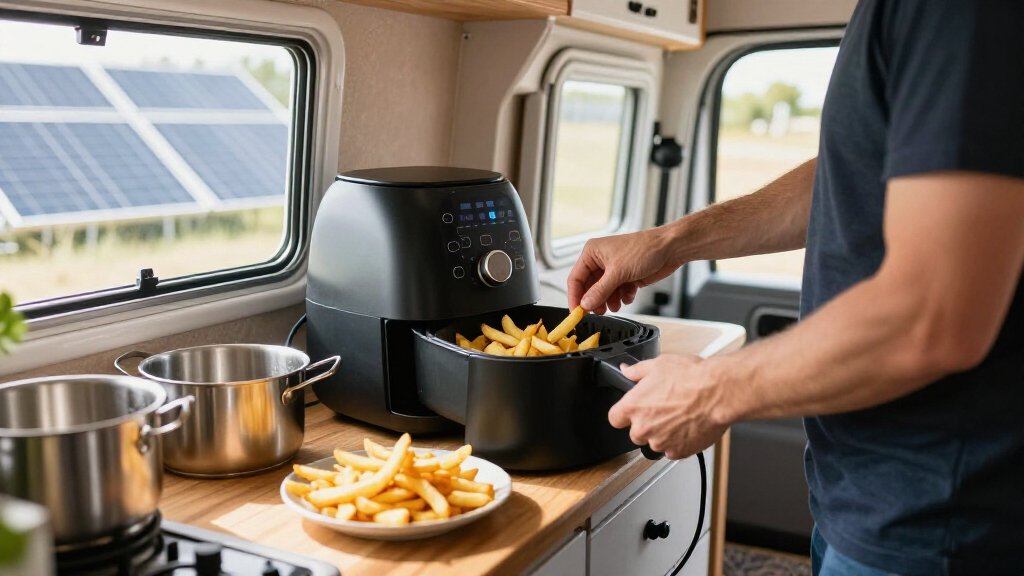
How We Picked
I ranked these generators around a specific job: supplying an air fryer with stable AC power and enough stored energy to finish a meal without forcing buyers into an oversized setup. I gave the most weight to continuous AC output, since a generator must meet the fryer’s running wattage, and to battery capacity, which determines how long it can supply that load. Surge ratings can help with brief startup demand, but they do not replace adequate continuous output.
I also compared solar equipment and recharge information, because a panel’s inclusion is useful only if the buyer understands the expected refill time and setup. Portability mattered too: a heavy station may suit an RV or home backup space but be inconvenient to carry to a picnic table. Finally, I considered practical tradeoffs such as charging controls, UPS features, listed port-count inconsistencies, separate shipments, and cycle-life claims. I did not assume an air fryer’s wattage; buyers should check its label or manual against the generator’s AC output before choosing.
| solar generator compatible with air fryer | Battery type |
|---|---|
| Jackery HomePower 3600 Plus Po | LFP with ceramic membrane |
| Jackery HomePower 3000 Portabl | LiFePO4 |
| EBL 2400W Portable Power Stati | LiFePO4 |
| Anker SOLIX C1000 Gen 2 Portab | — |
| Jackery Solar Generator 1000 v | LFP |
Factors to Consider When Choosing Solar Generator Compatible With Air Fryers
I would choose a generator by checking the air fryer’s label first, then matching that load to the station’s AC output and battery capacity. Solar input affects how the battery is replenished; it does not raise the generator’s AC output limit.Check the fryer’s rated wattage against continuous output
Find the air fryer’s wattage on its product label or in its manual and compare it with the generator’s stated AC output. Leave some headroom rather than choosing a station right at the fryer’s rating, especially if you may run other appliances at the same time. In this lineup, the Jackery 1000 v2 is rated at 1,500W, Anker at 2,000W, EBL at 2,400W, and both large HomePower stations at 3,600W. Surge figures describe brief peaks; I would not use them as a substitute for enough continuous output.
Estimate cooking time from battery capacity
Output tells you whether a generator can supply the fryer’s power demand, while watt-hours shape the likely runtime. A simple starting estimate is battery capacity divided by the fryer’s wattage, but real use will be lower because conversion losses and operating conditions affect usable energy. A 1,024Wh or 1,070Wh station suits shorter cooking use better than a 3,072Wh or 3,584Wh station. If you plan several batches, add capacity rather than relying on a peak-watt number.
Treat solar panels as recharge equipment
Panels refill a generator when sunlight and setup conditions allow; they do not guarantee that an air fryer can cook directly from solar power at its full draw. The EBL includes one 200W panel, while the two larger Jackery bundles list two 200W panels. Anker supports up to 600W of solar input but does not list a panel as included in the supplied description. Compare stated solar charge times, panel input limits, and compatibility, and plan for slower charging when sunlight is limited.
Match portability to where you will cook
A compact unit is easier to move from a vehicle to a campsite, but it usually carries less energy. Anker lists a weight of 11.3kg; the Jackery 1000 v2 is 23.8 pounds, while EBL is 55 pounds. The HomePower 3600 Plus adds wheels and a telescoping handle to ease movement, but it remains a larger system. If the generator will stay in an RV or home, capacity may matter more than hand-carrying weight.
Check charging modes, outlets, and purchase details
Fast AC charging can reduce the wait between cooking sessions: Anker lists 49 minutes, while the Jackery 1000 v2 lists one hour only with its app-enabled emergency mode. Consider UPS switching if the same station will support suitable electronics during an outage, but do not treat that feature as an air-fryer performance measure. Check the available AC outlets and the fryer plug, and note listing details that need clarification, such as Anker’s conflicting port count. Bundled panels and stations may ship separately.
Frequently Asked Questions
What size solar generator do I need to run an air fryer?
I would start with the fryer’s rated wattage and choose a generator whose continuous AC output is comfortably higher. For example, the Jackery 1000 v2 is listed at 1,500W, while the Anker provides 2,000W and the larger options offer 2,400W or 3,600W. Then select battery capacity based on how many batches you expect to cook; output compatibility alone does not determine runtime.
Can a solar panel run an air fryer while it is cooking?
These product details describe panels as a way to charge the power station, not as a promise that sunlight alone will continuously supply an air fryer’s full load. The generator’s inverter and stored battery energy handle the AC appliance, while solar input can replenish the battery under suitable conditions. I would plan around the station’s battery and treat panel charging as a way to extend use or restore energy over time.
Which option is best for a higher-wattage air fryer?
Among these five, the Jackery HomePower 3600 Plus and HomePower 3000 have the highest listed AC output at 3,600W. The EBL follows at 2,400W, then Anker at 2,000W and the Jackery 1000 v2 at 1,500W. Match the exact fryer rating to the generator’s continuous output and leave room for any other device running at the same time.
How long can a solar generator power an air fryer?
Runtime depends on the fryer’s actual wattage, how long it operates, the generator’s usable battery energy, and conversion losses. Battery capacity gives a useful comparison—the HomePower 3600 Plus has 3,584Wh, while Anker has 1,024Wh—but it is not a guaranteed cooking-time figure. I would use the fryer’s rating for a rough estimate and allow for real-world losses rather than planning to use every listed watt-hour.
Does a larger wattage rating mean longer air-fryer runtime?
No. The wattage rating tells you how much power the generator can deliver at a given time, while battery capacity in watt-hours is the more useful indicator of how long it may run a load. A generator can have ample output but a smaller battery, as the Anker illustrates, or combine high output with a large battery, as the HomePower models do. For an air fryer, check both numbers.
Conclusion
For buyers who want the strongest all-around cooking setup, I would choose the Jackery HomePower 3600 Plus for its 3,600W output, 3,584Wh battery, and two included panels. If outage support is a priority, the HomePower 3000 adds UPS switching and still offers 3,600W output, though its listed solar refill to 80% takes nine hours. Campers looking for a panel bundle at a more moderate capacity can choose the EBL 2400W, provided its 55-pound weight works for their plans.
For shorter sessions and easier handling, I would narrow the choice to the Anker SOLIX C1000 Gen 2 or Jackery 1000 v2. Anker suits buyers who favor fast AC recharge and 2,000W output; Jackery is the more complete compact solar kit but has a 1,500W output ceiling. Before ordering, verify the air fryer’s rated wattage, decide how many batches the battery must support, and confirm whether the solar equipment and station arrive together.
Halloween Picks
halloween
As an affiliate, we earn on qualifying purchases.