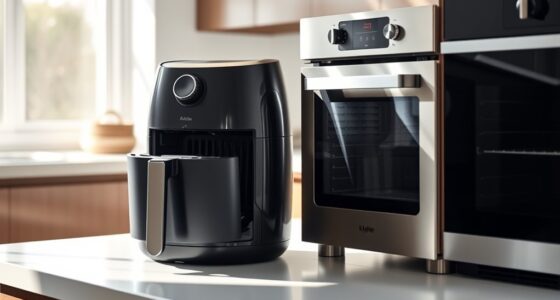
For a small kitchen, the choice between a compact single-basket air fryer and a slim, vertical air fryer comes down to which space constraint matters most. Compact models tend to have a simple shape and a smaller cooking basket, making them easier to tuck into a cupboard or bring out when needed. Slim models take up less width and may provide more usable capacity by stacking cooking space vertically, but they can be taller and harder to fit beneath cabinets.

Get kitchen gear delivered free with Prime
- Fast, free delivery on millions of items
- Prime Video, Amazon Music and more included
- Member-only deals all year

Chefman Compact Air Fryer 3.5 QT
- ✔ Capacity: 3.5 quarts
- ✔ Dimensions: 14.29 × 9.64 × 8.46 inches
- ✔ Maximum temperature: 450°F

CHEFMAN 2 Qt Mini Air Fryer
- ✔ Capacity: 2 quarts
- ✔ Dimensions: 10 × 10 × 8.3 inches
- ✔ Maximum temperature: 400°F

Cuisinart AIR-80 Compact Basket Air Fryer
- ✔ Capacity: 2.6 quarts
- ✔ Dimensions: 10.5 × 12 × 7 inches
- ✔ Maximum temperature: 400°F
The difference matters in daily use: a small, easy-to-store appliance suits occasional cooking and tight cupboards, while a narrow model can make better use of a permanently available counter spot. Capacity, clearance, cleaning, and price vary by model, so compare actual dimensions and basket layout before buying. Choose the compact option if storage and simple handling come first; choose the slim option if counter width is your main limit and you cook larger portions.
At a Glance
| Criteria | Compact single-basket air fryer | Slim, vertical air fryer | Winner |
|---|---|---|---|
| Counter footprint | Often small overall, though basket-style units can be wide or deep | Narrower front-to-back or side-to-side in many designs, but taller | Depends |
| Storage and handling | Usually easier to lift and store, depending on weight and shape | May be awkward to put away if its height or weight is substantial | A |
| Cooking capacity | Best suited to one or two people or smaller batches | Can offer more cooking area through stacked trays or vertical layout | B |
| Cooking flexibility | Straightforward single-basket cooking | Some models separate foods across levels; results can vary by position | B |
| Cabinet clearance | Often shorter, but lid and ventilation clearance still matter | Height may conflict with upper cabinets or overhead shelves | A |
| Cleaning | Fewer parts and a familiar basket format | More trays or racks can mean more washing | A |
| Value | Often lower-cost; pays off for occasional use and modest portions | Higher price is justified when extra capacity or narrow width solves a real constraint | Depends |
Chefman Compact Air Fryer 3.5 QT
The Chefman 3.5-quart is our leading pick for a small kitchen where compact should still mean useful for more than one small snack. Its listed width is just 9.64 inches, yet the basket holds 3.5 quarts and the manufacturer says it can cook for up to four people. That combination gives it an edge over the 2-quart CHEFMAN when we want to avoid splitting a meal into several rounds. The tradeoff is depth: at 14.29 inches deep, it may project beyond a shallow counter or be awkward to tuck away, so measure front to back before buying.Four functions—air fry, bake, dehydrate, and frozen—make this model more flexible than the simpler 2-quart CHEFMAN. Its frozen setting starts at lower heat and then raises the temperature, a useful convenience for freezer staples when we want a dedicated program instead of guessing at a starting point. A 450°F maximum also exceeds the 400°F limit listed for the other two picks. Those features make it the better fit for cooks who plan to use an air fryer often and want it to cover more than crisping snacks. The 1300-watt rating and larger basket may also be a less appealing match for someone watching available outlet capacity or prioritizing the smallest possible appliance.Cleanup is considered too: the ceramic nonstick basket and crisper rack are listed as top-rack dishwasher safe, and the coating is described as PFAS-free. Compared with the Cuisinart AIR-80, this Chefman offers more listed functions and a narrower body, while the Cuisinart adds a window for checking food. This is the strongest all-rounder of the three if the extra depth fits. If your counter is very short or you cook only one small portion at a time, the 2-quart model is easier to justify.
Pros:
- Largest capacity in this comparison at 3.5 quarts
- Narrow listed width of 9.64 inches
- Four functions, including a dedicated frozen-food setting
- Ceramic nonstick basket and rack are top-rack dishwasher safe
Cons:
- At 14.29 inches deep, it may not suit shallow counters
- Larger capacity means a bigger appliance than the 2-quart CHEFMAN
- No viewing window is listed
Best for: Households that want a narrow appliance with room for larger batches, plus multiple cooking functions.
Not ideal for: Buyers with shallow counters, very limited storage, or a routine built around single small portions.
Bottom line: Choose the Chefman 3.5-quart if you want the most cooking flexibility and capacity in a narrow design and have room for its depth.
“Choose the Chefman 3.5-quart if you want the most cooking flexibility and capacity in a narrow design and have room for its depth.”
CHEFMAN 2 Qt Mini Air Fryer
When the main requirement is leaving room for everything else, the CHEFMAN 2-quart is the most compact choice in this lineup. Its listed dimensions are 10 inches deep, 10 inches wide, and 8.3 inches high. That gives us a straightforward footprint to compare against a crowded counter, and its small frame is described as suitable for cabinet storage. Compared with the 3.5-quart Chefman, this model gives up capacity and cooking functions; in return, it is easier to fit into a kitchen where a larger basket would become a permanent obstruction.The 2-quart square basket is intended for meals for one or two people. The square shape uses its space efficiently, but it cannot make a small basket serve a group without extra batches. Digital touch controls let us set time and temperature up to 400°F, and a shake reminder signals when to move food during cooking. That reminder is a helpful cue for someone new to air frying, while the Cuisinart AIR-80 adds a window for visual checks and named presets. We should choose this CHEFMAN if simple portions and compact storage matter more than watching food through a window or using dedicated programs.The nonstick basket and rack are dishwasher safe, and automatic shutoff is listed as a safety feature. At 900 watts, it has the lowest power rating among these picks, which may suit someone looking for a smaller appliance, though the supplied information does not establish comparative cooking times. The limit is clear: this is a focused small-batch fryer, not the most flexible option for varied cooking or multiple servings. If we expect to cook for more people regularly, the 3.5-quart model offers a more practical balance, provided its extra depth fits the counter.
Pros:
- Compact listed dimensions of 10 × 10 × 8.3 inches
- Square 2-quart basket is intended for one or two people
- Digital time and temperature controls up to 400°F
- Shake reminder and dishwasher-safe basket and rack
Cons:
- Small capacity may require multiple rounds for a shared meal
- Fewer cooking functions are listed than on the 3.5-quart Chefman
- No viewing window or named presets are listed
Best for: One- or two-person households and anyone who needs a compact fryer that can be stored between uses.
Not ideal for: Families, batch cooks, or anyone who wants multiple cooking modes or a viewing window.
Bottom line: Pick the CHEFMAN 2-quart when minimizing footprint and storing the appliance easily matter more than batch size.
“Pick the CHEFMAN 2-quart when minimizing footprint and storing the appliance easily matter more than batch size.”
Cuisinart AIR-80 Compact Basket Air Fryer
The Cuisinart AIR-80 earns its place for cooks who would rather see what is happening than rely only on a timer and reminder. Its viewing window lets us monitor food without opening the basket, and the product description lists presets for French fries, wings, and frozen snacks. That makes it more guided than the compact 2-quart CHEFMAN, which offers a shake alert but no listed window or named presets. Its 2.6-quart capacity is still aimed at one or two people, so the Chefman 3.5-quart remains the better choice when we need extra serving room.The Cuisinart includes air fry, roast, and bake functions, plus three air-fry presets. The supplied details refer to four cooking functions in one place but enumerate three; we rely on the clearly named air fry, roast, and bake modes rather than assuming a fourth. At 12 inches wide and 10.5 inches deep, it is not the narrowest option here: both Chefman models list a smaller width. Check the counter’s front-to-back depth and width before choosing, particularly if the appliance will sit beside other equipment.With 1100 watts and a maximum temperature of 400°F, this model sits between the two CHEFMAN options on listed power while matching the 2-quart unit’s temperature ceiling. Its automatic warming mode after cooking may help keep food ready while the rest of a meal comes together, and the toss notification is a useful prompt. The product description mentions dishwasher-safe parts, but does not specify more about their care in the details provided. We would favor this over the 2-quart CHEFMAN if the window and presets matter, while choosing the 3.5-quart Chefman for greater capacity, a higher listed maximum temperature, and more named functions.
Pros:
- Viewing window helps monitor food during cooking
- Presets cover fries, wings, and frozen snacks
- Air fry, roast, and bake functions are listed
- Automatic warming mode and toss notification are included
Cons:
- 12-inch width is greater than either Chefman model’s listed width
- 2.6-quart capacity remains geared toward one or two people
- Supplied product details are inconsistent about the number of functions
Best for: Small households who want a compact basket with a viewing window, presets, and roast and bake modes.
Not ideal for: Buyers who need the narrowest possible appliance, larger batches, or a clearly documented set of dishwasher-safe parts.
Bottom line: Choose the Cuisinart AIR-80 if its window and presets are more useful to you than the extra capacity and narrower width of the top-ranked Chefman.
“Choose the Cuisinart AIR-80 if its window and presets are more useful to you than the extra capacity and narrower width of the top-ranked Chefman.”
As an Amazon Associate we earn from qualifying purchases.
Key Differences
The compact model is the safer choice when the appliance must disappear after use. Its smaller basket and simpler construction usually mean less weight, fewer accessories, and easier washing. The cost of that convenience is batch size: cooking for several people may require multiple rounds, and a crowded basket can reduce how evenly food cooks. In a kitchen where appliances share limited cupboard space, a modest unit that is easy to move can be more useful than a taller model with extra capacity.
The slim model addresses a different problem: a kitchen with little counter width but some vertical room. Its layout can create more cooking area without spreading as far across the counter, which may reduce the need to cook in batches. That benefit is model-specific. Multiple levels may cook differently, and more trays add cleanup. Height is also a real constraint beneath cabinets, so check the appliance’s full dimensions and the clearance its manual requires. Paying more makes sense when those features match your kitchen and meal sizes; otherwise, the compact model is better value.
Detailed Comparison
Counter footprint (moderate difference)
A compact air fryer is often smaller overall, but its basket shape may still occupy considerable width or depth. A slim model can fit more easily along a narrow counter, though its height can make it unsuitable beneath low cabinets. The winner depends on the exact counter dimensions: measure the space, including room for ventilation and opening the basket or trays. This is a moderate difference because the wrong shape can make either appliance inconvenient.
Storage and handling (Compact single-basket air fryer wins — moderate)
Compact models generally have an advantage when the air fryer has to be lifted into a cupboard after each use. They tend to be simpler to carry and have fewer loose accessories. A slim model may be narrow but still tall or heavy, making storage less convenient than its footprint suggests. For kitchens where counter space is shared, the compact option wins by a moderate margin; check product weight and dimensions, since the names alone do not guarantee easy handling.
Cooking capacity (Slim, vertical air fryer wins — moderate)
A slim vertical model may provide more space for food, especially if it has multiple trays, while a compact single-basket model is better matched to small portions. Nominal capacity does not tell the whole story: tray area and the ability to spread food in a single layer affect how much can cook well at once. The slim model wins for larger meals by a moderate margin when its layout suits the food. For one or two people, the compact basket may be ample and avoid unnecessary bulk.
Cooking flexibility (Slim, vertical air fryer wins — minor)
A basic compact basket is easy to understand: place food in the basket, set the controls, and shake or turn food as needed. Slim designs with separate levels can let users cook different items in one appliance, which is useful when a meal needs more than one component. But food on different levels may need rotation or different timing. The slim option has a minor edge for varied meals, while the compact option remains easier for straightforward snacks and small portions.
Cabinet clearance (Compact single-basket air fryer wins — major)
The compact model often wins because it is usually shorter, which makes it easier to place under cabinets. A tall slim air fryer may need open space above it for safe ventilation and access, even if it takes little counter width. Check the manufacturer’s specified clearance and measure the full appliance height before choosing. This can be a major difference in a kitchen with low shelves: a model that cannot sit safely in its intended spot is a poor fit regardless of capacity.
Cleaning (Compact single-basket air fryer wins — minor)
A compact single-basket model usually has fewer pieces to wash and less surface area to scrub. Slim models with racks or stacked trays can make it easier to separate foods, but every removable part adds cleanup. Nonstick coatings, dishwasher guidance, and access to corners differ by model, so check the care instructions rather than assuming every component is dishwasher-safe. The compact option wins by a minor to moderate margin for people who prioritize quick cleanup.
Value (moderate difference)
Compact air fryers often cost less, and that lower price is worthwhile when the user cooks small portions and stores the appliance between meals. A slim model can justify a higher price if its additional capacity prevents repeated batches or its shape fits a narrow counter that a wider appliance cannot use. The value winner depends on actual use: paying extra for unused levels or capacity is poor value, while paying more to solve a daily space or meal-size problem can be sensible.
Compact single-basket air fryer: Pros and Cons
Pros:
- Often easier to lift, store, and clean
- Usually has a simple basket and straightforward controls
- Often costs less than models with larger or more complex layouts
- A practical size for snacks and meals for one or two people
Cons:
- Smaller basket may require cooking in batches
- Can still take up substantial width or depth on a crowded counter
- Less suited to cooking several foods at once
Slim, vertical air fryer: Pros and Cons
Pros:
- Narrow layout may fit a counter with limited width
- Can provide more cooking area in a taller design
- Some models allow different foods to cook on separate levels
Cons:
- Height may prevent use beneath cabinets or shelves
- Extra trays and racks can add washing and storage
- May be harder to move or put away despite a narrow footprint
- Higher cost may go to waste if the extra capacity is rarely used
Who Should Choose What
Choose Compact single-basket air fryer if:
- You cook mainly for one or two people and modest portions.
- You need to store the appliance after each use and want it to be easy to move.
- Your kitchen has limited vertical clearance beneath cabinets.
- You prefer a simple basket with fewer removable parts to wash.
Choose Slim, vertical air fryer if:
- Your counter is narrow but has enough height and ventilation clearance.
- You regularly cook larger portions and want to reduce batch cooking.
- Separate trays or levels would help you cook different foods together.
- You have a permanent counter space that fits the model’s full height and depth.
Skip both if: Skip both if you have no safe counter spot with the required clearance and cannot store a hot appliance after use; a smaller countertop cooker or another cooking method may fit your kitchen better.
Value for Money
Compact models are usually the better value for people who cook small portions, use the appliance occasionally, or need to store it away. Their lower price and simpler cleanup matter more than capacity that may go unused. A slim model earns its higher price when its narrower footprint fits a specific counter and its extra cooking area regularly replaces another batch. Pay more only after confirming that the height, clearance, tray layout, and cleaning routine work in your kitchen. Compare actual dimensions and usable cooking surface, not just the product label or advertised capacity.
Final Verdict
For most small kitchens where the air fryer must be stored between uses, choose a compact single-basket model. It is generally easier to handle, simpler to clean, and a better match for one or two people. Choose a slim vertical model when counter width is the main constraint and you can spare the height, or when its extra capacity will be used often enough to justify the added cost and cleanup.
The deciding factor is the shape of the space you have: measure width, depth, height, and the clearance required for operation. If the compact model fits and your portions are small, it is the stronger value. If a narrow counter and larger meals describe your routine, the slim model is the more practical purchase.
Frequently Asked Questions
Which air fryer is better for a very small kitchen?
The better fit depends on the available shape of the space. Choose compact if you need to store the appliance in a cupboard or have limited clearance beneath cabinets. Choose slim if counter width is scarce but you have enough vertical space and can leave the unit out safely.
Does a slim air fryer always have more capacity?
No. Designs vary, and advertised capacity does not guarantee more usable cooking area. Compare the basket or tray dimensions and consider whether food can spread out without crowding. A larger stated volume may not suit the foods you cook.
Is a more expensive slim air fryer worth it?
It can be worth paying more if the narrow design fits your counter and the extra cooking space regularly saves you a batch. If you cook small portions or need to put the appliance away after every use, the added cost and extra parts may bring little benefit.
Can I keep an air fryer under a kitchen cabinet?
Only if the appliance’s instructions allow it and there is enough clearance for heat and airflow. Tall slim models may be a poor fit beneath low cabinets. Check the manual and measure the space before use.