
TL;DR

Get kitchen gear delivered free with Prime
- Fast, free delivery on millions of items
- Prime Video, Amazon Music and more included
- Member-only deals all year
A Livingetc report explains kogei as Japanese objects for everyday use, grounded in regional materials, inherited knowledge and practical human judgment. The approach also depends on networks of specialists, but employment in Japan’s traditional craft industries fell from 288,000 in 1979 to 48,334 in 2022, according to the report.
Livingetc has published a report explaining kogei, a Japanese approach to objects made for everyday use, in which value comes from practical purpose, regional materials and skills passed between generations. The account challenges the idea that such craft is defined simply by hand production or the work of a single artisan, and describes the regional networks behind it as facing a sharp decline in employment.
Tasuku Ogino, executive vice president of Japanese retailer Nakagawa, defines kogei as everyday tools shaped by local ways of life, available materials and makers’ accumulated skills. The report says the concept is distinct from both fine art made primarily to be admired and industrial production centered on uniformity and efficiency. Kogei objects, Ogino says, are used and adapted as lifestyles change.
The distinction is not whether an object is made by hand. Nakagawa’s Hana Fukin kitchen cloth, for example, is woven on machines using kaya, a breathable fabric associated with Nara’s mosquito-net industry. The report says loom operators adjust for humidity and differences between machines; it presents that continuing human judgment, alongside the cloth’s local material and practical use, as central to its connection with kogei.
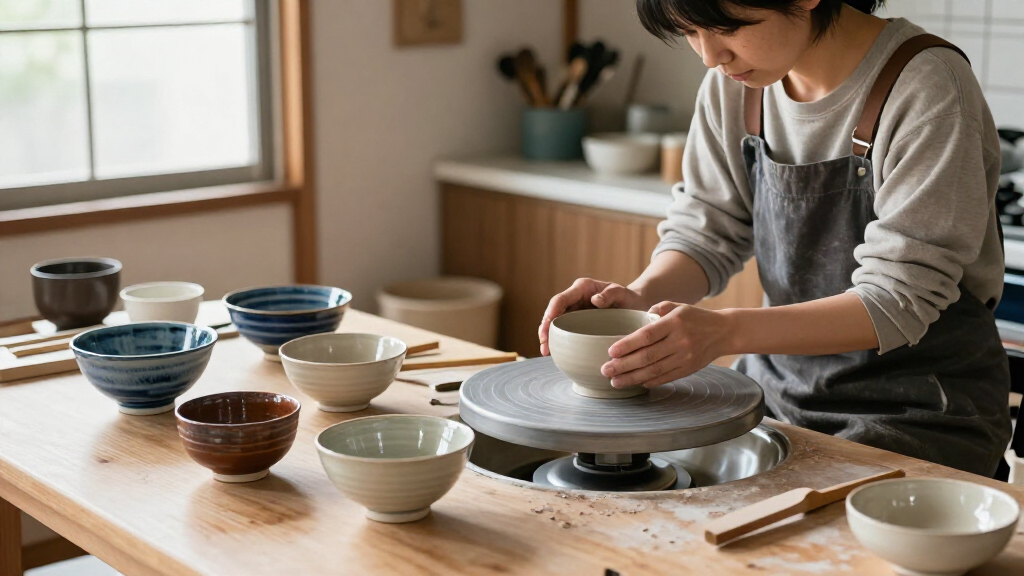
Production is also often shared among specialists. A ceramic object may involve separate workers handling clay, glaze, molds and firing. The report cites figures showing that employment in Japan’s traditional craft industries fell from 288,000 people in 1979 to 48,334 in 2022. It does not provide further detail on how those figures were compiled.
Why Everyday Craft Depends on Regions
Kogei offers a way to understand household objects as more than decoration: their design can reflect local climate, available materials and knowledge built through repeated use. For people arranging a home, that perspective shifts attention from whether an object looks handmade or collectible to how it works, where its materials and methods come from, and how it may be used over time.
The report’s employment figures also point to a wider concern than the loss of individual makers or products. Where a craft relies on a chain of regional specialists, the departure of one group can affect the rest of the production network. Ogino says Nakagawa hopes to pass on the regional ecosystems that support kogei, not just particular objects or techniques. The report does not establish that the employment decline has caused any specific craft to disappear, but it underscores the scale of the pressure described.
As an affiliate, we earn on qualifying purchases.
How Kogei Differs From Handmade Craft
The report says the Japanese term kogei (工芸) belongs to the category of craft, but should not be treated as a synonym for every handmade object. Its account draws on Nakagawa, a company founded in Nara in 1716 that works with more than 800 workshops across Japan, according to the source material.
Japan also recognizes individual master artisans through its Living National Treasures system, the report notes. But it distinguishes that tradition from the collective work behind many objects used in ordinary life. It says the government’s criteria for traditional crafts start with everyday use and lists 244 crafts, with at least one in each of Japan’s 47 prefectures. Those figures describe the list cited in the report; no date for the count is given.
What the Craft Figures Do Not Show
The report gives employment totals for 1979 and 2022, but does not identify the underlying dataset, explain which occupations are included or break down the change by region or craft. It also does not say how many workshops or specialist roles remain active, or whether the fall has continued since 2022. The figures should not be read as a count of kogei makers alone.
The explanation is based substantially on Nakagawa’s account of the term and its work with workshops. It does not provide independent interviews with other makers, researchers or government officials to compare definitions. The report also does not establish that machine production, by itself, qualifies an object as kogei: its description emphasizes local roots, inherited techniques and continuing human judgment together.
The Future of Regional Craft Networks
The source report does not announce a new policy, funding program or specific next milestone for Japan’s craft industries. It presents Nakagawa’s stated aim of sustaining the regional networks behind everyday objects, but gives no timeline or measurement for that work. Readers seeking updates would need further reporting from Nakagawa, relevant craft groups or public agencies on workshop activity, employment and support for training.
For household buyers and designers, the report’s practical takeaway is to look beyond a handmade label: ask what an object is for, which local materials and skills shape it, and how it is produced. Those questions help explain the meaning the report assigns to kogei without assuming that every attractive Japanese-made object shares the same history.
Key Questions
What does kogei mean?
Kogei refers to objects and tools for everyday use shaped by local materials, practical knowledge and makers’ skills, according to Nakagawa’s Tasuku Ogino in the Livingetc report.
Does kogei have to be handmade?
No. The report says hand production is not the defining test. A machine-woven cloth may fit the account of kogei when it is tied to regional materials and methods and human judgment remains part of production.
Is kogei usually made by one artisan?
Not necessarily. The report describes production as often involving multiple specialists, such as workers responsible for clay, glaze, molds and firing in a ceramic-making region.
How many people work in Japan’s traditional craft industries?
The report cites 288,000 people in 1979 and 48,334 in 2022. It does not provide the dataset or a breakdown by occupation, region or individual craft.
Source: rss
Columbus Day / Indigenous Peoples' Day Picks
long weekend sales
As an affiliate, we earn on qualifying purchases.