TL;DR

Get kitchen gear delivered free with Prime
- Fast, free delivery on millions of items
- Prime Video, Amazon Music and more included
- Member-only deals all year
Livingetc has outlined four Japanese tablescaping practices that can be adapted for autumn hosting: combine personal place settings with shared dishes, choose tableware for the person using it, match vessels to the food, and bring in seasonal plates and small accents. The report presents these as design guidance, not as a formal survey or a claim that every Japanese household sets its table the same way.
Livingetc has published four Japanese-inspired tablescaping lessons for autumn hosting, focusing on how personal bowls, shared serving dishes and seasonal ceramics can shape a meal. The advice offers a practical alternative to choosing between fully plated dinners and family-style service, while treating tableware as part of the food and the season.
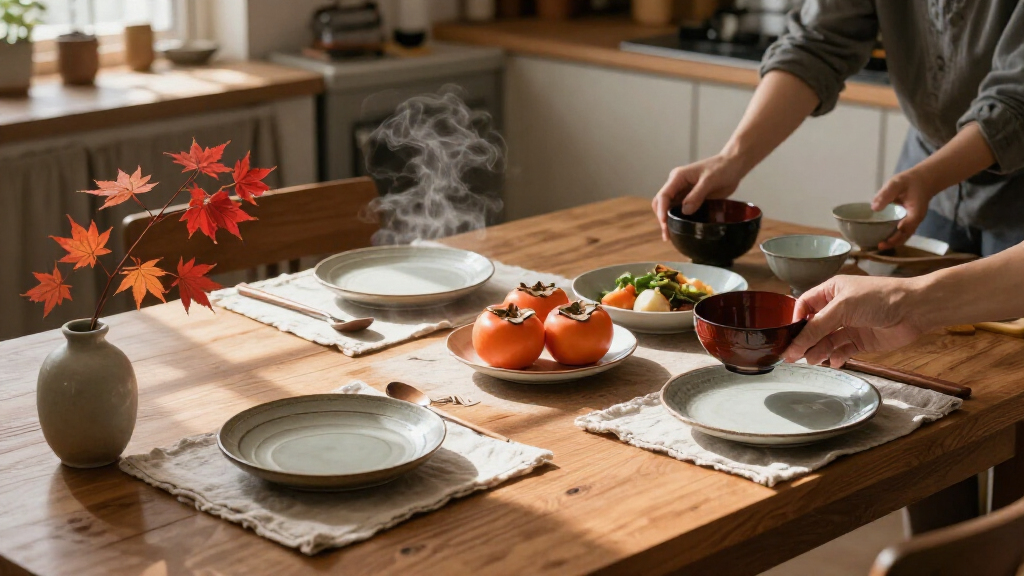
The first suggestion is to combine individual place settings with shared dishes. The report describes an oshiki, or flat tray, arranged for each guest with a rice bowl, soup bowl and small plate. These personal settings sit alongside larger platters in the middle of the table, from which diners serve themselves as the meal continues. The article uses the term meimei no ba for each person’s own place.
Its second lesson is to choose some tableware for the person using it rather than buying a uniformly matched set. The report says family members may have their own rice bowls, or chawan, and chopsticks, or hashi, selected for hand size and preferred feel. That practice can be adapted without requiring a full set of traditional Japanese dishes: individual pieces can make a table feel considered while still working with existing plates and serving ware.
The final two recommendations concern the relationship between a dish and its vessel, and seasonal change. The article describes a Japanese saying that a vessel is the “kimono” of the food, and suggests paying attention to a bowl’s feel and the space around food on a plate. For autumn, it proposes replacing summer glass and white porcelain with warm-toned clay or glazes in persimmon and rust, then adding a small seasonal detail such as a chrysanthemum-shaped chopstick rest or a mame-zara, a small plate.
The recommendations matter to hosts because they connect comfort, function and presentation without requiring a complete table makeover. A personal bowl or a small plate can help guests feel attended to, while shared dishes keep food accessible and make the meal less rigid than a sequence of individually plated courses.
The seasonal approach is also deliberately modest. Rather than changing the whole room, hosts can adjust the vessels and one small accent to mark autumn. The report’s ideas are design guidance, not evidence that these choices guarantee a warmer gathering; their value is in offering concrete ways to make a table more personal and responsive to the meal.
Products Worth Considering

Weber Genesis E-415 4-Burner Propane Gas Grill, Black

Weber Searwood 600 Wood Pellet Smoker Grill, Black

Cuisinart SM-50R 5.5-Quart Stand Mixer, Ruby Red
As an affiliate, we earn on qualifying purchases.
From Personal Trays to Autumn Ceramics
The Livingetc report says its advice draws on autumn tablescapes in Japanese homes and was developed while working with Nakagawa, a craft maker and retailer founded in Nara in 1716. It frames the practices as habits that can transfer to Western dining, rather than presenting them as rules that all households follow.
One historical reference in the piece is Kitaōji Rosanjin, a potter who opened a Tokyo restaurant in 1925 and made vessels for the food served there. The article links that example to the idea that tableware is part of how a dish is experienced. Its seasonal suggestion also extends beyond color: it says Japanese homes may welcome the coming season slightly early through plates, bowls and a small seasonal arrangement, or shitsurai.
“The vessel is the kimono of the food.”
— Livingetc report
Advice, Not a Household Survey
The report does not provide survey data or establish how widely each practice is followed across Japan. Its examples are presented as inspiration drawn from Japanese tablescapes, and the article does not claim that every household uses personal trays or changes dishes in the same way.
It also does not specify a single required shopping list, budget or table layout. The suggestions can be adapted with pieces a host already owns, but how closely a Western setting should reproduce the described customs is left to individual choice.
For hosts planning an autumn meal, the next step is to start with the menu and the people at the table: decide which dishes will be shared, choose personal bowls or utensils where useful, and select vessels that suit the food. A few warm-toned pieces or one seasonal accent can carry the look without replacing every item.
Livingetc’s report does not announce a scheduled follow-up or wider initiative. It presents the four practices as ideas readers can apply to their own tables, with the season and the meal guiding what changes.
Key Questions
What are the four Japanese tablescaping lessons?
The Livingetc report recommends combining personal settings with shared dishes, choosing some tableware for the person using it, treating the vessel as part of the dish, and changing plates or bowls to reflect the season.
What does the report suggest changing for autumn?
It suggests swapping summer glass and white porcelain for warm clay and persimmon- or rust-colored glazes, then adding a small seasonal detail such as a chrysanthemum-shaped chopstick rest or a small plate.
Do hosts need a full set of Japanese tableware?
No. The report presents the ideas as adaptable guidance and does not prescribe a complete set. A host can use existing dishes and add one personal or seasonal piece at a time.
What is an oshiki?
An oshiki is a flat tray used in the report’s example to group an individual diner’s rice bowl, soup bowl and small plate, while shared dishes remain in the middle of the table.
Source: livingetc.com