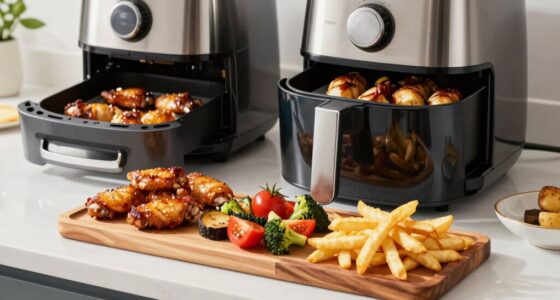
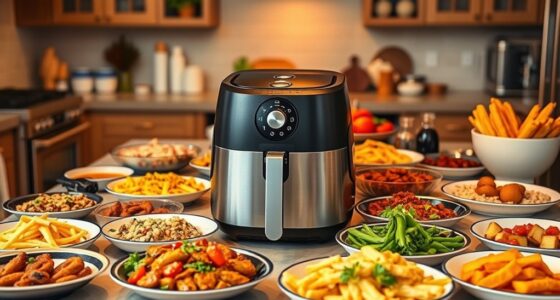
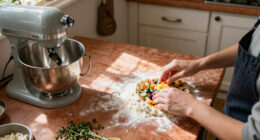
Proof settings in countertop ovens create the perfect environment for dough to rise by maintaining a steady, warm, and humid space. This helps activate yeast, develop gluten, and improve texture, volume, and flavor. They’re especially useful for bread and pizza dough, ensuring consistent results. With adjustable temperature and humidity, these settings make proofing easier and more reliable. Keep exploring to discover how these features can elevate your baking skills even further.

Get kitchen gear delivered free with Prime
- Fast, free delivery on millions of items
- Prime Video, Amazon Music and more included
- Member-only deals all year
Key Takeaways
- Proof settings create optimal warm, humid environments essential for proper dough fermentation and yeast activation.
- They help maintain consistent temperature and humidity, ensuring uniform proofing for better bread quality.
- Bread makers notice proof settings because they influence dough rise, texture, and overall baking results.
- Proofing functions support versatile baking, including pizza dough development and vegetable roasting.
- They help achieve professional-quality loaves with a light, airy crumb and well-developed crust.

Ever wondered how to get perfect baked goods with your countertop oven? One feature that can greatly improve your results is the proof setting. This function is especially handy for bread baking, but its benefits extend beyond just bread. When you activate the proof setting, your oven creates a warm, humid environment that encourages dough to rise properly. This is vital because a well-proofed dough leads to better texture, volume, and flavor in your baked bread. But don’t think the proof setting is limited to bread alone; many home cooks use it for pizza baking as well. It helps develop a perfect crust by ensuring the dough has risen adequately before baking, resulting in a crisp yet tender base. Additionally, some countertop ovens with proof settings are versatile enough to handle vegetable roasting at precise temperatures, giving you a consistent, evenly cooked result every time. Understanding how proof settings influence dough fermentation can help you optimize your baking process.
Using the proof setting is straightforward, but understanding its advantages can help you maximize its potential. When you set your oven to proof mode, it maintains a steady, low temperature—usually around 80 to 100 degrees Fahrenheit—and creates a humid environment that prevents the dough from drying out. This controlled environment is ideal for yeast activation and gluten development, which are essential steps in bread making. By taking advantage of this feature, you guarantee your dough gets the proper rise, resulting in a lighter, airier loaf once baked. For pizza baking, this means your dough will achieve the perfect elasticity and rise, making it easier to stretch and shape into a thin, crispy base. The proof setting can also be used to pre-warm your oven for vegetable roasting, ensuring that your vegetables cook evenly and retain their flavor and nutrients. Proper temperature control is critical for consistent results across various recipes, and many ovens with proof settings also let you adjust temperature and time, providing greater customization for different recipes. Additionally, understanding the benefits of controlled proofing environments can help bakers develop a more consistent and professional-quality outcome.
countertop oven with proof setting
As an affiliate, we earn on qualifying purchases.
As an affiliate, we earn on qualifying purchases.
Frequently Asked Questions
Can Proof Settings Be Used for Non-Bread Items?
Yes, you can use proof settings for non-bread items. This setting creates a warm, humid environment ideal for dough rising and yeast activation, making it perfect for items like pizza dough, cinnamon rolls, or even certain pastries. By using the proof setting, you guarantee your dough develops proper elasticity and volume, resulting in better texture and flavor for various baked goods beyond just bread.
Do All Countertop Ovens Have Adjustable Proof Temperatures?
Not all countertop ovens offer adjustable proof temperatures, but many do, giving you better control over proofing. You want to find the right proofing temperature to optimize yeast activation, ensuring your dough rises perfectly. With adjustable settings, you can gently nurture your bread’s development. Check your oven’s features—if it has a dedicated proof function, it allows you to fine-tune the environment for ideal proofing, enhancing your baking results.
How Long Should Proof Settings Be Typically Set For?
You should set the proof setting for about 30 to 60 minutes, depending on your dough’s needs. This period allows for proper dough fermentation and yeast activation, which helps your bread rise well. Keep an eye on the dough; if it’s not doubled in size after an hour, extend the time slightly. Proper proofing guarantees your bread develops the right texture and flavor.
Are Proof Settings Energy-Efficient Compared to Traditional Proofing?
Proof settings are generally more energy-efficient than traditional proofing methods because they optimize energy consumption through precise temperature control. By maintaining consistent warmth, your countertop oven uses less energy overall, reducing waste. This targeted temperature regulation guarantees your dough proofs properly without overworking the appliance, making proof settings a smart choice for energy-conscious bakers. Plus, they save you time and effort compared to traditional proofing.
Can Proof Settings Be Customized for Different Bread Recipes?
Yes, you can customize proof settings for different bread recipes. By adjusting temperature and time, you control dough fermentation and yeast activation, ensuring ideal rise and flavor. For delicate doughs, set a lower temperature for gentle proofing. For denser breads, increase the heat slightly. Customizing proof settings helps you achieve perfect results tailored to each recipe, giving you better control over dough fermentation and yeast activation every time.
Conclusion
Now that you know how proof settings in your countertop oven work, aren’t you curious to see how they transform your baking? These settings help create the perfect environment for your bread to rise beautifully, saving you from guesswork and frustration. So, why not give it a try and enjoy bakery-quality results at home? With a little practice, you’ll wonder how you ever baked without this handy feature. Ready to elevate your bread game?
Halloween Picks
halloween
As an affiliate, we earn on qualifying purchases.