A countertop gravity water filter can provide filtered water without plumbing or electricity, but capacity, filter claims, materials, and upkeep vary widely. My best overall pick is the Purewell 3-Stage 2.25-Gallon System for its straightforward stainless-steel format and balanced everyday setup. The Pureday 3-Gallon Stainless Steel stands out for households that want more holding capacity, while the Pureday Glass System suits buyers who prefer a glass reservoir. The main tradeoffs are countertop footprint, refill frequency, replacement-filter costs, and how well a filter’s claims match your water concerns. Read on for the full comparison and a guide to choosing the right system for your home.

Get kitchen gear delivered free with Prime
- Fast, free delivery on millions of items
- Prime Video, Amazon Music and more included
- Member-only deals all year
Complete the kit


Key Takeaways
- The roundup’s strongest all-around fit is a 2.25-gallon stainless-steel system: it balances everyday capacity with a more manageable footprint than the 3-gallon options.
- Capacity is a household-fit decision, not a performance rating: Pureday and Culligan’s 3-gallon models reduce refill frequency but take up more space when full.
- Filter stages and micron figures do not tell the whole story: match claims to the contaminants you need addressed and check what supporting test or certification information is available.
- Material choices change daily use: Pureday’s glass model offers an alternative to all-metal reservoirs, while stainless-steel systems generally suit buyers prioritizing a durable countertop body.
- Several Purewell models overlap: compare their level indicators, stands, spigots, and stated reduction targets rather than assuming that more stages alone make one the better choice.






| gravity water filter countertop | Capacity | Material |
|---|---|---|
| Purewell 3-Stage Gravity-Fed W | 2.25 gallons | — |
| Culligan MaxClear Gravity Wate | — | Brushed or polished stainless steel |
| Pureday 3 Gallon Stainless Ste | 3 gallons | Stainless steel |
| Pureday 2.25 Gallon Glass Grav | 2.25 gallons | Borosilicate glass |
| Purewell 3-Stage 0.01µm Ultra- | — | — |
| Big Berkey 2.25-Gallon Gravity | 2.25 gallons | AISI 304 stainless steel |
| GLACIER FRESH PC04 Gravity-Fed | 2.25 gallons | Stainless steel |
| Purewell Upgraded 9-Stage Grav | 2.25 gallons | — |
| Purewell 3-Stage Gravity Water | 2.25 gallons | — |
| Survivor Filter Ultra Gravity | 2.25 gallons | Stainless steel |
| 2.25‑Gal Gravity Water Filter | 2.25 gallons | — |
| Purewell 2.25G Gravity Water F | 2.25 gallons | Polypropylene and stainless steel |
| Culligan MaxClear Gravity Wate | 3 gallons | Stainless steel |
| Purewell 8-Stage Gravity-Fed S | 2.25 gallons | — |
More Details on Our Top Picks
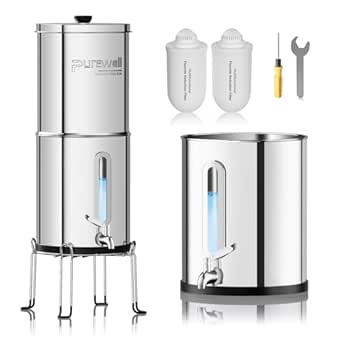
Purewell 3-Stage Gravity-Fed Water Filter System, 2.25-Gallon Stainless Steel Countertop
I’d choose this Purewell when reusable filter maintenance matters more than fine-membrane filtration. Its washable ceramic elements can be scrubbed to clear surface buildup, and the stainless housing, spigot, and non-slip stand make it a self-contained, no-power countertop setup. That contrasts with the other Purewell 3-Stage model in this lineup, which specifies a 0.01-micron membrane and a stated flow rate; this system instead emphasizes ceramic, carbon, and silver-ion layers. Its filters are rated for up to 5,000 gallons each, though actual life depends on source water and use. The main limitation is that it does not reduce TDS, and topping up while the lower chamber is full can lead to leaking. I’d also avoid treating the stated filter-life figure as a guarantee.
Pros:- Washable ceramic filters can be scrubbed to remove surface buildup
- 304 stainless steel housing and stainless spigot
- Gravity-fed operation works without electricity
- Non-slip stand and cleaning sponge are included
Cons:- Does not reduce TDS
- Filter lifespan varies with water quality and usage
- Refilling when the lower chamber is full may cause leaking
Best for: Households seeking a stainless gravity system with washable ceramic filters and no electricity requirement
Not ideal for: Buyers focused on lowering TDS or those who want a clearly stated filtration flow rate
- Capacity:2.25 gallons
- Filtration:Three stages: ceramic, activated carbon, and silver-ion layers
- Filter type:Washable, replaceable ceramic filters
- Filter life:Up to 5,000 gallons per filter; 10,000 gallons stated total
- Housing:304 food-grade stainless steel
- Power:Gravity-fed; no electricity required
- Certification:NSF/ANSI 372 for lead-free materials
- TDS reduction:Does not lower TDS
Our verdict“Choose this Purewell if washable ceramic filters and stainless construction matter more to you than TDS reduction or a specified fast flow rate.”
Culligan MaxClear Gravity Water Filter System – Microplastics, Lead & PFAS
The Culligan MaxClear earns its place for buyers who want a gravity system with named contaminant-reduction claims and more cartridge choice than a closed setup. It is NSF/ANSI 42 certified for reducing microplastics, lead, and total PFAS, and it accepts Berkey BB9-2 plus cartridges from several other listed brands. That flexibility is a meaningful contrast with the Purewell washable-ceramic model, whose system is built around its own replaceable filters. MaxClear needs no plumbing or electricity, and its stored height is under 12 inches, making it easier to put away than taller countertop units such as the 3-gallon Pureday. The tradeoff is gravity’s pace: filtration may be slower than pump-driven options, and the stated six-month cartridge life depends on water quality and use. I’d verify cartridge compatibility before buying replacements.
Pros:- NSF/ANSI 42 certification for reducing microplastics, lead, and total PFAS
- Compatible with several listed cartridge brands, including Berkey BB9-2
- Gravity-fed operation requires no electricity or plumbing
- Stored height is under 12 inches
Cons:- Gravity filtration may be slower than pump-driven systems
- Cartridge life varies with water quality and usage
- Buyers need to confirm the specific replacement cartridge is compatible
Best for: Buyers who want certified reductions for listed contaminants and the option to use several compatible cartridge brands
Not ideal for: People who need quick, high-volume dispensing or want a system with a fixed, included filter configuration clearly specified
- Certification:NSF/ANSI 42
- Contaminants reduced:Microplastics, lead, and total PFAS
- Compatible filters:Berkey BB9-2, Boroux, ProOne, Doulton, Purewell, and Waterdrop
- Filter life:Up to 6 months per filter
- Material:Brushed or polished stainless steel
- Power:Gravity-fed; no electricity required
- Stored height:Under 12 inches
Our verdict“Pick the MaxClear if certified contaminant reduction and broad cartridge compatibility outweigh the slower pace of gravity filtration.”
Pureday 3 Gallon Stainless Steel Gravity Water Filter, Meets NSF 42/53/401
For a household that draws water throughout the day, the Pureday’s 3-gallon capacity is its clearest advantage: it holds more than the 2.25-gallon Purewell and Pureday alternatives, so there can be fewer refill cycles. Its product information states that the system meets NSF/ANSI 42, 53, and 401 standards and describes reduction of PFAS, lead, chlorine, and other contaminants. It comes with two carbon filters and two PFOA/PFOS-reduction filters, plus a spigot with a water-level indicator that makes remaining supply easier to check. The tradeoff is its tall footprint—28.15 inches high—and the two filter types have different stated replacement intervals. I’d choose the smaller glass Pureday instead if countertop height or a detachable drink dispenser matters more than extra capacity.
Pros:- 3-gallon capacity suits households with frequent water use
- Product information states it meets NSF/ANSI 42, 53, and 401
- Includes carbon and PFOA/PFOS-reduction filters
- Spigot has a built-in water-level indicator
Cons:- At 28.15 inches tall, it needs generous countertop clearance
- The two filter types have different stated service intervals
- The supplied data does not specify a detailed filter flow rate
Best for: Families or shared households that want a larger gravity reservoir and a visible water-level indicator
Not ideal for: People with limited cabinet clearance or buyers who prefer fewer filter types and simpler replacement scheduling
- Capacity:3 gallons
- Dimensions:9.25 × 9.25 × 28.15 inches
- Weight:9.3 pounds
- Material:Stainless steel
- Filtration standards:NSF/ANSI 42, 53, and 401, as stated in product information
- Included filters:Two carbon filters and two PFOA/PFOS-reduction filters
- Carbon filter life:6 months or 3,000 gallons each, as stated
- PFOA/PFOS filter life:3 months or 1,000 gallons each, as stated
- Power:Gravity-fed; no electricity required
Our verdict“Choose this Pureday if household capacity and an at-a-glance water-level indicator matter more than a compact countertop footprint.”
Pureday 2.25 Gallon Glass Gravity Water Filter System, Meets NSF 42/53/401
This Pureday is the lineup’s clearest choice for buyers who want to see the water level and prefer glass over metal. Its borosilicate-glass chambers are transparent, and the lower chamber detaches for serving iced tea, infused water, or other drinks—an extra use the stainless Pureday 3-gallon system does not emphasize. Product information states that it meets NSF/ANSI 42, 53, and 401, with carbon and PFOA/PFOS-reduction filters included. At 2.25 gallons, it gives up capacity to that larger Pureday, but its stated height is 24.8 inches. Glass has practical costs: this unit weighs 17.3 pounds, needs careful handling, and the protective sleeve and wooden stand do not make the chambers shatterproof. I’d favor stainless steel if durability or frequent moving is a bigger priority.
Pros:- Borosilicate glass makes the water level visible
- Detachable lower chamber can serve other beverages
- Product information states it meets NSF/ANSI 42, 53, and 401
- Includes carbon and PFOA/PFOS-reduction filters
Cons:- Glass chambers need more careful handling than stainless steel
- 2.25-gallon capacity is smaller than the 3-gallon Pureday
- At 17.3 pounds, it is relatively heavy to move
Best for: Households that prefer a visible glass reservoir and want a lower chamber that can serve other drinks
Not ideal for: Buyers who move their filter often, need a larger reserve, or want a more impact-resistant housing
- Capacity:2.25 gallons
- Dimensions:9.45 × 8.66 × 24.8 inches
- Weight:17.3 pounds
- Material:Borosilicate glass
- Filtration standards:NSF/ANSI 42, 53, and 401, as stated in product information
- Included filters:Two carbon filters and two PFOA/PFOS-reduction filters
- Carbon filter life:6 months or 3,000 gallons each, as stated
- PFOA/PFOS filter life:3 months or 1,000 gallons each, as stated
- Stand:Wooden stand included
Our verdict“Choose this glass Pureday if visibility and beverage-serving versatility outweigh the durability and capacity advantages of stainless steel models.”
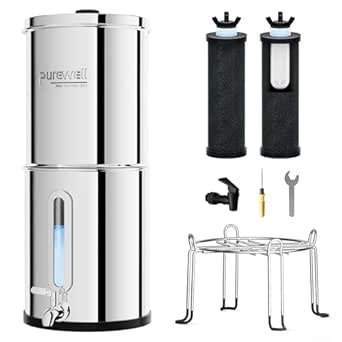
Purewell 3-Stage 0.01µm Ultra-Filtration Gravity Water Filter System – 304 Stainless Steel Countertop with 2 Filters, Metal Spigot & Stand
The standout here is the specified 0.01-micron hollow-fiber membrane, paired with silver ions and activated carbon in a three-stage design. Purewell states that the system filters up to 4 gallons per hour, which gives buyers a useful flow reference missing from the washable-ceramic Purewell model. The 304 stainless-steel housing, metal water-level spigot, and stand also make it a more fully equipped countertop package. Its stated total filter capacity is 6,000 gallons across two filters, but that figure is not a substitute for checking replacement guidance against actual source-water conditions. As with several gravity systems here, it does not lower TDS, so it is not a choice for dissolved-solids reduction. I’d pick it over the glass Pureday for a metal build and stated flow rate, but the glass model lists NSF/ANSI 53 and 401 standards while this Purewell lists 42 and 372.
Pros:- Three-stage filtration includes a 0.01-micron hollow-fiber membrane
- Stated flow rate of up to 4 gallons per hour
- 304 stainless-steel housing with a metal water-level spigot
- Gravity-powered setup needs no electricity
Cons:- Does not reduce TDS
- Requires manual refilling and monitoring for leaks
- Listed certifications are NSF/ANSI 42 and 372, not the 53 and 401 standards stated for the Pureday models
Best for: Buyers who want a stainless gravity filter with a stated 0.01-micron membrane and a specified flow rate
Not ideal for: People seeking TDS reduction or buyers who require the NSF/ANSI 53 and 401 standards listed for the Pureday models
- Filtration stages:3
- Membrane pore size:0.01 µm
- Flow rate:Up to 4 gallons per hour
- Total filter capacity:6,000 gallons total; 3,000 gallons per filter
- Housing:304 food-grade stainless steel
- Filter media:Hollow-fiber UF membrane, silver-ion layer, and activated carbon block
- Certifications:NSF/ANSI 42 and NSF/ANSI 372
- Power:Gravity-fed; no electricity required
- TDS reduction:Does not lower TDS
Our verdict“Choose this Purewell if you want a fine-pore membrane, stainless construction, and a stated flow rate, but not if TDS reduction is your priority.”
Big Berkey 2.25-Gallon Gravity-Fed Water Filter System with BB9-2 Filters
The Big Berkey stands out in this group for its stated filter capacity: the included pair of Black Berkey BB9-2 elements is rated for up to 6,000 gallons. That gives it a different maintenance profile from the GLACIER FRESH PC04, whose cartridge is rated for up to 200 gallons, and the Purewell 3-Stage, which lists up to 3,000 gallons per filter. Its 2.25-gallon stainless steel body runs without power or plumbing, making it a practical fit for households that want a countertop supply during outages as well as daily use. The tradeoff is its 19.25-inch assembled height, which can be awkward under cabinets, and the stated filter life varies with water quality and care. Replacement elements are sold separately, so long-term ownership depends on sourcing compatible filters.
Pros:- Operates without electricity, plumbing, or water pressure
- Includes two Black Berkey BB9-2 filter elements
- Filter pair is rated for up to 6,000 gallons
- AISI 304 stainless steel body suits a durable countertop setup
Cons:- At 19.25 inches tall when assembled, it may not fit beneath many cabinets
- Actual filter life varies with water quality, usage, and maintenance
- Replacement filter elements are sold separately
Best for: Households of one to four people seeking a non-electric countertop system with high stated filter-element capacity and stainless steel construction.
Not ideal for: Buyers with low cabinets or limited counter space, or anyone who wants a clearly stated short replacement schedule and does not want to source replacement elements separately.
- Capacity:2.25 gallons
- Filter elements:2 Black Berkey BB9-2
- Filter capacity:Up to 6,000 gallons per pair
- Material:AISI 304 stainless steel
- Dimensions:8.5 inches diameter x 19.25 inches tall
- Setup:Gravity-fed; no electricity or plumbing required
- Designed for:Approximately 1–4 people
Our verdict“Choose the Big Berkey if high stated filter capacity and power-free operation matter more than a compact fit or a defined replacement interval.”
GLACIER FRESH PC04 Gravity-Fed Countertop Water Filtration System
The GLACIER FRESH PC04 is the standout for buyers who want to limit water left sitting in the lower chamber: its inlet is designed to reduce leftover water and stale-water buildup. That practical detail sets it apart from the Big Berkey, which emphasizes long filter-element capacity, and the Purewell 3-Stage, which specifies a higher flow rate. The PC04 instead uses a single cartridge rated for up to 200 gallons, with replacement recommended every three months; that means more frequent upkeep than the Purewell systems or Big Berkey. Its 2.25-gallon stainless steel body and tool-free, non-electric setup suit kitchens, RVs, or emergency use, but the cartridge’s short stated life may be a poor fit for heavy daily demand. The product also calls for flushing two gallons before first use.
Pros:- Inlet design aims to minimize leftover water in the lower chamber
- Non-electric, tool-free countertop setup
- 2.25-gallon capacity is specified for households of up to four
- Stainless steel body fits home and portable-use settings
Cons:- Cartridge is rated for up to 200 gallons, shorter than the stated capacities of the Big Berkey and Purewell systems
- Replacement is recommended every three months
- Requires a two-gallon flush before first use
Best for: Households of up to four people who value a gravity-fed setup, low leftover water, and a regular cartridge replacement schedule for home, RV, or emergency use.
Not ideal for: High-volume households seeking long intervals between replacements, since the cartridge is rated for up to 200 gallons and replacement is recommended every three months.
- Capacity:2.25 gallons
- Filtration technology:Elarisey electrosorption
- Filter capacity:Up to 200 gallons per cartridge
- Recommended replacement:Every 3 months
- Material:Stainless steel
- Dimensions:14.25 x 13.58 x 16.14 inches
- Power and setup:Gravity-fed; no electricity or tools required
- First-use preparation:Flush with 2 gallons before use
Our verdict“Pick the PC04 if minimizing water left in the dispenser matters more than maximizing cartridge life between replacements.”
Purewell Upgraded 9-Stage Gravity Water Filter System with Water Level Window, 0.01μm Ultra-Filtration Countertop, 2 Filters and Stand, Reduces Fluoride & Chlorine
The Purewell Upgraded 9-Stage is the specific choice here for shoppers prioritizing fluoride reduction and a quick visual check of the water level. Its transparent window helps avoid opening or lifting the chambers just to see how much filtered water remains, while its composite media includes a 0.01 μm hollow-fiber UF membrane and fluoride-reduction material. The stated fluoride reduction is up to 90%; that claim makes this a more targeted option than the Purewell 3-Stage, whose listed focus is chlorine, rust, sediment, organics, and some heavy metals. The compromise is proprietary filter compatibility and no TDS reduction. Its two elements are rated for 2,000 gallons total with replacement recommended every six months, far below the Big Berkey’s stated pair capacity. The listing also warns that adding tap water when the lower chamber is full can cause leaking.
Pros:- Transparent window makes the remaining water level easy to check
- Nine-stage media includes fluoride-reduction material and a 0.01 μm UF membrane
- Fluoride reduction is stated as up to 90%
- Two filters provide a stated total capacity of up to 2,000 gallons
Cons:- Does not lower TDS levels
- Compatible only with Purewell filter elements
- Lower chamber can leak if tap water is added while it is full
Best for: Households seeking a visible water-level window and a filter specifically described as reducing fluoride, chlorine, sediment, and other listed impurities.
Not ideal for: Buyers who need TDS reduction, want broad replacement-filter compatibility, or prefer a stated filter capacity comparable to the Big Berkey.
- Capacity:2.25 gallons
- Filtration stages:9
- Membrane:0.01 μm hollow-fiber UF
- Filter media:Fluoride-reduction material, mesh layers, PP cotton, activated carbon, KDF, silver ions, and hollow-fiber UF membrane
- Filter capacity:Up to 1,000 gallons per element; 2,000 gallons total
- Recommended replacement:Every 6 months
- Water-level window:Transparent
- Fluoride reduction:Up to 90%
- Compatibility:Purewell filter elements only
Our verdict“Choose this Purewell if fluoride reduction and a visible water-level window outweigh TDS reduction and flexible filter sourcing.”
Purewell 3-Stage Gravity Water Filter System, 2.25 Gallons
The Purewell 3-Stage has the clearest flow-rate information in this set: it is listed at 4 gallons per hour, a useful benchmark for buyers who want to estimate how quickly a gravity-fed system can replenish its lower chamber. Its 2.25-gallon capacity and two included filters make it a straightforward alternative to the Big Berkey, whose stated strength is much higher pair capacity rather than a listed flow rate. The Purewell combines a 0.01-micron hollow-fiber membrane, silver-ion membrane, and activated carbon block, with a stated focus on chlorine, rust, sediment, organic matter, and some heavy metals. It does not lower TDS, and its filter-life figure is up to 3,000 gallons per filter, subject to water quality. The listing also warns against adding tap water when the lower chamber is full because leakage can occur.
Pros:- Listed flow rate of up to 4 gallons per hour
- Includes two filters rated for up to 3,000 gallons each
- 304 food-grade stainless steel housing and spigot
- Uses gravity and needs no electricity
Cons:- Does not lower TDS
- Filter life varies with water quality
- Lower chamber can leak if tap water is added when it is full
Best for: Buyers wanting a stainless steel, no-electricity countertop system with two included filters and a stated flow rate for planning daily use.
Not ideal for: Shoppers who need TDS reduction, require fluoride-focused filtration, or want to add water without monitoring whether the lower chamber is full.
- Capacity:2.25 gallons
- Filtration stages:3
- Filter pore size:0.01 microns
- Flow rate:4 gallons per hour
- Included filters:2
- Filter lifespan:Up to 3,000 gallons per filter
- Housing material:304 food-grade stainless steel
- Power:Gravity-fed; no electricity required
- TDS reduction:Does not lower TDS
Our verdict“Choose the Purewell 3-Stage if a stated flow rate and included long-capacity filters matter more than TDS reduction.”
Survivor Filter Ultra Gravity Water Filter System – 2.25-Gallon Stainless Steel Countertop Filter
The Survivor Filter Ultra is the broad-coverage pick in this group: its description lists bacteria, viruses, parasites, heavy metals, chemicals, and organics, while stating that essential minerals are retained. That makes it a different proposition from the Purewell 3-Stage, which provides specific membrane and flow-rate details but does not list the same breadth of targets. The stainless steel housing and lifetime warranty add appeal for buyers planning long-term home or outdoor use. Its ceramic cartridges are described as compatible with Big Berkey units, which may offer more flexibility than systems restricted to a brand’s own elements. The tradeoffs are a 2.25-gallon batch size that may require frequent refills for groups and gravity-fed speed that can lag behind pressurized filtration. The supplied specifications do not state a flow rate or filter lifespan, so upkeep planning is less clear than with the Big Berkey.
Pros:- Description lists bacteria, viruses, parasites, heavy metals, chemicals, and organics among its targets
- Stainless steel housing suits countertop or outdoor use
- Ceramic cartridges are described as compatible with Big Berkey units
- Backed by a lifetime warranty
Cons:- 2.25-gallon capacity may require frequent refills for larger households
- Gravity filtration can be slower than pressurized systems
- Provided specifications do not state a flow rate or filter lifespan
Best for: Buyers seeking a stainless steel gravity system whose stated filtration targets include bacteria, viruses, parasites, chemicals, and organics, with a lifetime warranty.
Not ideal for: Large households or groups needing a high-volume supply, and buyers who want a published flow rate or filter-life figure before choosing.
- Capacity:2.25 gallons
- Material:Stainless steel
- Filter type:Ultra Ceramic
- Contaminant targets:Bacteria, viruses, parasites, heavy metals, chemicals, and organics
- Mineral retention:Designed to retain essential minerals
- Cartridge compatibility:Compatible with Big Berkey units, per product description
- Warranty:Lifetime
- Use:Home and outdoors
Our verdict“Pick the Survivor Filter Ultra if broad stated contaminant coverage and a lifetime warranty matter more than batch capacity and published upkeep details.”
2.25‑Gal Gravity Water Filter System – Stainless Steel Countertop Filtration
This is the straightforward choice for households whose main goal is better-tasting water from chlorine reduction. Its two coconut-shell activated carbon filters are stated to reduce chlorine by more than 99%, and the system carries NSF/ANSI 42 certification. That makes its focus clearer than the Purewell PW-KS, which adds a 0.01-micron ultrafiltration membrane and a water-level window, but also brings more filtration components and operating details. The 2.25-gallon capacity suits a family that wants a countertop reserve without stepping up to the Culligan MaxClear’s 3-gallon size. Stainless steel construction and a stackable design help with moving or storing it. The tradeoff is a narrower stated reduction focus: buyers seeking listed reductions for lead, PFAS, or fluoride should compare other models, and the filters still require replacement.
Pros:- NSF/ANSI 42 certification and stated chlorine reduction of over 99%.
- 2.25-gallon capacity is suited to regular household use.
- Food-grade stainless steel construction is BPA-free.
- Stackable design supports storage and transport.
Cons:- The supplied information focuses on chlorine reduction rather than a broad set of contaminant claims.
- Filters require periodic replacement, with service life dependent on water use.
- Bulkier on a counter than a pitcher-style filter.
Best for: Households prioritizing chlorine taste reduction, a stainless steel countertop reservoir, and occasional portability for outdoor use.
Not ideal for: Buyers seeking stated lead, PFAS, fluoride, or ultrafiltration performance, or anyone with limited counter space.
- Capacity:2.25 gallons
- Filter type:2 natural coconut-shell activated carbon filters
- Certification:NSF/ANSI 42
- Housing material:Food-grade stainless steel
- Chlorine reduction:Over 99%
- Filter life:Up to 6,000 gallons per set of filters
- Design:Stackable and portable
Our verdict“Choose this model for certified, chlorine-focused filtration in a portable stainless steel countertop format, not for the widest stated contaminant coverage.”
Purewell 2.25G Gravity Water Filter System with Water Level Window, 3-Stage 0.01μm Ultra-Filtration Stainless Steel Countertop System with 2 Filters and Stand, Reduce 99% Chlorine, PW-KS
The PW-KS is the pick for people who want to check the supply without lifting the upper chamber. Its transparent water-level window makes routine use simpler than the Culligan MaxClear, which has a larger 3-gallon capacity but no level window listed in its supplied details. Purewell also specifies a three-stage filter combining a 0.01-micron hollow-fiber membrane, silver-ion membrane, and activated carbon block, with stated chlorine reduction and interception of several types of material. The listed flow rate is 4 gallons per hour, though another spec gives a maximum flow rate of 0.06 gpm; those figures do not align, so I would not choose it on flow claims alone. It does not lower TDS, and the instructions warn against refilling the upper chamber while the lower one is full.
Pros:- Water-level window lets users check the lower chamber without opening the system.
- Three-stage filter combines ultrafiltration, silver-ion membrane, and activated carbon.
- Gravity operation needs no electricity.
- Includes two filters and a stand.
Cons:- Product information gives conflicting flow-rate figures.
- Does not lower TDS.
- Refilling while the lower chamber is full can cause leakage, according to the instructions.
Best for: Households that want a 2.25-gallon gravity system with a visible water-level window and layered filtration.
Not ideal for: Buyers who need TDS reduction, want straightforward flow-rate specifications, or prefer a simpler filter setup.
- Capacity:2.25 gallons
- Filtration:3-stage composite filtration
- Filter pore size:0.01 microns
- Filter components:Hollow-fiber UF membrane, silver-ion membrane, and activated carbon block
- Included filters:2
- Filter life:Up to 3,000 gallons per element; recommended replacement every 6 months
- Dimensions:8.8 × 8.8 × 20 inches
- Material:Polypropylene and stainless steel
- TDS reduction:Does not lower TDS
Our verdict“Pick the PW-KS if at-a-glance water-level monitoring and layered filtration matter more than TDS reduction or unambiguous flow specifications.”
Culligan MaxClear Gravity Water Filter System, 3-Gallon Stainless Steel
The MaxClear stands out when a 2.25-gallon reservoir feels limiting. Its 3-gallon capacity means fewer refills than the Purewell PW-KS, while gravity operation avoids electricity and plumbing. Its strongest distinction is its stated IAPMO certification for reducing microplastics, lead, and total PFAS, giving buyers specific claims beyond the chlorine-focused 2.25-gallon stainless steel system in this lineup. The ceramic and granular activated-carbon filter is rated for up to six months, but only one filter is included, so there is no spare in the box. The assembled dimensions reach 27.6 inches high, making its capacity costly in vertical counter space. It can nest under 12 inches when stored, but that compact storage benefit does not erase its tall working footprint.
Pros:- 3-gallon capacity reduces refill frequency compared with 2.25-gallon systems.
- IAPMO certified for stated reduction of microplastics, lead, and total PFAS.
- Gravity-fed operation requires no power or plumbing.
- Can nest under 12 inches when not in use.
Cons:- Tall assembled height and large footprint can be awkward on crowded counters.
- Only one ceramic and activated-carbon filter is included.
- Filter service life is listed as up to six months, rather than a gallon capacity.
Best for: Larger households that want a 3-gallon countertop supply and value stated, certified reductions for microplastics, lead, and total PFAS.
Not ideal for: Small kitchens, buyers with low overhead clearance, or anyone who wants a spare filter included.
- Capacity:3 gallons
- Dimensions:9.4 × 9.4 × 27.6 inches
- Material:Stainless steel
- Purification method:Ceramic and granular activated carbon
- Included filter:1 ceramic and carbon filter
- Filter life:Up to 6 months
- Certification:IAPMO certified
- Supported maximum TDS:300 ppm
- Power source:Gravity-fed
Our verdict“Choose the MaxClear for higher household capacity and its specified certified reduction claims, provided you have room for its tall assembled form.”
Purewell 8-Stage Gravity-Fed Stainless Steel Water Filter System, 2.25 Gallons
Among these four, this Purewell is the one to examine when fluoride reduction is a priority. Its eight-stage setup includes separate ceramic and fluoride filters, with fluoride reduction stated at up to 90%; that sets it apart from the Culligan MaxClear, whose listed certified claims cover microplastics, lead, and total PFAS instead. The ceramic filters can be scrubbed clean, which may extend their useful life, while the fluoride elements have a much shorter stated capacity of up to 1,000 gallons. That difference means filter upkeep is not uniform across the set. The 2.25-gallon stainless steel housing, metal water-level spigot, and non-slip stand make it a substantial countertop unit. Its listed NSF/ANSI 42 certification and NSF/ANSI 372 material certification should not be read as proof of every reduction claim, and it does not lower TDS.
Pros:- Includes fluoride filters with stated reduction of up to 90%.
- Ceramic filters can be scrubbed clean to extend service life.
- Stainless steel housing, metal spigot, and non-slip stand.
- Includes two ceramic filters and two fluoride filters.
Cons:- Fluoride filters have a shorter stated lifespan than the ceramic filters.
- Does not lower TDS.
- Filter performance and service life may vary with water quality.
Best for: Buyers specifically seeking a gravity countertop system with stated fluoride reduction alongside ceramic filtration.
Not ideal for: People who need TDS reduction, want one simple replacement interval, or do not want to track separate filter lifespans.
- Capacity:2.25 gallons
- Filtration:8-stage
- Housing:304 food-grade stainless steel
- Included filters:2 ceramic filters and 2 fluoride filters
- Ceramic filter life:Up to 10,000 gallons
- Fluoride filter life:Up to 1,000 gallons
- Fluoride reduction:Up to 90%
- Certifications:NSF/ANSI 42; ceramic filter materials certified to NSF/ANSI 372
- TDS reduction:Does not lower TDS
Our verdict“Choose this Purewell for its stated fluoride-filtration focus, while accepting separate filter upkeep and no TDS reduction.”

How We Picked
I ranked these countertop gravity filters by how well their stated design and features address everyday household needs: usable capacity, countertop footprint, reservoir materials, filter configuration, ease of monitoring and dispensing, and expected maintenance. I also weighed whether each model’s stated contaminant-reduction claims are specific enough for shoppers to compare and whether the system appears suited to routine home use or a more specialized need.
The ranking favors balanced, practical setups over the longest feature list. A larger tank can reduce refills but needs more room; added stages or very small pore-size claims matter only when they align with the buyer’s water concerns and are supported by clear documentation. I distinguish closely related models by their included accessories and usability features, while treating similarly named products as separate options when their listed configurations differ. Buyers should verify current manufacturer specifications, replacement-filter availability, and certification details before choosing.
| gravity water filter countertop | Material |
|---|---|
| Purewell 3-Stage Gravity-Fed W | — |
| Culligan MaxClear Gravity Wate | Brushed or polished stainless steel |
| Pureday 3 Gallon Stainless Ste | Stainless steel |
| Pureday 2.25 Gallon Glass Grav | Borosilicate glass |
| Purewell 3-Stage 0.01µm Ultra- | — |
| Big Berkey 2.25-Gallon Gravity | AISI 304 stainless steel |
| GLACIER FRESH PC04 Gravity-Fed | Stainless steel |
| Purewell Upgraded 9-Stage Grav | — |
| Purewell 3-Stage Gravity Water | — |
| Survivor Filter Ultra Gravity | Stainless steel |
| 2.25‑Gal Gravity Water Filter | — |
| Purewell 2.25G Gravity Water F | Polypropylene and stainless steel |
| Culligan MaxClear Gravity Wate | Stainless steel |
| Purewell 8-Stage Gravity-Fed S | — |
Factors to Consider When Choosing Gravity Water Filter Countertop
Before choosing a countertop gravity filter, I’d start with your water source and daily routine rather than the number of filter stages. The sections below cover practical decisions that product descriptions often leave to the buyer.
Match Filter Claims to Your Water
First identify what you want to reduce: municipal water concerns, a known contaminant, or a broader range of possible impurities. A filter listing may name substances such as lead, PFAS, chlorine, or microplastics, but a claim is not interchangeable with independent certification or a test report. Check the exact model and replacement element, since performance can differ between filter versions. If your concern comes from a water report, compare its listed contaminants with the manufacturer’s documentation. Avoid buying based on a stage count or micron figure alone; neither tells you by itself which substances are reduced. For private wells or changing water quality, testing the source can help you choose a suitable treatment approach.
Choose Capacity Around Refill Habits and Counter Space
A larger upper chamber can mean fewer refills, especially in a busy household, but it also adds weight and occupies more counter space. Measure the intended spot, including room above the unit for filling and removing the upper reservoir. Think about how quickly your household drinks water and whether everyone will refill the system before it runs low. A smaller setup may work better for one or two people or a compact kitchen, even if it needs more frequent attention. Capacity labels can describe the full holding volume rather than the amount of ready-to-drink water available at once. Confirm the layout and chamber arrangement before treating gallons as a direct measure of convenience.
Look Beyond the Main Tank Material
Stainless steel and glass offer different handling and maintenance tradeoffs. Stainless-steel bodies are a common choice for a durable countertop appliance, while a glass reservoir may appeal to buyers who prefer to see the water or avoid a metal storage chamber. Glass can be heavier and more vulnerable to impact, so placement and household traffic matter. Check which parts actually contact filtered water; a stainless exterior does not mean every component is metal. Spigot material, seals, seams, and the fit between chambers affect cleaning and day-to-day use. Choose the material that suits your handling habits, not just the one that sounds most premium.
Calculate Maintenance Before You Buy
Gravity systems need regular care even though they do not connect to plumbing. Find the maker’s recommended filter replacement schedule and cleaning instructions, then check that compatible replacement elements are available for the exact model. Filter life can depend on source-water quality and usage, so a lifespan figure should not be treated as a guarantee for every household. A system with multiple elements may require replacing more than one part, while a simple design may be easier to maintain. Ask whether the unit needs priming, periodic scrubbing, or special handling after extended periods without use. A filter that is easy to service is more likely to remain part of your routine.
Treat Stands, Windows, and Spigots as Usability Features
Accessories can solve specific annoyances, but they do not automatically improve filtration. A stand may make it easier to fill a glass beneath the spigot, provided it fits your counter and can support the loaded unit. A water-level window can reduce guesswork, though it cannot replace checking that the lower chamber has room before topping up. Metal spigots may appeal to buyers seeking a particular material, while any spigot should be checked for leak prevention and ease of cleaning. Consider who will use the system and whether lifting or tipping a heavy reservoir would be awkward. Choose add-ons for a real daily task rather than treating a longer feature list as a performance advantage.
Use Independent Documentation to Set Expectations
Gravity filters are not all-purpose substitutes for every water-treatment method. Their suitability depends on the exact contaminants, the condition of the source water, and the product’s tested claims. Read documentation for the specific model and filter element, and distinguish a manufacturer’s stated reduction from a certification that covers the same contaminant and operating conditions. If you need to address a health-related contaminant, confirm that the documentation applies to your concern before relying on the system. Keep in mind that flow rate can change as filters age or water conditions vary. When the required treatment is unclear, use a water test or qualified local guidance to narrow the options.
Frequently Asked Questions
Should I choose a 2.25-gallon or 3-gallon countertop gravity filter?
Choose based on how much water your household uses between refills and how much counter space you can spare. A 3-gallon model may suit a larger household or frequent water use, but its full size and weight can make filling and placement less convenient. A 2.25-gallon unit is often easier to fit into a smaller kitchen and may be simpler to handle. Check the usable chamber arrangement, since listed capacity does not always mean that volume is immediately ready to pour. Measure your counter and compare expected daily use before deciding.
Do more filter stages or a smaller micron rating mean a better filter?
Not by themselves. Stage counts and pore-size claims describe parts of a design, but they do not confirm which specific contaminants a complete system reduces. Look for documentation tied to the exact filter element and model, including the contaminants covered and the conditions used for testing. Compare those claims with your water report or the concern you are trying to address. A simpler filter with clear, relevant documentation may fit your needs better than a more elaborate system with claims that do not match them.
Can a countertop gravity filter treat water from a private well?
It may address some contaminants, but a gravity filter should not be assumed to make every well-water source safe. Well water can contain different contaminants depending on location and can change over time, so testing is a useful first step. Compare test results with documentation for the exact filter and replacement element. If the report identifies a concern that the system does not cover, another treatment method may be needed. Follow local health guidance when test results indicate a risk.
How can I tell whether a filter’s contaminant claims are meaningful?
Check whether the maker provides test reports or certification details for the exact model and filter cartridge, not just a broad claim on a product page. Confirm that the documented contaminants match the ones you care about and note any stated operating limits. A claim about one substance does not automatically apply to another, even when both appear in the same marketing list. Replacement filters can also differ from the elements supplied with the system, so verify the part number. If the documentation is unclear, contact the manufacturer before relying on the system for a specific health concern.
Is a glass countertop gravity filter a better choice than stainless steel?
Neither material is automatically better for every kitchen. Glass can suit buyers who prefer a visible water chamber, but it is heavier and can break if dropped or struck. Stainless steel is a common choice for a sturdy body, though you should check which components contact the water and what the spigot is made from. Both styles still need regular cleaning and compatible filter replacements. Pick the material that best fits your handling habits, kitchen layout, and preferences for seeing the water.
Conclusion
For most buyers seeking a balanced countertop setup, I’d start with the Purewell 3-Stage 2.25-Gallon System as the best overall fit in this lineup. For buyers prioritizing a larger reservoir, the Pureday 3-Gallon Stainless Steel is the best capacity-focused choice, while the Pureday Glass System is my pick for shoppers who specifically prefer a glass reservoir. The Purewell 9-Stage model is a premium-feature option for buyers who want its added monitoring and stated reduction targets, but I would verify the supporting documentation before choosing it for a particular contaminant. For beginners, I’d favor a straightforward 2.25-gallon model with easy-to-source replacement filters and clear care instructions rather than the most complicated configuration. If you have a specific water-quality concern, select the system whose exact filter documentation addresses it; otherwise, prioritize capacity, fit, and manageable maintenance.