TL;DR

Get kitchen gear delivered free with Prime
- Fast, free delivery on millions of items
- Prime Video, Amazon Music and more included
- Member-only deals all year
Matter Alpha’s report describes seven smart-home device categories that can benefit from Thread: bulbs, door and window sensors, motion and occupancy sensors, smart locks, blinds, buttons and remotes, and home hubs or media streamers. It explains potential advantages such as lower power use and mesh connectivity, but device features vary and Thread support alone does not guarantee router functionality.
Matter Alpha has published a guide to seven smart-home device categories that may work particularly well with Thread, a low-power wireless mesh network used in some Matter-compatible products. The report argues that Thread can suit battery-powered sensors, locks and blinds, and can help devices communicate across a home, while stressing that capabilities differ by product.
The guide covers smart light bulbs, door and window sensors, motion and occupancy sensors, smart locks, blinds and shades, smart buttons and remotes, and devices that can serve as smart-home hubs or Thread border routers. Its examples include IKEA’s KAJPLATS bulbs, the Aqara Smart Lock U400, the Google TV Streamer and an Apple TV 4K model. These are examples cited by the source, not a ranking or a claim that every version of each product supports Thread.
Matter Alpha says Thread’s low power use and mesh networking can be useful for small, battery-powered devices that send limited amounts of data. Sensors, for example, can support automations such as sending an alert when a window is opened or triggering other connected devices. The report also says motion and occupancy sensors may help lighting and other systems respond when people move through a home.
For devices such as bulbs, locks and blinds, the report’s case is that they generally do not need Wi-Fi’s bandwidth for basic control, while Thread can connect devices without relying on a power-hungry Wi-Fi connection at each device, as discussed in this look at Thread-enabled Wi-Fi access points. Some Thread devices can also relay data for other devices, but the guide cautions that this router function is not universal. Buyers should check the manufacturer’s specifications for the exact model.
Where Thread Can Help at Home
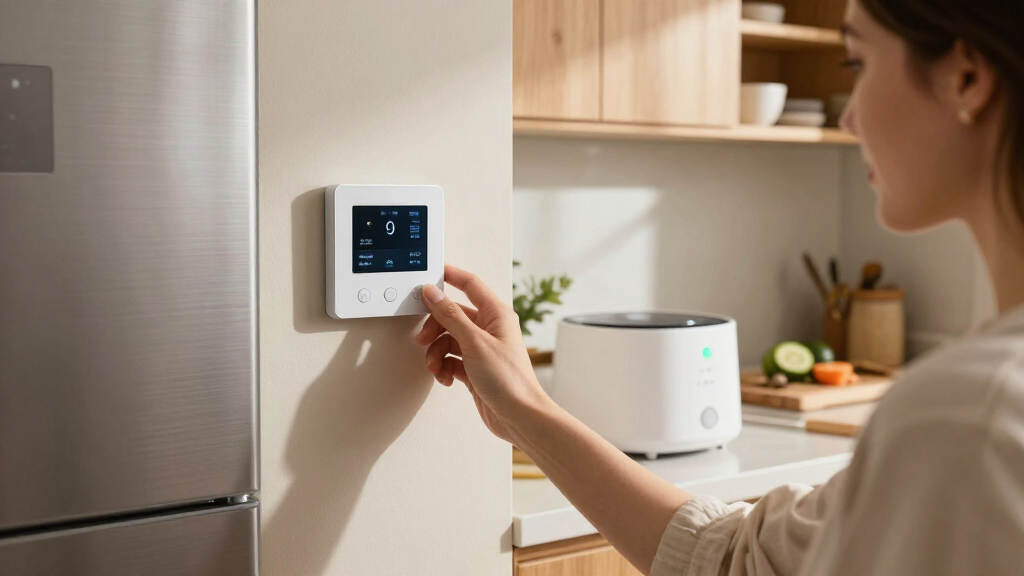
The practical appeal is less about a new feature on its own than about how devices connect. Thread may make it easier to place small battery-powered devices around a home, including sensors and locks, without requiring each one to use Wi-Fi. A mesh network can also give supported devices more than one communication path through the home, though actual performance depends on the products and the home setup.
That can matter when a smart-home routine relies on quick, dependable signals. A door sensor may prompt an alert or automation; an occupancy sensor may trigger lights; and blinds may respond to a schedule or another device. These are potential uses described in the guide, not guarantees of speed or reliability in every installation. The benefit depends on compatible products, a suitable Thread network and the automations configured by the owner.
Thread support may also affect which hub or media device a buyer chooses. A device with a built-in Thread border router can connect a Thread network to other parts of a compatible smart home. The source lists some media streamers and home devices as examples, but buyers need to confirm support for their specific model and software version.
Products Worth Considering

KitchenAid Artisan 5-Quart Tilt-Head Stand Mixer, Almond Cream

Cuisinart ICE-70P1 2-Quart Ice Cream Maker with Countdown Timer

Le Creuset Signature Enameled Cast Iron Round Dutch Oven, 5.5 qt, Deep Teal
As an affiliate, we earn on qualifying purchases.
Thread Across Seven Device Types
The report places Thread within a broader shift toward Matter-compatible smart homes. Matter is a smart-home interoperability standard; Thread is one network technology that compatible devices can use. The two are related in some products, but the terms are not interchangeable: a product’s Matter support does not by itself establish that it uses Thread, and Thread features can vary between products.
The guide says Thread is increasingly appearing in light bulbs and smart locks, as well as in sensors and blinds. It names IKEA’s KAJPLATS range as offering Matter over Thread alongside a Zigbee mode for older smart-home setups, and identifies the Aqara U400 as a Thread-equipped lock. These are claims and product examples from Matter Alpha; the source does not provide a full model-by-model compatibility table.
For smart buttons and remotes, the supplied source text begins to describe the Flic Duo but ends before explaining its Thread features. The guide’s seventh category is therefore identified, but the available material does not provide enough detail to assess that example. Its other device categories show the range of the report’s argument: Thread is presented not only for sensors, but also for devices that control lighting, entry, shading and connected-home routines.
“Smart home devices typically work well with Wi-Fi, but some are even better when they have Thread.”
— Matter Alpha
Product Support Varies by Model
The source does not give a publication date, test results, performance measurements or a complete list of supported products. It also does not establish that Thread will make every device faster, more reliable or longer-lasting. Battery life, network coverage and automation responsiveness depend on the specific hardware, settings and home environment.
Some descriptions in the supplied material are incomplete. In particular, the section on smart buttons and remotes stops during its Flic Duo description, and the guide’s opening refers to five devices even though its title promises seven. The available text does not resolve that mismatch or provide sufficient detail to verify the full set of product recommendations. Product compatibility and features can also change, so shoppers should check current manufacturer documentation.
Check Compatibility Before Buying
Readers considering a Thread device should check the manufacturer’s current specifications for Thread and Matter support, the exact model number, and whether the product functions as a Thread router or border router. They should also verify that their existing hub or smart-home platform can connect to the device and support the intended automation.
The source does not announce a follow-up report or provide a date for further testing. For now, the next step for buyers is to compare product-specific documentation rather than treating Thread as a uniform feature across a category. The report’s broader point remains a qualified one: Thread can be a useful fit for low-bandwidth, battery-powered or widely distributed smart-home devices, but the advantage depends on the implementation.
Key Questions
What is the news in this report?
Matter Alpha published a guide identifying seven smart-home device categories that may benefit from Thread connectivity. It is a consumer report, not an announcement of a new Thread standard or product launch.
Which devices does the guide cover?
The categories are bulbs, door and window sensors, motion and occupancy sensors, smart locks, blinds and shades, smart buttons and remotes, and hubs or media devices that can support Thread connectivity. The supplied text provides limited detail about the buttons and remotes category.
Does every Thread device relay data for other devices?
No. Matter Alpha says router functionality is not universal. Check the manufacturer’s specifications for the exact device to see whether it can relay Thread traffic.
Is Thread the same as Matter?
No. Matter is a smart-home interoperability standard, while Thread is a wireless networking technology used by some compatible devices. A buyer should confirm support for both the relevant network and smart-home platform.
Will Thread guarantee better battery life or faster automations?
No such guarantee is established by the report. Thread’s low-power design may suit battery-powered devices, but real-world battery life and responsiveness vary by product, network setup and use.
Source: matteralpha.com