
🔍 Read the full analysis: Pizza Dough, Neapolitan Style: 24-Hour Fermentation Made Simple on Mad Tasting

Get kitchen gear delivered free with Prime
- Fast, free delivery on millions of items
- Prime Video, Amazon Music and more included
- Member-only deals all year
TL;DR
Mad Tasting’s home recipe guide sets out a roughly 24-hour method for four Neapolitan-style pizzas, using flour, water, salt and a small amount of instant yeast. The schedule combines a short room-temperature rest, an overnight refrigerator rest and about three hours at room temperature before baking; the guide says dough condition matters alongside timing.
Mad Tasting has published a home recipe guide for making four Neapolitan-style pizzas with a roughly 24-hour dough schedule. The method uses flour, water, salt and instant yeast, with an overnight refrigerator rest intended to make slow fermentation manageable for home cooks.
According to Mad Tasting’s recipe, the formula calls for 500 grams of flour, 315 grams of water, 14 grams of salt and 1 gram of instant yeast. It yields four dough balls of about 250 grams each. Mad Tasting describes the water level as 63% hydration, with salt at 2.8% and yeast at 0.2% relative to the flour weight. The guide recommends a gram scale because the small yeast quantity can vary when measured by spoon.
Mad Tasting’s example schedule begins with mixing in the evening, followed by a 30- to 60-minute room-temperature rest. The dough is then divided, shaped into balls and refrigerated overnight in a covered container. On the following day, the balls come out of the refrigerator about three hours before baking. The guide’s example runs from a 6 p.m. mix to baking around 6 p.m. the next day, though it notes that exact elapsed time depends on the schedule.
Mad Tasting advises readers to watch for dough balls that have expanded, softened and become airy, while still holding their shape. The guide says refrigerator time slows fermentation but does not stop it. It also recommends keeping the dough covered to prevent the surface from drying, and adjusting the initial rest when the room is unusually warm or cool.
MAD TASTING · HOME PIZZA GUIDE
Pizza Dough, Neapolitan Style: 24-Hour Fermentation Made Simple
A practical overnight plan for four pizza dough balls: mix in the evening, let the refrigerator slow the rise, then bring the dough back to room temperature before shaping and baking.
01 / THE FORMULA
Four ingredients, measured simply
Use a gram scale for accuracy, especially for the small amount of yeast. Percentages are relative to the flour weight.
02 / THE SCHEDULE
Mix tonight. Bake tomorrow.
The refrigerator slows fermentation while you sleep. The clock is a guide; dough condition helps determine the final timing.
Mix the dough
Combine flour, water, salt and instant yeast until a dough forms.
Rest, divide, cover
Rest at room temperature, divide into four balls and place in a covered container.
Refrigerate
Chill the covered dough balls. Fermentation slows, but does not stop.
Warm and bake
Bring the balls out about three hours before baking, then check their feel.
03 / READINESS CHECK
Let the dough set the pace
Temperature, flour and yeast measurement can shift the schedule. Use the dough’s look and feel alongside elapsed time.
Signs it is ready to shape
Warm room? Check sooner.
A warmer kitchen can speed fermentation; a cooler room may slow it. Adjust the initial rest when conditions are unusual, and keep dough covered to prevent a dry surface. Dough that spreads substantially may have gone too far.
04 / STYLE & FLOUR
Neapolitan-style, made at home
The guide presents a home-kitchen approach inspired by a restrained ingredient list, long fermentation and gentle shaping.
FLOUR CHOICES
“00”, bread or all-purpose
All can work, with differences in stretching and browning. “00” describes how finely flour is milled; it does not specify protein strength.
LEAN FORMULA
No oil or sugar
The dough uses flour, water, salt and yeast. Some home recipes add oil or sugar for browning in cooler ovens, changing the texture and moving away from this lean formula.
HOME OVEN
Different heat, different bake
A domestic oven cannot reproduce the intense heat and quick bake of a wood-fired oven. Preheat a steel or stone thoroughly; bake time varies by appliance and surface.
05 / SHAPE & BAKE
Protect the airy rim
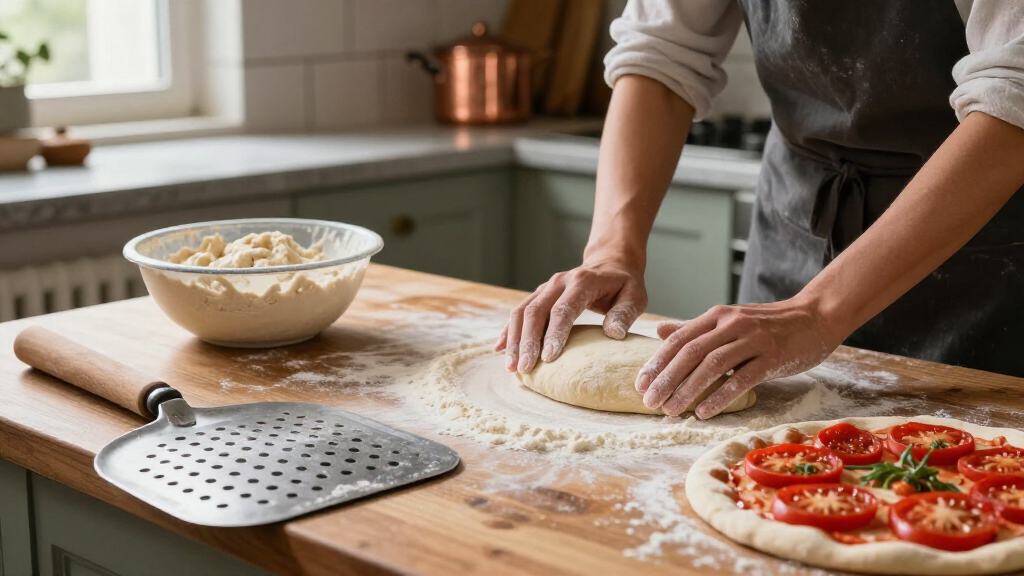
Gentle shaping helps retain gas at the edge, supporting the raised border known as the cornicione.
THE RIM
AIRY
Press the center. Leave the edge.
Press from the middle outward while leaving the outer ring less compressed. Aim for dough that stretches without tearing and remains rounded enough to handle.
Heat a baking steel or stone thoroughly before the pizza goes in. Your oven and baking surface determine the temperature and bake time, so use the guide as a starting point.
QUICK ANSWERS
Common questions
A few useful details to plan the batch and set expectations.
How much dough does it make?
Four dough balls of about 250 grams each, using 500 g flour, 315 g water, 14 g salt and 1 g instant yeast.
Is fermentation exactly 24 hours?
No. The guide describes roughly 23–24 hours from mixing to baking. Use dough expansion and feel as well as the clock.
Can I use all-purpose flour?
Yes. The crust may stretch and brown differently than dough made with “00” or bread flour.
Is it certified traditional Neapolitan pizza?
No certification claim is made. The guide describes Neapolitan-style home pizza and notes the limits of a domestic oven.
A Home Schedule for Slow Fermentation
Mad Tasting’s method gives home cooks a four-ingredient plan that can be started the evening before a pizza meal. The recipe places most of the fermentation in the refrigerator, so the cook does not need to knead or monitor the dough continuously. It also offers a way to plan around fermentation rather than relying on a same-day rise.
The recipe’s instructions emphasize the dough’s condition as well as the clock. Mad Tasting notes that room temperature and yeast measurement affect fermentation speed. A warmer kitchen can move the dough along faster, while a cool room can slow its return to a workable state after chilling. The guide presents the timings as a starting point, not a guarantee that every batch will be ready at the same hour.
For readers aiming for a Neapolitan-style result, Mad Tasting focuses on handling as well as ingredients. It recommends pressing the center outward while leaving the outer ring less compressed, helping retain gas in the rim. The guide calls that rim the cornicione, a term for the raised edge. It adapts the shaping advice for a home oven, which the source says differs from a wood-fired oven in heat and baking speed.
What the Recipe Calls Neapolitan Style
Mad Tasting describes the dough as a lean mixture of flour, water, salt and yeast. The guide says traditional dough leaves out oil and sugar; some home recipes include them to encourage browning in cooler ovens, but doing so changes the dough’s texture and moves away from the lean formula presented here.
The recipe allows for “00” flour or bread flour, and says all-purpose flour can also work with differences in stretching and browning. Mad Tasting cautions that “00” refers to how finely flour is milled and does not, by itself, specify protein strength. Because bread flour can absorb water differently, the guide suggests holding back a spoonful of water during mixing and adding it if the dough feels stiff.
Mad Tasting explicitly frames the method as Neapolitan-style home pizza, not as a claim that the result meets traditional certification standards. The guide also says a domestic oven cannot reproduce the intense heat and quick bake of a wood-fired oven. Its approach borrows a restrained ingredient list, a long fermentation and gentle shaping.
Timing Depends on Dough Conditions
The available Mad Tasting source material does not identify a publication date or author, or report independent testing of the recipe. It also does not provide a single fermentation time for every kitchen. The guide notes that room temperature, refrigerator conditions, flour choice and yeast measurement can affect how quickly the dough develops.
Mad Tasting describes visual and tactile signs of readiness but does not set numerical targets for dough temperature or expansion. The guide says a puffy ball that holds its shape is in good form, while dough that spreads substantially may have fermented too far. It leaves the precise point at which each batch should be shaped and baked to observation.
Shape and Bake the Dough
On baking day, Mad Tasting’s guide says to check that the dough balls look fuller and feel relaxed after their room-temperature rest. For shaping, it recommends pressing the center outward and leaving the rim less compressed, preserving some gas that supports the raised edge. The guide says the dough should stretch without tearing while remaining rounded enough to handle.
For baking, Mad Tasting recommends heating a steel or stone thoroughly before the pizza goes into the oven. The source does not give a universal oven temperature or baking time, and says results depend on the appliance and baking surface. It presents the schedule and shaping method as a home-kitchen starting point, with dough feel guiding the final timing.
Key Questions
How much dough does the recipe make?
Mad Tasting’s formula makes four dough balls of about 250 grams each, using 500 grams of flour, 315 grams of water, 14 grams of salt and 1 gram of instant yeast.
Does the dough spend exactly 24 hours fermenting?
Mad Tasting describes the schedule as roughly 23 to 24 hours from mixing to baking, depending on start and finish times. The guide advises using expansion and feel along with the clock because kitchen conditions affect fermentation.
Can I use all-purpose flour?
Yes. Mad Tasting says all-purpose flour can work, though the crust may brown and stretch differently from dough made with “00” or bread flour.
Is this a certified traditional Neapolitan recipe?
Mad Tasting makes no certification claim. The guide calls it Neapolitan-style home pizza and notes that a domestic oven does not match the intense heat and quick bake of a wood-fired oven.
Source: Mad Tasting
Halloween Picks
halloween
As an affiliate, we earn on qualifying purchases.